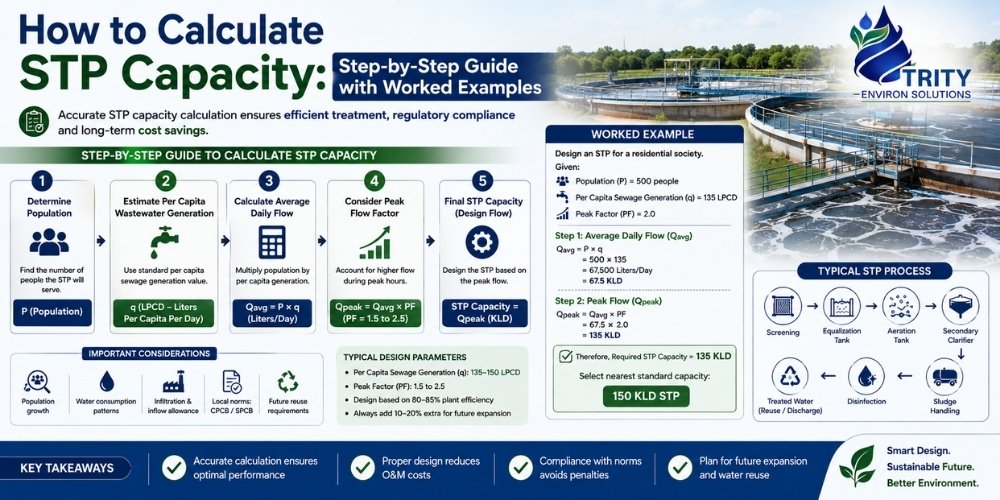
How to Calculate STP Capacity: Step-by-Step Guide with Worked Examples
Calculate STP capacity correctly with worked examples for residential, hotel, hospital, and industrial projects. CPHEEO-based formulas, peak factors, and tank sizing explained.

 ISO 9001:2015 & QCI Approved
Iron, hardness, turbidity and high TDS each need a different fix. Learn how to read your water report and build the treatment train your process actually needs.
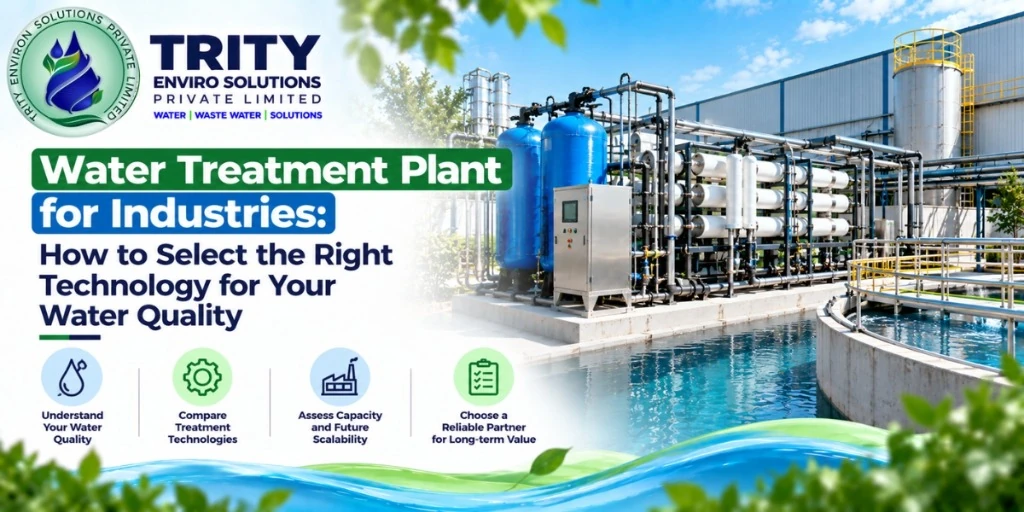
Every industrial water treatment plant starts with one uncomfortable fact: you cannot buy the right system until you know what is in your water. A borewell in one industrial estate may deliver clear water at 400 mg/L TDS. A borewell two kilometres away may give iron stained, hard water at 2,500 mg/L. Municipal supply may be soft in winter and hard in summer. Tanker water can vary from load to load.
Meanwhile, the process has its own demand. A cooling tower tolerates different water from a boiler. A pharma unit needs purified water that is nothing like canteen water. A textile unit needs soft water for dyeing. A food plant needs water that passes drinking standards and tastes right.
A good water treatment plant for industries closes the gap between the two. It takes raw water of whatever quality you have and delivers water of the quality your process needs, at the flow you need, at an acceptable cost. This guide explains how to do that selection step by step: test the water, define the end use, map problems to technologies, build the treatment train, size it and compare suppliers. It is written for plant heads, utility engineers and project managers who want to spend once and get it right.
Ask an accredited laboratory for a full analysis of your raw water, and repeat it across seasons if the source varies. The standard panel includes:
For RO feed, add Silt Density Index (SDI). For boiler feed, silica and alkalinity are key. For cooling water, hardness, chloride and silica control how many cycles of concentration you can run.
Write down the end uses and the required quality for each. Typical examples:
You may end up with several quality grades from one plant, with the best water going only where it is needed. This split saves a lot of money.
Each problem has a typical fix. The skill is in combining them.
Where bacteria or biofouling are a concern, use chlorination, UV or an ultrafiltration system. Ultrafiltration removes suspended particles and most bacteria and gives steady feed quality to downstream RO, which is a big help when raw water changes from day to day.
Common arrangements, which your own water report will adjust:
Order matters. Remove suspended solids and iron first, chlorine next, then hardness, then dissolved salts. Reversing the sequence damages equipment. For instance, chlorine can destroy RO membranes if the carbon filter is missing or exhausted.
Size on peak demand and not just average. Add storage so that the plant can run steadily instead of starting and stopping with each draw. Add a margin of 10 to 20 percent for growth and for membrane or resin ageing, but avoid large oversizing. If production is likely to double within a few years, plan the layout so that a second skid or vessel can be added without rebuilding the plant. Also decide whether the plant must run during power cuts, and if so, size a standby generator or storage tank so that critical processes do not stop when the supply fails.
Plan the waste streams from day one. A softener produces brine regeneration waste. A DM plant produces acid and alkali regeneration effluent that needs neutralisation. Filter backwash adds suspended solids. An RO plant produces reject water with concentrated salts. All of these need a destination. For many plants the answer is reuse for gardening, flushing or cooling where the quality allows, and treatment through an effluent treatment plant for the rest. If salts cannot be discharged, you may need a zero liquid discharge system.
Keep the water balance simple on paper: how much comes in, how much each use takes and how much leaves as reject or backwash. Also check any permission or registration requirements for extracting groundwater in your area, since these are set by state and central groundwater authorities and may affect which source you can use.
The purchase price covers tanks, filters, vessels, media, pumps, membranes, instrumentation, piping and installation. The running cost includes power, chemicals such as salt, acid, alkali, antiscalant and cleaning agents, media and membrane replacement, water used for backwash and rinse, reject disposal and manpower.
Compare options over five to ten years. RO costs more to buy than a simple softener but saves chemicals, while a DM plant can be cheaper for low TDS water but needs regular regeneration chemicals and effluent handling. The right answer depends on your TDS and your required purity.
A supplier who treats both clean water and wastewater can design the entire water cycle of your site. Review our wastewater treatment plant range, commercial RO plant options and the wastewater recycling system for reuse. Once the plant is running, an annual maintenance contract keeps filters, softeners and membranes in good condition.
A water treatment plant should be handed over with proof that it works. Ask for a commissioning test in which each stage is checked against its design values: turbidity and iron after filtration, residual chlorine after the carbon filter, hardness after the softener, conductivity of RO permeate and, for DM or polishing units, conductivity and silica in the product water. Record flow, pressure and differential pressure across every filter, vessel and membrane stage so that you have a baseline.
After start up, a simple monitoring routine keeps the plant healthy. Operators should log flow, pressures and a few quick tests every shift: pH, conductivity, hardness and chlorine where relevant. Weekly or monthly, a laboratory test of raw and treated water confirms that nothing is drifting. Watch for trends, such as a slow rise in softener hardness leakage or a gradual fall in RO flow, since these usually appear weeks before a failure. Keep a maintenance calendar for backwash, regeneration, cartridge changes, cleaning and calibration, and keep spare cartridges, a spare pump seal kit and key instruments in stock. Good records also help when you renew consents, answer an audit or ask a supplier for warranty support.
| Parameter / Stage | Target Optimal Range | Failure Impact / Risk | Corrective Engineering Action |
|---|---|---|---|
| Turbidity and SDI to RO or ion exchange | Low turbidity and SDI below about 5 for RO feed | Fouled membranes and resin, frequent cleaning | Improve clarification and filtration, add UF |
| Hardness after softener (boiler or RO feed) | Near zero, as per equipment requirement | Scale on boilers, heat exchangers and membranes | Regenerate on time, check resin condition, test daily |
| Residual chlorine to RO membranes or resin | Below about 0.1 mg/L | Irreversible membrane and resin damage | Maintain carbon filter, test downstream, add dechlorination |
| Treated water conductivity | As set by the process, for example low microsiemens for boiler or pharma use | Off-spec product, boiler carryover, process rejects | Add RO or polishing, check regeneration and membrane health |
Trity Environ Solutions is an ISO 9001:2015 certified and QCI-approved water treatment plant manufacturer and supplier in India, delivering robust, high-efficiency systems engineered for CPCB and SPCB regulatory compliance.
Every installation is supported by pan-India Annual Maintenance Contract and Operation and Maintenance services.
Speak directly with our environmental engineering specialists for system sizing, CPCB/SPCB compliance review, or a tailored technical proposal.
Request Free Engineering ConsultationCall: +91-9821030072 | Email: enquiry@trityenviro.com
Calculate STP capacity correctly with worked examples for residential, hotel, hospital, and industrial projects. CPHEEO-based formulas, peak factors, and tank sizing explained.
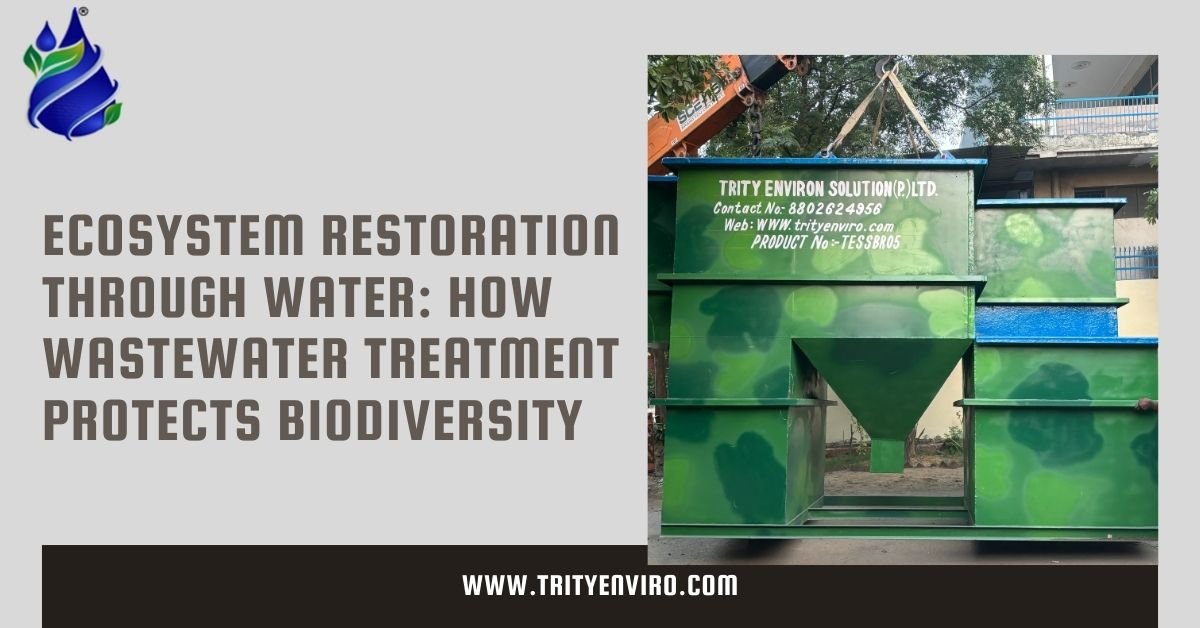
Discover how wastewater treatment supports ecosystem restoration, protects biodiversity, and promotes sustainable practices for cleaner water and healthier habitats.
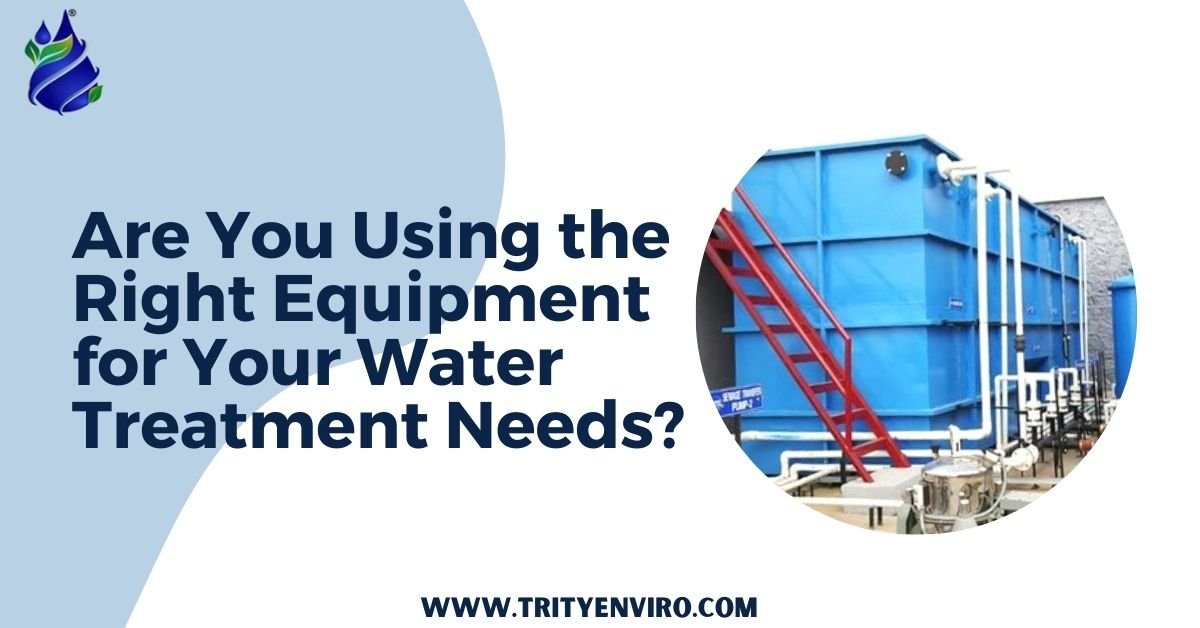
Ensure effective water treatment by selecting the right equipment. Learn how to choose, maintain, and optimize your system for clean water and cost savings.




Discuss your requirements with our engineering team and get practical guidance for your project.