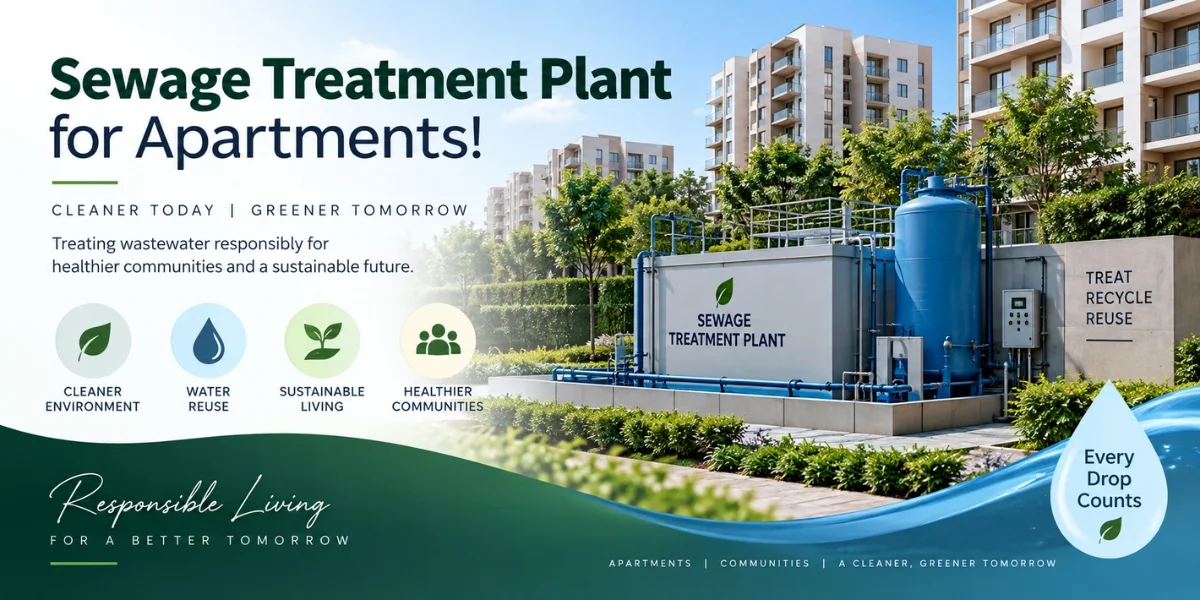
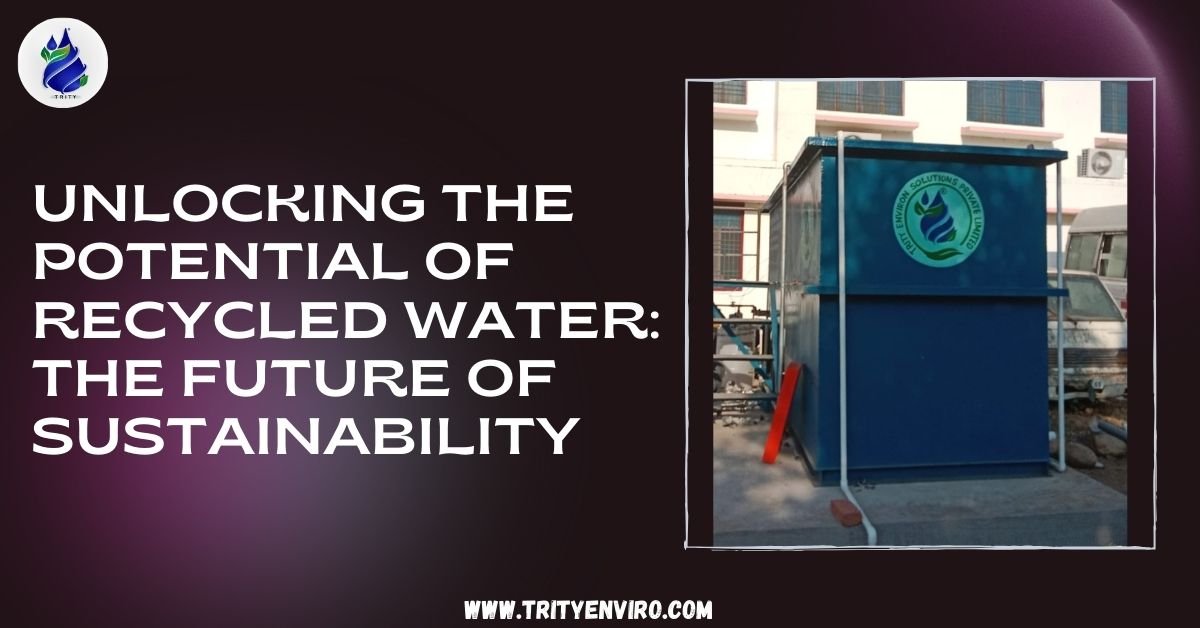
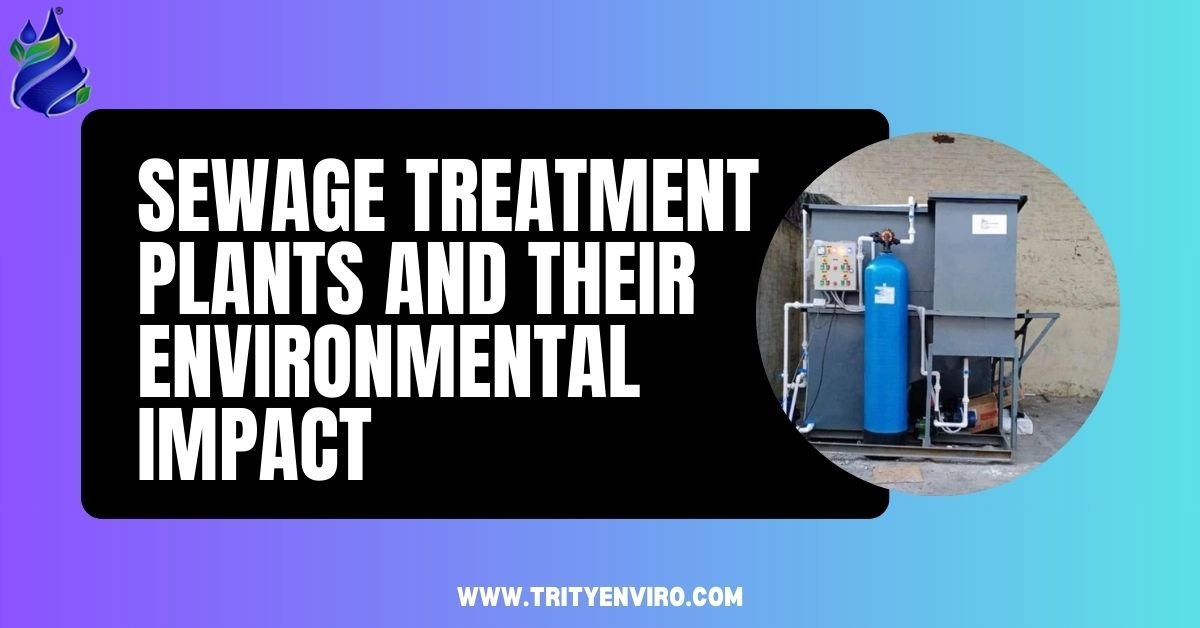
Keeping the environment clean starts with treating wastewater properly before it reaches rivers, ponds, or groundwater, and a sewage treatment plant (STP) is the facility that makes this possible for residential complexes. What used to be seen mainly as an industrial or municipal requirement is now a standard, and in most Indian cities legally mandatory, feature of apartment complexes and housing societies above a certain size. This guide covers exactly when an STP for apartments becomes legally required, how it is sized based on actual occupancy, what it realistically costs, which treatment technology fits different housing society layouts, and how the plant actually works from collection to discharge or reuse.
Is an STP Legally Mandatory for Your Apartment Complex?
In most major Indian cities, yes, and the trigger is usually tied to either built-up area or daily wastewater generation. A commonly used national benchmark, referenced by the Ministry of Environment, Forest and Climate Change, requires housing projects with a built-up area above 20,000 square metres, or generating more than 10 KLD (kilolitres per day) of wastewater, to install an on-site STP. However, the exact threshold varies by state and city. Bangalore, for instance, currently requires an in-situ STP only for apartment complexes with more than 120 units generating over 80 KLD of sewage, following relief provided to societies connected to underground drainage lines, while other cities apply different area or unit-based cutoffs entirely.
Beyond the size threshold, any housing society planning to discharge treated sewage also needs to obtain a Consent to Establish and Consent to Operate, effectively a No Objection Certificate, from the relevant State Pollution Control Board under the Water (Prevention and Control of Pollution) Act, 1974, before commissioning the plant. Non-compliance in most jurisdictions can result in penalties and, in serious cases, water supply disconnection, so confirming your specific city and state's exact threshold with the local municipal authority or SPCB before finalizing plans is a necessary first step, not an optional one.
Why STPs Matter for Apartment Complexes
Beyond the legal requirement, there are practical reasons every housing society benefits from a properly functioning STP.
- Environmental impact: Untreated sewage discharged into drains or natural water bodies contaminates groundwater and surface water, directly harming aquatic ecosystems and the broader local environment.
- Health and hygiene: Inadequately treated wastewater poses real health risks to residents and the surrounding community, making proper treatment a public health matter, not just an environmental one.
- Resource conservation: Treated wastewater can be reused for non-potable purposes, gardening, car washing, construction activity, and toilet flushing, directly reducing a society's dependence on fresh water and lowering its municipal or tanker water bill over time.
- Regulatory compliance: Beyond avoiding penalties, a functioning STP keeps a society in good standing with local and state authorities, which matters increasingly as enforcement around apartment-level compliance tightens across Indian cities.
How to Size an STP for Your Apartment Complex
STP capacity for a housing society is generally calculated from expected daily water consumption per resident, with a standard assumption of roughly 135-150 litres per capita per day (LPCD) of water use, of which approximately 80% typically returns as wastewater requiring treatment. In practice, many designers use a simpler rule of thumb of around 0.5 KLD of sewage generation per flat, adjusted for average occupancy per unit in that specific society.
Worked example: For a housing society with 400 flats at an average occupancy of 4 people per flat, using 135 LPCD water consumption and an 80% return-to-sewage factor:
400 flats × 4 people × 135 litres × 0.8 = approximately 172,800 litres, or roughly 173 KLD
This is a starting estimate only. Actual sizing should always account for peak-hour flow, not just the daily average, since morning and evening usage spikes in residential complexes are significant, and should be confirmed through a proper site assessment rather than a rule-of-thumb calculation alone.
Indicative Cost of an STP for Housing Societies
Cost varies significantly based on capacity, technology, civil work requirements, and site-specific factors, but as a general indicative reference, societies can expect the following rough ranges based on typical market pricing across India.
| Society Size (approx.) |
Typical STP Capacity |
Indicative Cost Range |
| 100-150 flats |
40-60 KLD |
Rs 25-40 lakh |
| 400 flats |
150-200 KLD |
Rs 70-80 lakh |
| 1,000 flats |
450-500 KLD |
Rs 90-110 lakh |
These figures are indicative only and will vary based on the technology chosen, civil work complexity, site conditions, and current material costs. Getting a formal quotation based on your society's actual flat count, occupancy pattern, and site layout from an experienced sewage treatment plant manufacturer is the only reliable way to budget accurately, rather than relying on generic figures from an unrelated project.
Choosing the Right Technology for Apartment STPs
Space is almost always the binding constraint for housing society STPs, particularly where the plant needs to fit into a basement, parking area, or a small dedicated plot, which makes technology choice especially important.
- SBR (Sequencing Batch Reactor): A cyclic process that combines aeration and settling within a single tank, making it a strong fit for societies with genuine space constraints, since it avoids the multiple separate tanks a conventional plant needs.
- MBBR (Moving Bed Biofilm Reactor): Uses bio-carrier media to increase treatment capacity within a compact tank footprint, commonly requiring 30-50% less space than a conventional extended aeration plant of the same capacity, and well suited to mid-size societies with moderate reuse requirements.
- MBR (Membrane Bioreactor): Combines biological treatment with membrane filtration to produce very high quality, near reuse-ready water, a strong choice for societies planning extensive treated water reuse for gardening, flushing, or car washing, though typically at a higher capital cost than SBR or MBBR.
For most mid-size Indian housing societies, MBBR or SBR technology offers the best balance of compact footprint, manageable operating complexity, and reasonable capital cost, while larger societies with strong reuse ambitions increasingly opt for MBR despite the higher upfront investment.
How Does an STP Work for Apartments?
A sewage treatment plant for a housing society follows a defined sequence of stages, regardless of which specific technology is used.
- Collection: Wastewater from all flats, kitchens, bathrooms, and common areas, is collected and channelled into the plant for treatment.
- Primary treatment: Physical processes, screening, sedimentation, and flotation, remove large solids and floating contaminants before the water moves to biological treatment.
- Secondary treatment: Biological processes, using activated sludge, MBBR, or SBR depending on the technology chosen, break down dissolved organic matter using microorganisms.
- Tertiary treatment (where reuse is planned): Additional filtration, chemical treatment, or UV disinfection brings water quality up to a level suitable for reuse in gardening, flushing, or other non-potable applications.
- Sludge management: Solid waste separated during treatment is dewatered, typically using a filter press or sludge dewatering system, for safe disposal.
- Discharge or reuse: Treated water meeting regulatory standards is either discharged responsibly or reused within the complex for irrigation, flushing, or other non-potable purposes, reducing the society's dependence on fresh water supply.
Industry Applications / Use Cases
| Society Type |
Key Consideration |
Recommended Approach |
| Small societies (under 150 flats) |
Budget-conscious, moderate space |
Compact SBR system |
| Mid-size societies (300-600 flats) |
Balance of space, cost, and reuse |
MBBR with tertiary polishing |
| Large townships with strong reuse goals |
High reuse-grade water requirement |
MBR for premium effluent quality |
| Societies with underground parking below plant location |
Severe space and access constraints |
Compact, low-footprint modular design |
Why Choose Trity Enviro
Among wastewater treatment companies in India, Trity Environ Solutions stands out as a trusted sewage treatment plant manufacturer in Ghaziabad, delivering end-to-end STP solutions for housing societies and apartment complexes across the country. Our engineering team sizes every plant around your society's actual flat count and occupancy data rather than generic capacity slabs, recommends the right technology, SBR, MBBR, or MBR, based on your available space and reuse goals, and provides a formal, site-specific quotation rather than a rough estimate. Every installation is backed by pan-India Annual Maintenance Contract and operation and maintenance support, so your STP stays compliant and efficient for years after commissioning, not just at handover. We are ISO 9001:2015 certified, QCI approved, and deliver CPCB-compliant engineering nationwide.
Planning an STP for your apartment complex or housing society?
Call +91-9821030072 or email enquiry@trityenviro.com to discuss your society's requirements.
Request a Free Site Assessment & Quotation
Frequently Asked Questions (FAQs)
Ans: In most major Indian cities, yes, typically triggered once a housing project's built-up area exceeds 20,000 square metres or wastewater generation exceeds 10 KLD, though the exact threshold varies by state and city. Confirming the specific rule with your local municipal authority or State Pollution Control Board is essential before planning.
Ans: Capacity is typically estimated from expected water consumption per resident (around 135-150 LPCD), with roughly 80% of that volume returning as sewage. A common rule of thumb is approximately 0.5 KLD of sewage generation per flat, adjusted for the society's actual average occupancy per unit.
Ans: Cost varies by capacity and technology, but as an indicative reference, a 150-200 KLD plant for around 400 flats often falls in the Rs 70-80 lakh range, while larger plants of 450-500 KLD for around 1,000 flats can range from Rs 90-110 lakh. These figures vary based on site conditions and technology chosen, so a formal site-specific quotation is recommended.
Ans: MBBR and SBR technologies typically need 30-50% less space than conventional extended aeration plants for the same capacity, making them well suited to societies with basement or limited plot space. MBR is a stronger choice where extensive treated water reuse is the priority, despite a higher upfront cost.
Ans: Yes, water passing through proper tertiary treatment, filtration, chemical treatment, or UV disinfection, is safe for non-potable reuse such as gardening, car washing, construction activity, and toilet flushing, directly reducing a society's freshwater consumption and water bill.