Comprehensive Guide to Water Softener Systems in India
Explore the complete guide to water softener systems in India. Learn about types, working, benefits, and expert tips to choose the right water softener for your home or business.

 ISO 9001:2015 & QCI Approved
A guide to GSPCB's sewage treatment plant requirements in Goa, covering current discharge norms, CRZ considerations, and compliance steps for coastal projects.
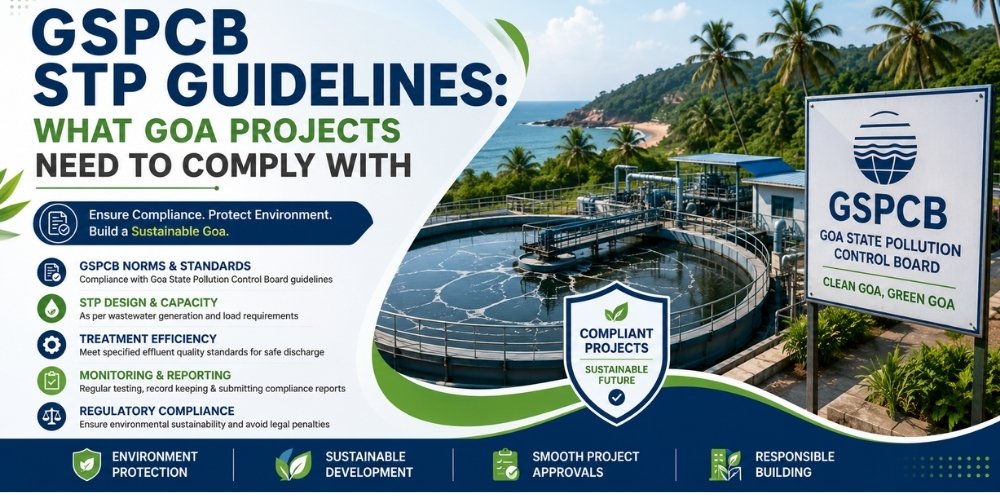
Goa's appeal runs almost entirely on its coastline, rivers, and water quality, which is exactly why the Goa State Pollution Control Board (GSPCB) treats sewage treatment compliance with particular seriousness. Constituted on 1 July 1988 under the Water (Prevention and Control of Pollution) Act, 1974, GSPCB has spent over three decades managing water and air pollution control across a state where tourism pressure and ecological sensitivity collide more directly than almost anywhere else in India.
GSPCB operates under the Department of Environment, Government of Goa, now headquartered at Saligao, and runs an extensive monitoring network covering 16 ambient air quality stations and 52 water quality monitoring stations across the state. Its core STP-related responsibilities include:
| Parameter | Commonly Cited Standard |
|---|---|
| pH | 6.5 – 9.0 |
| BOD (5-day) | ≤ 10 mg/L |
| COD | ≤ 50 mg/L |
| Total Suspended Solids | ≤ 10 mg/L |
| Oil and Grease | Monitored specifically given Goa's hospitality-sector discharge profile |
| Fecal Coliform | Subject to stricter scrutiny near beaches and coastal water bodies given ongoing contamination concerns |
These figures reflect CPCB's baseline standard as applied through GSPCB's framework. Given that GSPCB has recently intensified scrutiny of STP performance across the state, confirming the current figure applicable to your specific project category directly with the board is particularly worth doing in Goa.
Goa's situation is not generic, and a few current, documented realities explain why.
GSPCB does not mandate a single treatment technology. It specifies the discharge and quality outcome a plant must achieve, leaving room for several established approaches suited to Goa's specific conditions.
Salt-tolerant and corrosion-resistant material specification matters more in Goa than inland states. Coastal humidity and occasional saline groundwater intrusion in low-lying areas make material selection for tanks, piping, and electrical enclosures a genuinely location-specific design decision, not a detail to standardise from an inland template.
Given the pressure tourism places on Goa's freshwater sources, particularly documented water table depletion in popular coastal belts from over-extraction by resorts and private developments, treated water reuse carries more practical weight here than in many other states.
Hotels, resorts, residential complexes, and commercial establishments above specified size or occupancy thresholds are required to install and operate a compliant STP, with hospitality-sector projects facing particular scrutiny given the sector's documented contribution to coastal water quality issues. Any Orange or Red category unit is generally expected to have treatment infrastructure in place as a condition of consent. Given the board's current focus on auditing existing infrastructure, confirming the applicable threshold and any project-specific requirements directly with GSPCB before finalising design is especially worthwhile in the current environment.
Securing STP approval in Goa follows a two-stage clearance process common to most Indian states but worth understanding in sequence.
Trity Environ Solutions designs and installs STP and ETP systems engineered around the specific discharge and reuse requirements a coastal, tourism-driven project needs, backed by installation and ongoing AMC support.
If your hotel, resort, or commercial project in Goa needs a compliance-ready STP, reach out through our services page or contact us at enquiry@trityenviro.com or +91-9821030072 for a site-specific assessment.
GSPCB was constituted on 1 July 1988 as a statutory board under the Water (Prevention and Control of Pollution) Act, 1974, and has operated as Goa's primary water and air pollution control authority since.
Commonly cited figures include BOD ≤10 mg/L, COD ≤50 mg/L, TSS ≤10 mg/L, and pH 6.5–9.0, though these should be confirmed against GSPCB's current notification for your specific project category, particularly given the board's recent focus on STP performance audits.
Following a High Court directive, GSPCB has been assessing whether Goa's roughly dozen operational STPs, both government and privately run, are functioning effectively, working with GSIDC to address gaps linked to documented bacterial contamination at several beaches.
Yes. Projects within Coastal Regulation Zone boundaries face additional restrictions on siting and discharge beyond standard GSPCB norms, making CRZ status an important early consideration for any coastal project's treatment plant design.
Hospitality establishments fall under the same basic GSPCB framework as other commercial projects, but currently face particular scrutiny given tourism's documented role in Goa's coastal water quality challenges.
Compliance in Goa means more than meeting a discharge number, it means operating in a state where GSPCB is actively reviewing existing STP infrastructure, where beach water quality is under public scrutiny, and where CRZ provisions add a genuine layer of complexity for coastal projects. Given this environment, building a properly designed, adequately sized STP from the outset matters more in Goa than in most other states, both for regulatory standing and for the tourism-dependent reputation of the business it serves. Trity Environ Solutions works with hospitality and commercial developers across Goa to get that design right, backed by current regulatory awareness and support well beyond commissioning.
Explore the complete guide to water softener systems in India. Learn about types, working, benefits, and expert tips to choose the right water softener for your home or business.
Discover sustainable solutions for microplastic removal in wastewater treatment. Explore innovative methods and eco-friendly approaches for a cleaner environment.
Explore how STPs and ETPs help scale wastewater treatment systems to address challenges of urbanization, funding, space, and regulations in growing cities.



Discuss your requirements with our engineering team and get practical guidance for your project.