Why STPs and ETPs Are Essential for Corporate Social Responsibility
STPs and ETPs help companies achieve CSR goals, reduce pollution, conserve water, and comply with regulations, contributing to a sustainable future and better brand image.

 ISO 9001:2015 & QCI Approved
From equalisation tanks to self-monitoring reports, this checklist walks Gujarat industrial units through what to verify in an ETP before a GPCB visit.
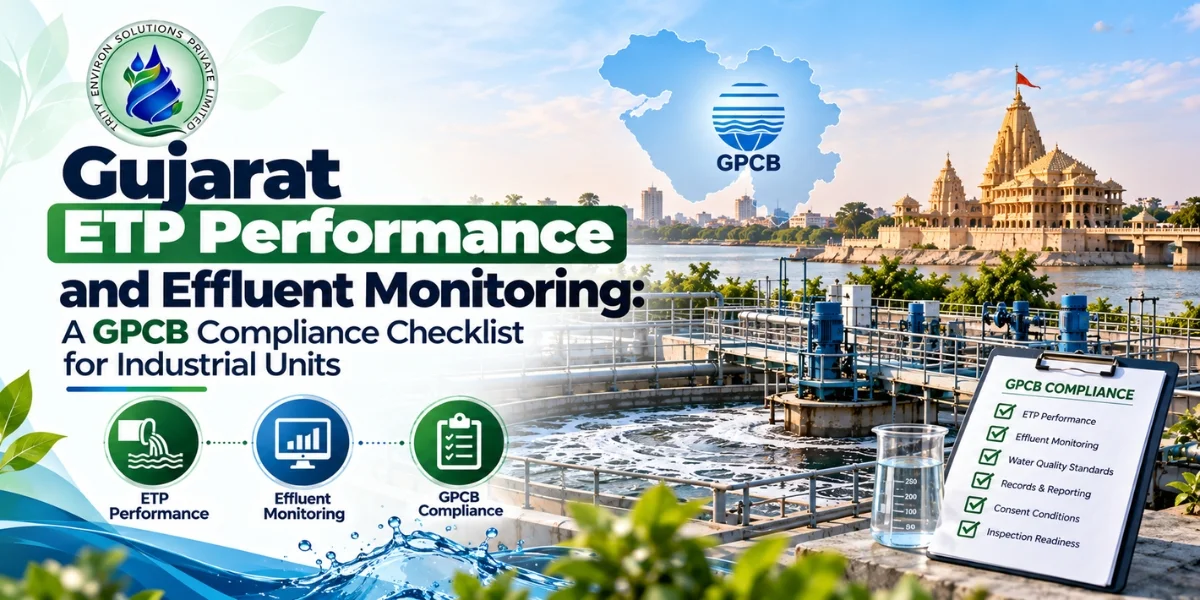
Gujarat is home to some of India's densest chemical, dye, pharma and engineering clusters. Places such as Vapi and Ankleshwar have long appeared in national discussions on industrial pollution, and that history shapes how the Gujarat Pollution Control Board (GPCB) approaches inspections today. Industry guides commonly describe the board as focused on industrial estates, insistent on periodic self-monitoring reports and firm on water reuse and zero liquid discharge in water-stressed regions such as Saurashtra.
For a plant manager, the practical question is simple. If an officer arrived tomorrow, could you show that your ETP performance is stable, that your outlet numbers are consistent and that your records are complete? Most units can answer the first question and struggle with the other two.
This checklist is built for plant heads, EHS officers and maintenance teams. It moves through the plant in the order effluent flows: inlet, treatment stages, outlet, sludge and paperwork. Use it as an internal audit, and mark each item as good, weak or missing.
The board grants consent through its online system and tracks compliance through inspections, sampling and reports submitted by the unit. Industry commentary suggests that Gujarat offers convenience for units with a clean record, for example simpler renewal for compliant green category units, but enforcement is firm for units in polluted clusters.
Your consent order names the discharge route, permitted quantity and quality limits. Units that discharge to a common effluent treatment plant (CETP) must meet the CETP's inlet norms, which are often tighter on colour, COD and TDS than a direct discharge standard. Self-monitoring means testing your effluent at intervals set by the board and keeping the results ready for inspection. Some sources describe quarterly reporting for many units, so confirm the frequency in your consent.
Dye and textile units struggle with colour and salts. Pharma and chemical units deal with high COD and hard to degrade organics. Engineering and metal finishing units generate oil, metals and acidic streams. Food units face high BOD and fats. The right upgrade depends on which of these you are.
Walk the plant with this list. Note down anything you cannot verify with a reading or a record.
Why Equalisation Comes First
Most biological failures begin at the inlet. A single batch dump of concentrated effluent can kill the bacteria that took weeks to build. An equalisation tank with proper mixing and retention time of 8 to 12 hours, sized for your batch pattern, evens out the load and protects everything after it.
If your effluent is hard to degrade, a plain activated sludge system may not be enough. Read about biological ETP systems and physico-chemical ETP systems to see where each is a fit. For fine solids, oil and grease, a dissolved air flotation system is often the right first stage.
Cooling tower blowdown, boiler blowdown, floor washings and process effluent rarely belong in the same channel. Blowdown is low in organics but high in dissolved solids, and mixing it with process effluent increases the volume you have to treat without adding anything that biology can remove. Where possible, route blowdown to a reuse line or a separate polishing stage.
The jar test is the cheapest tool in the plant. Take samples of the effluent, dose different amounts of coagulant and polymer, and watch how quickly flocs form and settle. The best dose is the lowest one that gives clear water and firm flocs. Repeat the test whenever the process or chemical supplier changes. Plants that dose from a fixed habit often spend more on chemicals than they need to and produce more sludge as a result.
Simple Daily Checks
Operators can also check the sludge blanket depth in the clarifier, colour of the aeration tank, foam level and smell at the outlet. A daily tick sheet with five or six items is enough to catch most problems before a sample does.
A well run plant can still be marked down because reports are late or inconsistent.
Keep a folder, physical or digital, with daily flow and chemical logs, weekly operator checks, laboratory reports, calibration records for meters and analysers, sludge disposal manifests and copies of every report sent to the board. When numbers in the monthly report do not match the logbook, that is where trouble starts.
Water stress pushes Gujarat units toward reuse. Recycling treated water to cooling towers, gardening or process rinsing lowers freshwater demand and, in some regions, is expected by the board. Reuse needs cleaner water than discharge does, usually with filtration and a membrane stage. Our wastewater recycling system and tertiary treatment plant pages describe typical configurations.
Zero liquid discharge takes reuse further: RO reject is concentrated by evaporation and the salts are handled as solid waste. It is expensive to run, so use it where the consent or the water situation demands it. See our zero liquid discharge systems for options.
Units that send effluent to a common effluent treatment plant should read the CETP's inlet norms and membership terms closely, since penalties for violating them can come from the CETP operator as well as the board. Pre-treat on site to the CETP's specification, keep your own flow meter and sampling point and log the readings, and reconcile them with the CETP's records at regular intervals. At consent renewal, gather your reports, sampling results and maintenance logs in advance, and fix any open corrective actions before the application date.
If your checklist shows many weak items, avoid buying equipment first. Get your effluent characterised, then decide.
Repair when the tanks are structurally sound and problems are with pumps, diffusers, dosing systems or operating discipline. Upgrade when your load, colour or dissolved solids exceed what the plant can handle. Replace when the design does not fit the effluent at all, for example a sewage type process treating solvent-rich waste.
Look at our sector pages for chemical industry ETP, textile and dyeing ETP and pharmaceutical ETP, and consider a service plan under operation and maintenance if your team is small.
Large upgrades do not have to happen at once. A sensible order is to fix inlet control first, then aeration and dosing, then clarification and sludge handling, and only then add tertiary, membrane or evaporation stages. Measure the result after each phase. Many units find that the first two phases solve most of the problem, which avoids the cost of stages they never needed.
Include laboratory equipment, spare probes, standby power for aeration blowers, sludge storage, operator training and the first year of chemicals in your budget, and ask suppliers to list what their price excludes. If you plan reuse or ZLD, add the cost of membranes, evaporator steam or power and salt disposal, since these often exceed the purchase price over the plant's life.
The purchase price of an ETP is visible, and the operating cost is not. Power for aeration is usually the largest continuing item, followed by chemicals, sludge disposal, manpower and spare parts. Ask suppliers to estimate power in kilowatt-hours per cubic metre treated, chemical use per cubic metre and sludge production per day. Small differences in these figures add up over a decade, and they often reveal which design has been optimised and which has only been priced to win the order. Also ask about turndown: how the plant performs when production runs at half load, since many units operate well below capacity for months and a plant that only performs at full flow will waste power and struggle with weak effluent. A design with staged blowers, variable frequency drives and split tanks handles this far better.
| Parameter / Stage | Target Optimal Range | Failure Impact / Risk | Corrective Engineering Action |
|---|---|---|---|
| Equalisation retention time | Often 8 to 12 hours, based on batch pattern | Shock loads, biological failure | Enlarge tank, add mixing, segregate strong streams |
| Dissolved oxygen in aeration | 1.5 to 3 mg/L | Poor BOD removal, odour, bulking sludge | Service blowers and diffusers, add DO control |
| Outlet quality vs consent | Within limits on repeated samples | Notice, direction, closure on repeat | Add tertiary or advanced treatment, tune process |
| Self-monitoring records | Complete, consistent and on time | Penalty for missing or contradictory data | Assign an owner, use a common register, cross-check with lab |
Trity Environ Solutions is an ISO 9001:2015 certified and QCI-approved effluent treatment plant manufacturer and supplier in India, delivering robust, high-efficiency systems engineered for CPCB and SPCB regulatory compliance.
Every installation is supported by pan-India Annual Maintenance Contract and Operation and Maintenance services.
Looking to upgrade or install a high-performance ETP system? Call +91-9821030072 or email enquiry@trityenviro.com, or request a free engineering consultation from our technical team.
STPs and ETPs help companies achieve CSR goals, reduce pollution, conserve water, and comply with regulations, contributing to a sustainable future and better brand image.

Proven approaches to raising wastewater treatment awareness, from Singapore's NEWater model to school partnerships and facility tours.

Discover how vermifiltration uses earthworms and microbes to treat wastewater naturally, offering a low-cost, eco-friendly alternative to traditional methods.




Discuss your requirements with our engineering team and get practical guidance for your project.