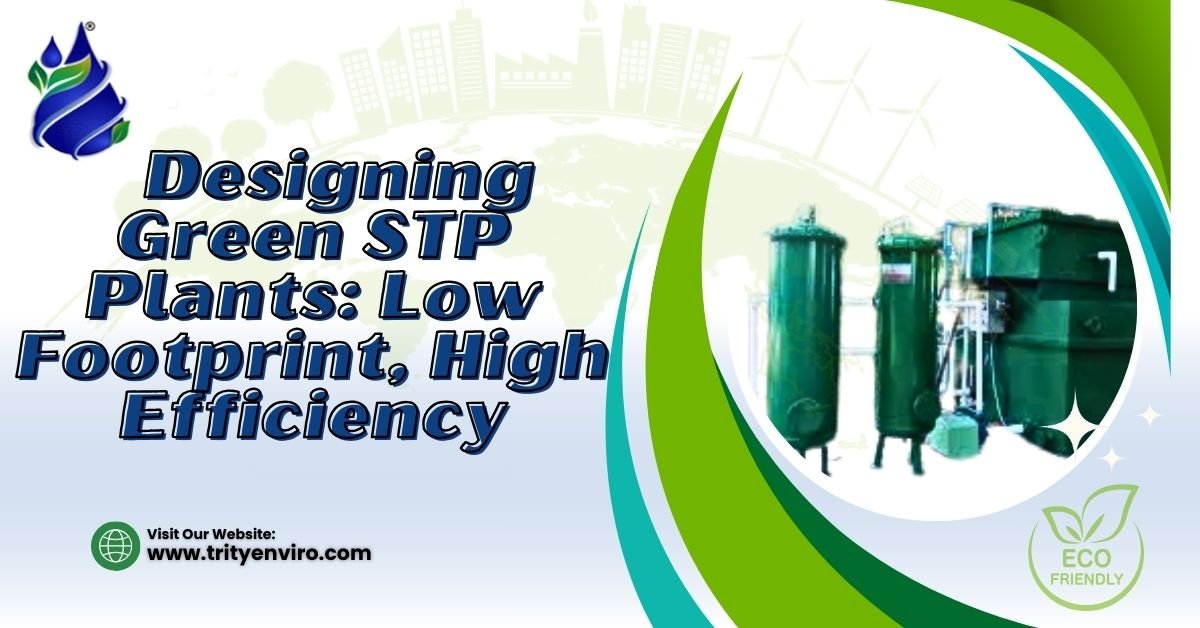
Designing Green STP Plants: Low Footprint High Efficiency
Discover how modern green STP plants save space, reduce energy use, and promote sustainability through smart design and eco-efficient technologies.

 ISO 9001:2015 & QCI Approved
Match your feed water treatment to your boiler pressure. This guide shows what to remove, how to control blowdown and what the numbers mean.
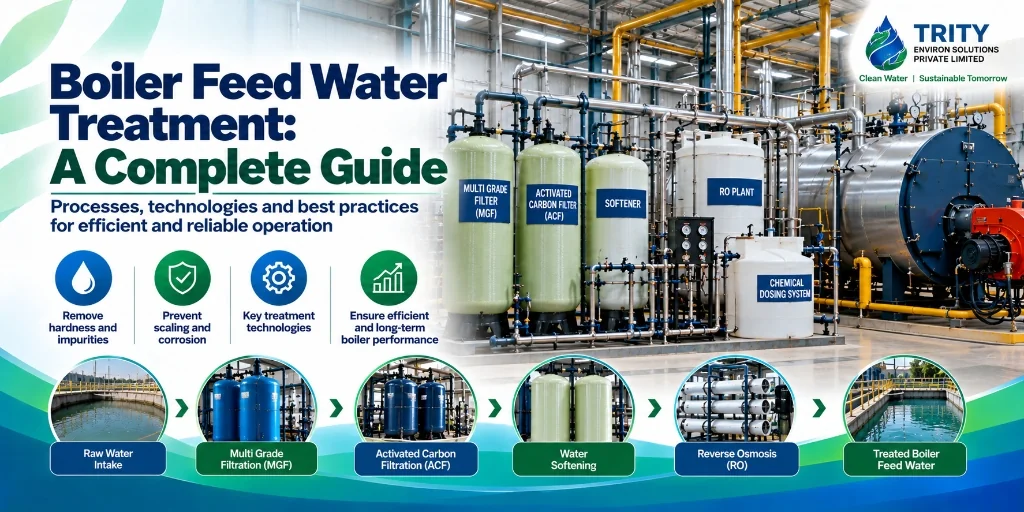
A boiler turns water into steam, and steam runs processes, turbines and heating across industry. What most people forget is that a boiler is also a concentrator. Every litre of feed water carries dissolved minerals. When the water evaporates into steam, those minerals stay behind in the boiler, getting more concentrated with each hour of operation. If they are not controlled, they form scale on heat transfer surfaces, corrode metal and cause water to be carried over into the steam.
Scale is the most expensive of these. A thin layer of hardness scale, as little as a millimetre, insulates the tubes, raises fuel use and overheats the metal. Left unchecked, it can lead to tube failure, forced shutdowns and, in the worst case, a dangerous incident. Corrosion from dissolved oxygen and carbon dioxide eats through pipes and condensate lines. Carryover contaminates the steam, damaging turbines, valves and process products.
Boiler feed water treatment is the discipline that prevents all of this. It starts with an analysis of your raw water and the requirements of your boiler pressure and application, then selects the right combination of filtration, softening, RO, demineralisation, deaeration and chemical conditioning. It is also a fuel saving exercise, because the quality of feed water decides how much hot water you have to blow down.
This guide explains the problems, the water quality targets by boiler pressure, the treatment options and how to choose, the arithmetic of blowdown with a worked example and what to ask a supplier. It is written for plant managers, utility engineers and procurement teams in industries that run steam boilers. Trity Enviro designs and supplies the softener, RO and DM trains that feed boilers, and the guide draws on that experience.
To stop solids from building up, a boiler continuously or intermittently discharges a portion of boiler water, called blowdown. That water is at boiler temperature, so every litre removed carries heat out of the system and must be replaced with cold feed water that has to be heated again. The better your feed water, the less blowdown you need, and the more fuel and water you save. This is the main economic argument for investing in better feed water treatment.
The permitted limits depend on boiler type, pressure, design and the code or standard it follows, and the boiler manufacturer's recommendation is the final authority. As a general pattern:
Dissolved oxygen after the deaerator is typically held to a few parts per billion in higher pressure boilers and slightly higher in low pressure units, with feed pH in the alkaline range. Treat these as pattern examples, and take the numbers for your boiler from the manufacturer, the applicable boiler regulations and your water treatment consultant.
Choose the treatment by raw water quality and boiler pressure:
Our guide to selecting a water treatment plant for industries shows how these stages are combined.
Oxygen is removed in two steps. A mechanical deaerator heats the feed water with steam and strips out most dissolved gases. A chemical oxygen scavenger, such as sodium sulphite or an organic alternative, then removes the remainder, and a small residual is maintained in the boiler water as proof that it is working. As a stoichiometric guide, sodium sulphite needs roughly eight parts by weight for every part of dissolved oxygen, but practical dosing is higher. Maintain a feed water pH in the alkaline range, often with a neutralising or filming amine for the condensate system. A boiler water chemical supplier or your treatment consultant sets the programme.
Internal treatment also controls residual hardness and scale with phosphate or polymer programmes, as appropriate to the boiler. These chemicals complement good feed water treatment and do not replace it.
Blowdown depends on the ratio between boiler water TDS and feed water TDS, called cycles of concentration (C). For a boiler making steam S, blowdown B is about S ÷ (C − 1).
Take a 10 tonne per hour boiler operating at about 10 bar, with the boiler water TDS limit set at 3,000 mg/L.
The heat in blowdown water at 10 bar is about 760 kJ/kg, against about 105 kJ/kg for feed at 25 °C. In the softened case, 2,500 kg/h × (760 − 105) kJ/kg is about 1.6 GJ/h of heat lost in blowdown, plus the water itself. In the RO case it is about 0.07 GJ/h. Over a year of continuous operation, the saving in fuel and water can easily pay for the RO plant, quite apart from the lower risk of scale and carryover. These are estimates: your pressure, limits and fuel cost change the numbers. Heat recovery from blowdown, with a flash vessel and heat exchanger, reduces the loss further.
Treat the water programme as a routine, not a project:
Maximise condensate return, since condensate is hot, pure water. A higher return reduces make-up water, treatment cost and fuel. Keep the condensate lines free of corrosion with correct conditioning.
Trity Enviro designs complete water treatment trains for boilers, from filtration and softening to RO and DM, and an annual maintenance contract or operation and maintenance service keeps the system performing.
Boilers that stand idle corrode quickly. For short shutdowns, keep the boiler full and treated, with the right scavenger and pH residual. For longer breaks, drain and dry the boiler or use a recognised layup method, and keep manholes closed with desiccant if dry layup is used. Inspect the water side before restart, and record what you find. Trity Enviro engineers include layup and restart advice in our O&M support, because many corrosion problems begin during the weeks when the boiler is not running.
| Parameter / Stage | Target Optimal Range | Failure Impact / Risk | Corrective Engineering Action |
|---|---|---|---|
| Feed water hardness | Close to zero, often under 2 mg/L as CaCO3 for low pressure boilers | Scale, tube overheating, higher fuel use | Regenerate softener on time, test daily, add RO if needed |
| Dissolved oxygen after deaeration | A few parts per billion for higher pressure, low for all boilers | Pitting corrosion in feed lines and boiler | Service deaerator, dose scavenger, maintain residual |
| Boiler water TDS and cycles | Controlled to the limit set for the boiler, with blowdown set by cycles | Carryover and foaming if too high, fuel waste if too low | Add RO or DM, automate blowdown, recover heat |
| Condensate return | As high as practicable | High make-up and chemical cost, fuel waste | Fix leaks and traps, insulate lines, treat condensate |
Trity Environ Solutions is an ISO 9001:2015 certified and QCI-approved boiler feed water treatment plant, DM plant and RO plant manufacturer and supplier in India, delivering robust, high-efficiency systems engineered for CPCB and SPCB regulatory compliance.
Every installation is supported by pan-India Annual Maintenance Contract and Operation and Maintenance services.
Discover how modern green STP plants save space, reduce energy use, and promote sustainability through smart design and eco-efficient technologies.
Everything housing societies need to know about a sewage treatment plant for apartments: legal rules, sizing, cost, and choosing the right STP manufacturer.
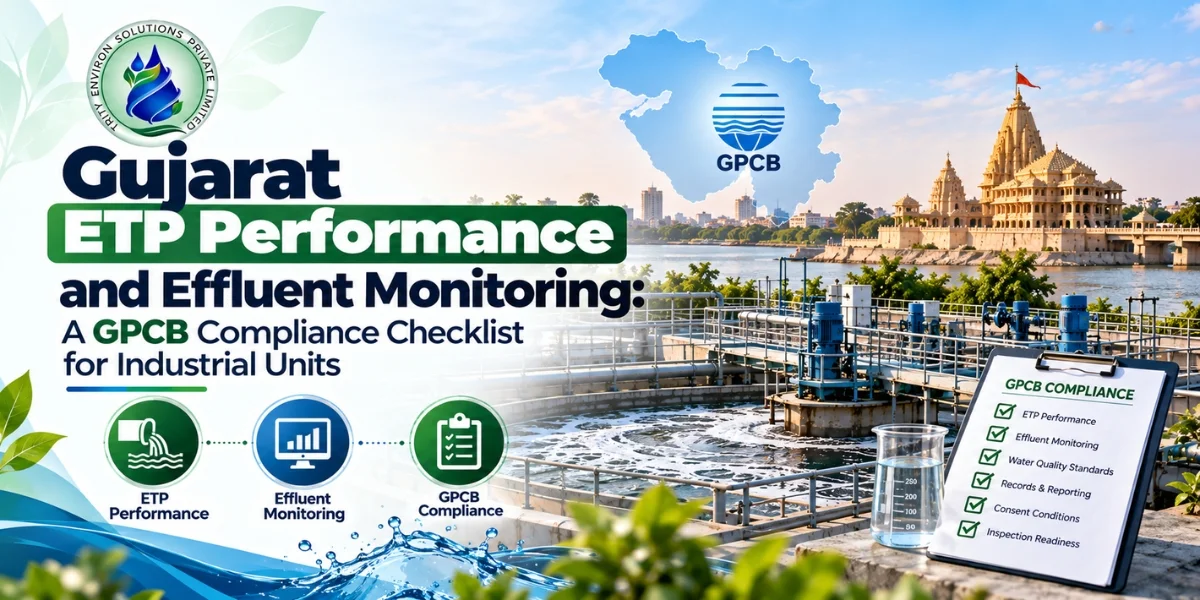
A practical GPCB checklist for Gujarat industrial units covering ETP performance, effluent monitoring, self-monitoring reports, ZLD readiness and upgrades.











Discuss your requirements with our engineering team and get practical guidance for your project.

