
Nanotechnology in ETP Membranes: Opportunities and Environmental Risks
Explore how nanotechnology boosts ETP membranes in wastewater treatment, enhancing efficiency while addressing environmental risks and sustainability.

 ISO 9001:2015 & QCI Approved
An STP treats what people produce. An ETP treats what a process produces. Pick the wrong one and you either fail your discharge norms or spend far more than you needed to. Here is how to decide.
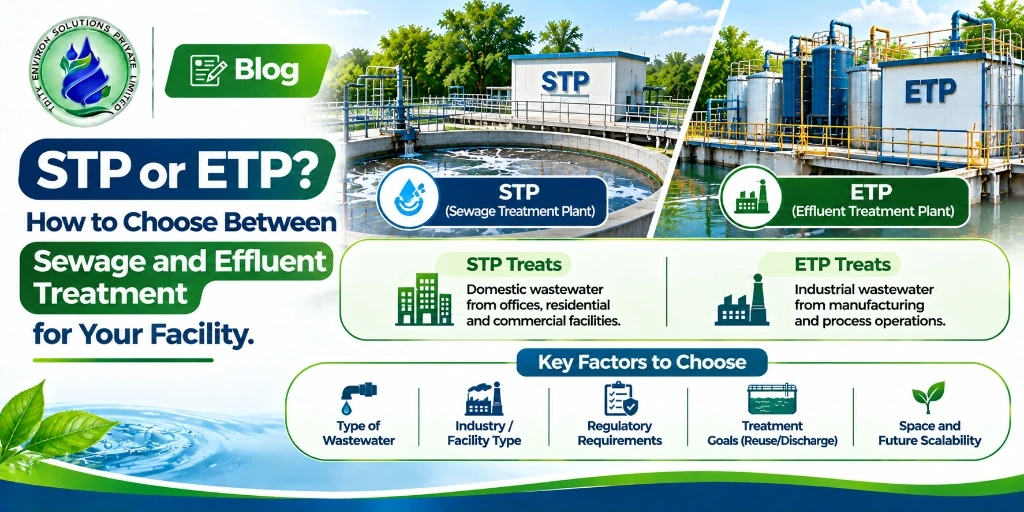
An STP (sewage treatment plant) treats domestic wastewater from toilets, kitchens and bathrooms. An ETP (effluent treatment plant) treats wastewater produced by industrial processes. The source decides the contaminants, and the contaminants decide the technology.
Both aim to bring water within discharge or reuse standards, but their inputs are very different. Sewage is fairly predictable and mostly biodegradable. Industrial effluent can be acidic, toxic, coloured, oily or very strong.
If you are unsure what the three acronyms stand for, see our explainer on WWTP, STP and ETP full forms. This guide focuses on choosing between them.
Typical strength differs by orders of magnitude:
An STP is built around biology:
An ETP starts with chemistry and adds biology only where the effluent allows:
The sequence differs because the problem differs: an STP mostly digests, an ETP first conditions and separates.
Always confirm limits with your State Pollution Control Board before finalising design.
Our guides on operational costs and customised design cover both in more detail.
Many sites generate two separate wastewaters:
Keep the streams separate wherever possible. Mixing a toxic process stream into sewage can poison the STP's biology. Combined ETP-cum-STP systems are designed to treat each stream correctly and, where suitable, polish them together.
| Feature | STP | ETP |
|---|---|---|
| Treats | Domestic sewage | Industrial effluent |
| Typical pollutants | Organics, nutrients, pathogens | Chemicals, metals, oils, dyes, high COD |
| Core process | Biological | Physico-chemical plus biological |
| Chemical use | Low | Moderate to high |
| Standards | CPCB and state norms by location | Industry-specific, set in consent |
| Design basis | Occupancy and flow | Characterised effluent |
| Typical users | Apartments, hotels, hospitals, offices | Factories, pharma, textile, food, chemical units |
Trity Environ Solutions is a trusted STP and ETP manufacturer in Ghaziabad, designing standalone STPs, ETPs, CETP-linked pretreatment and combined ETP-cum-STP systems for clients across Delhi NCR and India. Trity Enviro helps you decide which plant your facility actually needs by testing the wastewater first, then specifying the right combination of MBBR, MBR, physico-chemical and biological ETP stages.
As an experienced wastewater treatment plant manufacturer and supplier, we back each plant with Annual Maintenance Contract and operation and maintenance support. We are ISO 9001:2015 certified, QCI approved, and deliver CPCB-compliant engineering nationwide.
Speak directly with our senior environmental engineers for technical guidance, sizing calculations, or a tailored project proposal.
Call +91-9821030072 or email enquiry@trityenviro.com
Explore how nanotechnology boosts ETP membranes in wastewater treatment, enhancing efficiency while addressing environmental risks and sustainability.
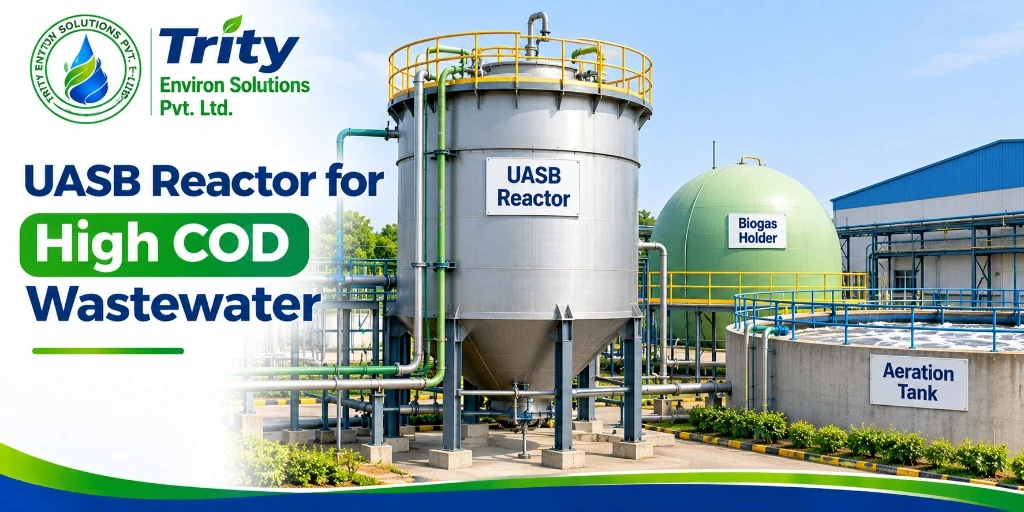
Trity Enviro explains UASB reactors for high COD wastewater: how they work, where they suit, design numbers, biogas yield and a worked 500 KLD example.

Empower communities with sustainable wastewater solutions. Learn how local participation boosts efficiency, education, and environmental care











Discuss your requirements with our engineering team and get practical guidance for your project.

