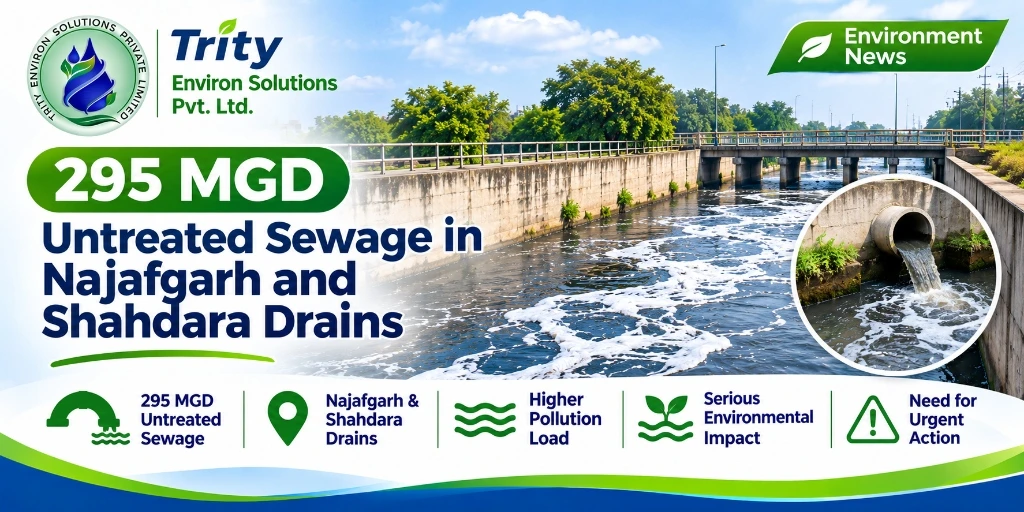
About 295 million gallons a day (MGD) of untreated sewage from Haryana and Uttar Pradesh flows into two of Delhi's biggest drains, the Najafgarh and the Shahdara, according to the Delhi Pollution Control Committee (DPCC).
The figure comes from DPCC's August 2026 monthly report, prepared for a National Green Tribunal (NGT) hearing on polluted river stretches. It was reported by PTI on November 14.
The Flow Figures
Total wastewater
- Combined flow: 1,022.82 MGD
- Najafgarh drain: 862 MGD
- Shahdara drain: 160.82 MGD
Najafgarh's flow is attributed to the Delhi Jal Board (DJB), and Shahdara's to Water and Power Consultancy Services Limited (WAPCOS).
Untreated sewage from neighbouring states
The total is about 294.24 MGD, which PTI's lead rounds to "nearly 295 MGD".
- Haryana into Najafgarh: 220 MGD, entering through the Dhansa regulator and the Badshahpur, Dharampur and Palam Vihar drains
- Uttar Pradesh into Shahdara: 74.24 MGD, entering through the Sahibabad, Indirapuri, Karawal Nagar and Banthala drains
Of Najafgarh's 862 MGD, 452 MGD is treated effluent from sewage treatment plants (STPs), according to the report. Several sub-drains in both catchments are untapped or only partly tapped.
By our arithmetic, untreated sewage from the two states is about 29% of the combined flow, 294.24 divided by 1,022.82. The report does not give that percentage.
What the Report Does and Does Not Say
It says
- The flows are from DPCC's August 2026 monthly report, submitted to the Union Ministry of Jal Shakti for the NGT hearing
- DPCC and the Central Pollution Control Board have monitored the Najafgarh, Shahdara and other drains monthly at 52 locations since May 2025
- Five STPs serve the Shahdara basin with a combined capacity of 99 MGD, and actual treatment in August 2026 was about 101 MGD, per DJB records
It does not say
- The hearing date or outcome
- Whether any action has been taken against specific sources or local bodies in Haryana or Uttar Pradesh
- How the untreated flow was measured at each entry point
- What the figures were in earlier months
The figures are reported by PTI from the DPCC report and not independently measured by us.
Delhi's Own Sewage Gap
The same reporting gives citywide figures from a DPCC progress report.
- Delhi generates about 800 MGD of sewage daily and treats 742.32 MGD, a gap of 57.68 MGD
- 25 operational STPs meet DPCC standards and 10 do not
So the problem has two parts. Delhi has its own treatment shortfall, and large volumes also arrive from upstream.
Why Inter-State Sewage Is Hard to Fix
This section is general background and not a finding from the report.
A drain that crosses state lines carries whatever is discharged upstream. A city downstream can build treatment capacity and still receive untreated flow from its neighbour. Fixing it needs action at several points.
- Sewer connectivity: many urban areas have sewers that do not reach all households, so sewage enters storm drains
- Treatment capacity: a plant that cannot handle peak flow sends the excess untreated
- Interception: untapped sub-drains need to be diverted to a treatment plant before they reach the main drain
- Operation: an STP that is built but running poorly does not deliver treated water
The accountability gap
Coordinating Delhi, Haryana and Uttar Pradesh requires shared data and shared targets. Earlier reporting on DPCC's RTI replies found that the committee had no compiled records of notices or compensation against Najafgarh polluters for 24 months, and that no funds were specifically allocated to it for Yamuna cleaning in the past three years. That points to a coordination problem as well as a technical one.
What Treatment Capacity Needs
These are general engineering points and not directions in the report.
Intercept and treat
- Intercept sub-drains and route them to a sewage treatment plant sized for peak flow, not only average flow
- Where land is limited, compact decentralised plants can treat flow near the source
- Treated water should meet discharge standards for BOD and other parameters
Keep plants performing
- A plant that is on paper compliant can still fail in practice. Routine operation and maintenance of aeration, pumping and sludge handling keeps performance steady
- Online monitoring at outlets lets operators and regulators see lapses early
Control industrial inflow
Where industrial effluent enters municipal drains, it complicates treatment. Units should treat their effluent in their own effluent treatment plant or send it to a common facility, and the wider wastewater treatment system should be designed around the real load.
Reuse treated water
Treated sewage can supply industry and gardens, which reduces freshwater demand and removes the incentive to discharge. Where reuse is the goal, advanced polishing steps can be added.
What It Means for the Yamuna
The Najafgarh drain is among the largest carriers of wastewater into the Yamuna in Delhi, and Shahdara serves the east of the city. The reports reviewed do not give the share of the Yamuna's pollution load that these two drains contribute, so that figure is not stated here.
The more useful point is that treatment inside Delhi cannot clean the river on its own if untreated flow continues to arrive from outside.
Reading the Numbers Carefully
- The 295 MGD is untreated sewage that enters from outside Delhi. It is separate from the 57.68 MGD gap in Delhi's own treatment
- The 452 MGD of treated effluent in Najafgarh shows that much of the drain is already treated water, so the drain is a mix of treated and untreated flow
- Shahdara's five STPs treated about 101 MGD against a combined capacity of 99 MGD, which means they ran slightly above rated capacity, per the DJB figures in the report. Running above capacity can strain treatment performance
- The report's figures are monthly values for August 2026. Flow changes with season, rain and diversion
Readers should avoid adding the 57.68 MGD and 295 MGD together as a single "sewage gap". They measure different things.
What to Watch Next
- The NGT's next hearing and any directions to Delhi, Haryana and Uttar Pradesh
- Monthly DPCC reports and whether untreated inflow falls
- Progress on interception of the sub-drains the report calls untapped
- Any shared monitoring or accountability arrangement between the states
Official updates are published by the Central Pollution Control Board and the National Green Tribunal.
Numbers like these are useful because they show where the flow comes from. The next step is to show who is responsible for stopping it.