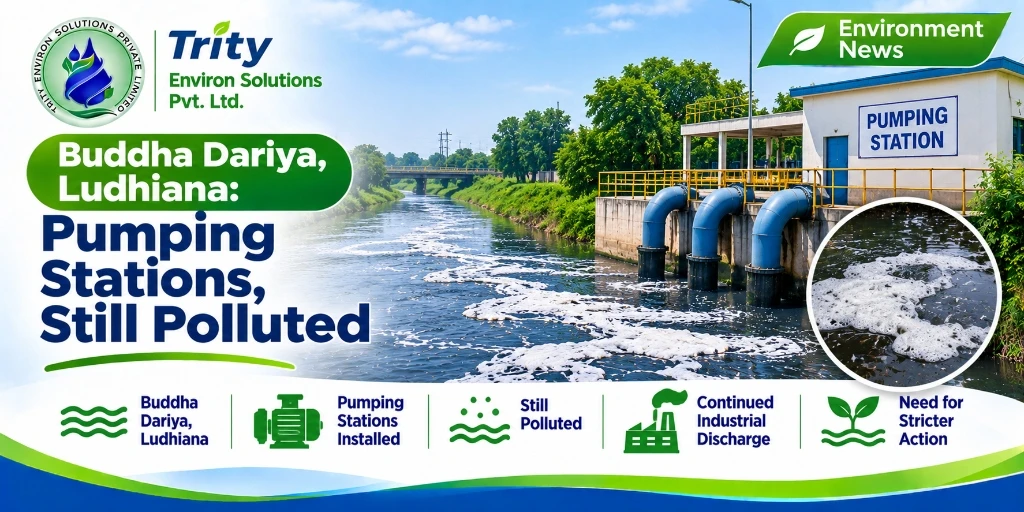
A citizens' panel that inspected Ludhiana's Buddha Dariya catchment on Sunday found black wastewater, foul smell, scattered garbage and choked drains even though several intermediate pumping stations (IPS) are operating.
The Public Action Committee (PAC) has questioned whether pumping stations alone are curbing the pollution, and wants a technical probe into where the wastewater is going.
Who Inspected and What They Saw
The details below come from The Tribune's Ludhiana edition of November 16. The report does not include responses from government or departmental officials.
The PAC team had five members: Mahinder Singh Sekhon, Dan Singh Osahan, advocate Yogesh Khanna, Gurpreet Singh Gopi and Col CM Lakhanpal. The committee is a citizens' group. It should not be confused with a legislative Public Accounts Committee.
Sites visited
- Transport Nagar
- Industrial Area A
- Malhar Road
- Gaughat, including pumping stations and adjoining drains
Findings at the pumping stations
- Transport Nagar IPS: non-functional. Flow in the open drain from the Sherpur side had declined significantly
- Shingar Cinema Road IPS: partially functional, with one pump running
- Gaughat pumping stations: both functioning
- No direct discharge into Buddha Dariya was seen at the inspected sites, yet black wastewater still moved through the drainage system
Conditions on the ground
- Foul smell, scattered waste and blocked drains at several points
- An AQI of 305, classed as "very poor", near Gaughat Gurdwara Sahib
The finding is about the sites the team visited on one day. It is not a measurement of the whole river or of water quality.
The Questions the PAC Raised
Where does the wastewater go?
The panel asked where the wastewater was being diverted. It sought a technical probe into whether the flow was going through concealed pipelines or into the sewerage network linked to the Bhattian sewage treatment plant (STP). That is a question and not a finding. The report does not say the water was found to be going anywhere in particular.
What is still hard to control?
- Industrial effluents and dairy waste remain major challenges, according to the panel
- Pumping stations alone have not curbed the pollution
What the PAC Wants
- Trace all discharge points through sewer networks, pumping stations, common effluent treatment plants (CETPs) and the 225-MLD sewage treatment plant
- Make public the recommendations of the 15-day action committee headed by Rajya Sabha MP Sant Balbir Singh Seechewal, along with an implementation schedule and departmental responsibilities
- Conduct independent audits of treatment plants
- Take strict action against illegal discharges
- Remove accumulated waste
- Stop the release of untreated wastewater into Buddha Dariya
The PAC said restoration needs measurable outcomes and accountability, not "a cycle of meetings and announcements".
What Is Not Known
- Official response. None is reported
- Why Transport Nagar IPS is not working. The cause is not stated
- Water quality results. The report gives no lab data
- The capacity gap. The report gives the 225-MLD figure for the STP but no flow data for the pumping stations
- The status of the Seechewal committee's recommendations. The panel says they should be made public, which suggests they have not been
Why Pumping Stations Alone Do Not Clean a Drain
This section is general background and not a finding about Ludhiana.
An intermediate pumping station lifts sewage or drain flow and sends it onward, usually to a treatment plant. It is a transfer step. It does not treat anything. If the pumps fail, the flow backs up or overflows. If the downstream treatment plant is overloaded or the sewer is blocked, the flow still ends up in the wrong place.
What a working system needs
- Interception: all drains and outfalls routed to a pumping station or sewer
- Reliable pumps: standby units and backup power so that the stations keep running
- Adequate treatment: capacity sized for peak flow, with a sewage treatment plant that actually removes organic load
- Industrial control: units that discharge effluent must treat it before it enters a sewer or drain
- Maintenance: regular desilting and a clear operation and maintenance plan for pumps, screens and sewers
Industrial and Dairy Effluent
The panel named industrial and dairy waste as continuing challenges. In a city with many small units, the usual solution is a mix of on-site and shared treatment.
- Industrial units should have an effluent treatment plant designed for their process and should not send untreated effluent to drains
- Clusters of small units can use a shared plant, but it must be maintained and monitored
- Dairy waste has a high organic load, so it needs treatment and proper handling of solids
- Where fresh water is scarce or discharge is not allowed, zero liquid discharge can recover water for reuse
These are general measures and not directions from any authority.
What Residents Can Do
- Report illegal discharges and garbage dumping to the municipal corporation and the Punjab Pollution Control Board
- Avoid dumping waste in drains
- Ask for public data on treatment plant performance and pumping station status
Reading the Report Fairly
- The Tribune does not report any response from the Ludhiana Municipal Corporation, the Punjab Pollution Control Board or the water supply and sewerage department. Their view would complete the picture
- The panel saw no direct discharge into Buddha Dariya at the sites visited. That is a finding in the units' favour that should not be lost in the rest of the report
- Black wastewater in a drain does not by itself tell us whether it is untreated sewage, industrial effluent or a mix. Testing would show that
- A pumping station that is non-functional at one point may be repaired within days, and the report is a snapshot of Sunday
A fair reading is that the panel's visit raised specific questions that the authorities can answer with data.
What to Watch Next
- Any official response to the PAC's findings
- Repairs at Transport Nagar IPS and Shingar Cinema Road IPS
- Publication of the 15-day committee's recommendations
- Any technical probe into the flow paths
- Independent audits of the Bhattian STP and CETPs
The Central Pollution Control Board publishes river water quality information.
A pumping station that runs shows that something is being moved. Only measurements at the end of the line show whether the river is cleaner.