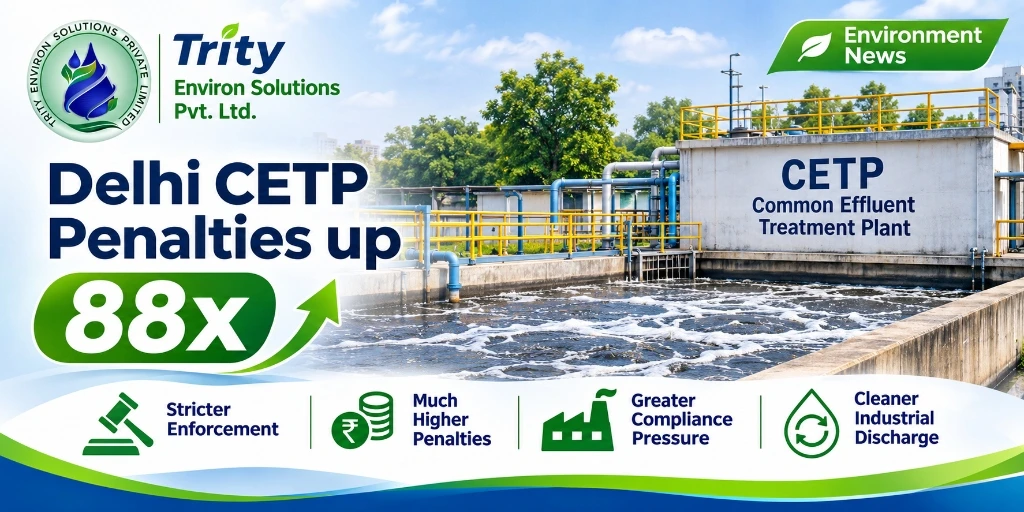
Environmental compensation imposed on Delhi's Common Effluent Treatment Plants (CETPs) rose from Rs 5 lakh in 2024-25 to about Rs 4.43 crore in 2025-26, according to replies from the Delhi Pollution Control Committee (DPCC) under the Right to Information Act.
Separate orders imposed Rs 22.95 crore on the Delhi Jal Board (DJB) and sewage treatment plants. Activists say the numbers show tougher paperwork, not yet a cleaner river.
The Numbers
The figures below come from a PTI report dated November 14, hosted by ThePrint, which cites three RTI responses obtained by activist Amit Gupta. The report puts the CETP figure at Rs 4.42 crore. Other reports round it to Rs 4.43 crore.
CETP penalties
- 2024-25: Rs 5 lakh
- 2025-26: about Rs 4.42 to 4.43 crore
- Three-year total (FY 2023-24 to 2025-26): Rs 5.32 crore
- Increase: about 88 times (our arithmetic: Rs 4.43 crore divided by Rs 5 lakh)
A CETP is a shared treatment plant that serves a cluster of small industrial units. The amounts are penalties imposed. They are not necessarily amounts collected.
Penalties on DJB and sewage treatment plants
For February 2025 to May 2026, the report lists Rs 22.95 crore across 17 orders.
- Rs 18.54 crore on DJB in February 2025, for failing to provide a sewerage network
- Rs 2.89 crore on 15 sewage treatment plants (STPs) in April 2026
- Rs 1.50 crore on DJB in May 2026
The three items add up to Rs 22.93 crore (our arithmetic), close to the reported Rs 22.95 crore. Combined with the CETP total, penalties across CETPs, STPs and DJB come to about Rs 28.27 crore.
What the Records Do Not Show
The same RTI replies expose gaps in record-keeping.
- DPCC's Water Management Cell-II said it had no compiled records of notices, closure directions or environmental compensation against polluters in the Najafgarh drain for the past 24 months
- Requests on flow data were referred to other agencies, including the irrigation and flood control department and DJB
- DPCC's accounts branch said no funds were specifically allocated to it for Yamuna cleaning in 2023-24, 2024-25 or 2025-26
Gupta said the replies show a lack of centralised data and departments passing responsibility to one another. "Unless we fix accountability, nothing will change," he is quoted as saying, and "Merely imposing fines on paper will not revive the Yamuna."
Those are his views and not findings by a regulator.
Imposed Versus Recovered
A separate report, summarised by Indian Opinion on November 13, draws on a second RTI by environmentalist Kamal Anand and on coverage in The Times of India and Hindustan Times. It claims a much larger gap between imposition and recovery.
- Rs 25.5 crore imposed on 13 CETPs, with no recovery recorded
- Rs 23.2 crore levied on 18 STPs from November 2011 to May 2026, with only Rs 3 lakh recovered
- A headline total of Rs 49.7 crore, though the two components add up to Rs 48.7 crore
The summary does not explain the Rs 1 crore difference, and it is not itself the original reporting. We could not read the original Times of India or Hindustan Times articles. These figures should therefore be treated as reported and not independently confirmed.
Why CETPs Are Penalised
This section is general background and not specific to Delhi's orders.
A CETP receives effluent from many small units, treats it together and discharges it within prescribed standards. Regulators can levy environmental compensation when a plant discharges beyond limits, is not operating properly or fails to meet conditions. The "polluter pays" principle underlies this.
Common reasons a CETP fails
- Inlet effluent that exceeds the design load or has unexpected chemistry, such as high dissolved solids, colour or metals
- Member units that discharge without pre-treatment
- Equipment that is poorly maintained, such as aerators, pumps or sludge handling
- Insufficient trained operators or monitoring
- Sludge that is not disposed of properly
The report on the Delhi penalties does not give the reason for each order, so none of these should be assumed for any specific plant.
What the Wider Data Says
The same PTI report gives context on sewage in the capital.
- Delhi generates about 800 MGD of sewage daily and treats 742.32 MGD, leaving a gap of 57.68 MGD, according to a DPCC progress report
- Of the city's STPs, 25 comply with DPCC standards and 10 do not
- DPCC and the Central Pollution Control Board have monitored Najafgarh, Shahdara and other drains monthly at 52 locations since May 2025
Compensation is one tool in this system. Reliable treatment capacity and discharge control matter more over time.
What CETP Operators and Member Units Should Do
These are general good-practice steps and are not directions from DPCC.
Fix the inputs
- Set and enforce inlet quality limits for member units
- Require pre-treatment at the source for streams with high load or toxic content
- Keep a log of each unit's discharge and test it regularly
Keep the plant performing
- Treat plant performance as a compliance obligation. A planned operation and maintenance programme covers aerators, pumps, clarifiers and sludge handling
- Match the design of the effluent treatment plant to the actual effluent, not to an older profile
- Where regulators require it or where reuse is a goal, consider zero liquid discharge for difficult streams
Measure and document
- Install online monitoring where required and keep it calibrated
- Keep records of flow, quality, sludge and maintenance ready for inspection
- Review each notice quickly, since penalties often follow repeated lapses
Why the Penalty Jump May Matter
The rise from Rs 5 lakh to Rs 4.43 crore suggests that enforcement picked up sharply in 2025-26. The reports do not explain why. It could reflect more inspections, larger violations, a change in methodology or a few large orders. Without unit-wise detail, the trend cannot be explained from the figures alone.
What to Watch Next
- Whether DPCC publishes order-wise details, including plant names and reasons
- How much of the imposed amount is recovered
- Whether compensation funds are spent on treatment capacity or river restoration
- The outcome of the National Green Tribunal proceedings that the DPCC report was prepared for
Official updates on pollution control are published by the Central Pollution Control Board, and the National Green Tribunal publishes its orders.
Penalties can signal that a problem exists. Only working treatment plants can solve it.