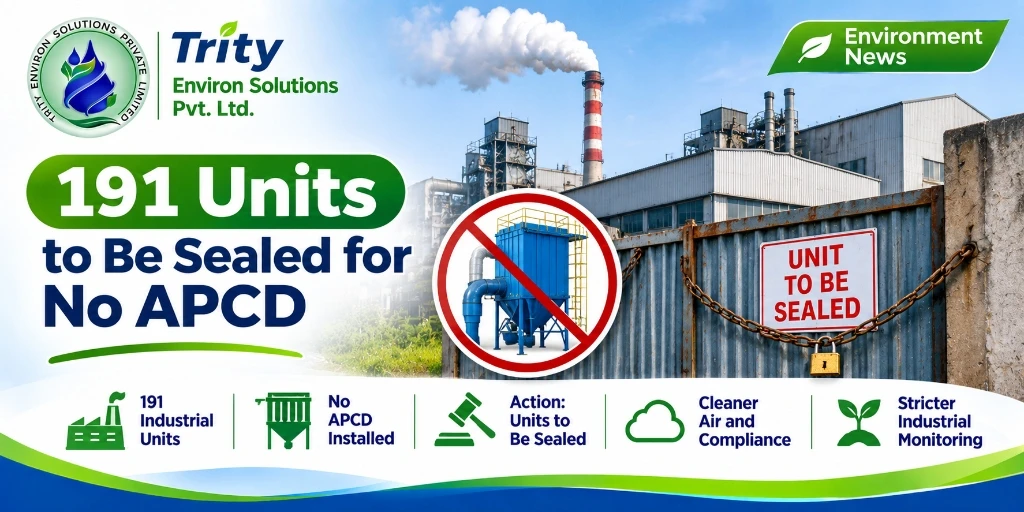
Union Environment Minister Bhupender Yadav has directed the Central Pollution Control Board (CPCB) to immediately seal 191 industries in Delhi-NCR that had not ordered Air Pollution Control Devices (APCDs) despite repeated directions.
He gave the instruction at a review meeting on winter pollution on Saturday, November 14, and warned of action against officials and agencies that miss deadlines.
The Decision
The details below come from a Tribune report on the meeting. The Press Information Bureau release listed in your source note was not available to us, so the report has been read as the secondary account.
- The meeting was chaired by Union Environment Minister Bhupender Yadav
- Delhi, Haryana, Uttar Pradesh and Rajasthan were directed to strengthen enforcement
- CPCB was told to seal 191 identified polluting industries immediately
- These units have not ordered APCDs despite repeated directions, the report says
- The report does not name the units, their sectors or their locations
Your own source note describes them as units that did not even issue an installation work order. The Tribune report words it as not having ordered the devices.
Where Industrial Monitoring Stands
The report gives these figures for industrial monitoring.
- Of 2,345 targeted NCR industries, 2,298 (98%) are connected to Online Continuous Emission Monitoring Systems (OCEMS)
- Non-compliant units face closure, electricity disconnection or sealing
- The particulate matter emission limit is 50 mg per normal cubic metre
By our arithmetic, 2,298 of 2,345 is 98.0%, and about 47 targeted units are not yet connected.
How this compares with earlier figures
Earlier reports used slightly different counts. Down To Earth reported on September 28 that Delhi's winter plan targeted 2,354 industries and that 2,197 had installed OCEMS. Those figures were for Delhi alone, with a different date and base, so they should not be set against the NCR-wide numbers above. On October 30, CPCB had separately directed boards in Delhi-NCR to issue closure notices to units with no APCD orders, as covered in our earlier article.
Beyond Industry: The Wider Package
The meeting covered more than industrial units. The items below are reported for context.
Vehicles and transport
- The Commission for Air Quality Management (CAQM) will pursue criminal prosecution against Transport Department officials in states that fail to install Automatic Number Plate Recognition cameras by November 30
- ANPR monitoring at fuel stations is to be linked to the VAHAN and pollution-under-control databases
- The PARIVARTAN scheme aims to replace pre-BS-VI trucks and buses with BS-VI, CNG or electric vehicles by 2028
- The Municipal Corporation of Delhi must complete Multi-Lane Free Flow systems at 154 Delhi border entry points by December 31
Accountability and oversight
- States must name Secretary-level officers for 15 cities: seven in Haryana, four in Uttar Pradesh and four in Rajasthan
- These officers will oversee field inspections and send weekly progress reports to CAQM
- CAQM will issue notices to officers who do not perform
- Yadav noted more than 30 review meetings with NCR governments and municipal bodies over the past year
Road dust, traffic and waste
- Only 3,221 km of the targeted 5,480 km of roads have been redeveloped
- Traffic congestion at 233 points across the NCR needs immediate attention
- States must close a 6,747-tonne-per-day gap in municipal solid waste processing and clear legacy waste at Okhla, Ghazipur, Bhalswa and Bandhwari
The meeting also stressed strict implementation of the Graded Response Action Plan (GRAP) and hotspot action plans for markets, schools, hospitals, railway stations and bus terminals.
What Is Not Clear
- Which units are on the list of 191. Not named
- The time frame for sealing. The word used is "immediately", with no date
- Whether the 191 are in one state or spread across the NCR. Not stated
- What follows sealing. Whether units can reopen on installing devices is not described in the report
These are points to look for in any official notice.
What an APCD Does and Why It Matters
This section is general background and not part of the meeting report.
An air pollution control device captures or reduces pollutants before they leave a chimney. The type depends on the process.
- Bag filters and electrostatic precipitators capture particulate matter
- Scrubbers remove gases such as sulphur dioxide and acid fumes
- Cyclones remove coarse dust
- Dust extraction and hoods capture fumes at the source, for example at furnaces
An order for a device is the first step. Installation, commissioning and stable operation follow, and a device that is installed but poorly maintained does little. Regulators have therefore moved from asking for devices to asking for proof of performance through online monitoring.
What Industrial Units Should Do Now
These are general steps and not directions from the Centre.
If you have no device
- Identify the right control technology for your process and fuel
- Place the order and keep a dated work order and delivery records, since regulators are checking for exactly this
- Seek technical advice on sizing and installation before the order, not after
If you have a device
- Keep it running and maintained. A structured operation and maintenance schedule covers filters, fans, dampers and hoppers
- Check that the OCEMS is connected, calibrated and transmitting
- Use calibrated SOx NOx gas analysers for periodic stack checks that confirm the online data
- Keep fuel, consent and monitoring records ready for inspection
Prepare for inspection
- Weekly reporting by city officers means inspections are likely to be more frequent
- Arrange for camera or monitoring requirements that apply to your category
- Respond quickly to any notice, as the report says non-compliance can lead to closure or disconnection
Why This Matters Now
Delhi-NCR air quality worsened after Diwali, with Stage III of GRAP in force, and the reported AQI at IGI Airport was 351 at the time of the report. Industry is one source among several, but it is one where regulators can order devices and demand data. The 191-unit order targets the clearest case: a unit that has not taken the first step.
What to Watch Next
- CPCB's notice or list naming the units
- The November 30 ANPR deadline and the December 31 border-system deadline
- The first weekly reports from the 15 city officers
- Progress on the remaining OCEMS connections
Official updates are published by CAQM and the CPCB APCD portal. Enforcement has a better chance of working when the rules are clear and the data is public.