Introduction: Two Numbers That Hide Everything Else
Search for a commercial RO plant in India and two sizes dominate: 500 LPH and 1000 LPH, litres of permeate per hour. Dozens of pages list them with prices, and the numbers look simple. A 500 LPH plant makes five hundred litres of purified water an hour, a 1000 LPH makes a thousand. Buy the one that fits.
But a litre-per-hour figure on its own tells you very little. It does not say what feed water quality the rating assumes, what temperature, what recovery, which membranes or how many hours a day the plant can run. Two plants with the same label can be built very differently: one with proper pre-treatment, four or six good membranes and a sturdy pump, and another with minimal filters and the cheapest components. They look alike on the quotation and behave very differently over two years.
This guide explains what actually sits inside a 500 LPH and a 1000 LPH RO plant, how feed flow, recovery and reject follow from the rating, what power and pre-treatment to expect, who each size suits and what to check on a specification sheet. We have kept price out of it deliberately, because quoted prices for these sizes vary widely and change often, and have pointed to our separate guide on RO plant cost for that. It is written for hotel and hospital engineers, factory utility managers, school and office administrators and anyone buying a commercial RO plant. Trity Enviro designs and supplies commercial and industrial RO plants, and the guide reflects that work.
What a 500 and a 1000 LPH Rating Really Means
Conditions Behind the Rating
RO output depends on feed water TDS, temperature, pressure and the condition of the membranes. Manufacturers rate membranes at standard conditions, commonly a test feed of 2,000 mg/L sodium chloride at 25 °C. Real water with higher TDS, colder temperature or fouling gives less. A plant rated 500 LPH at standard conditions might deliver 400 LPH or less on cold, high TDS water in winter. Always ask for the output at your own feed TDS and the lowest temperature you expect.
Feed Flow, Recovery and Reject
Recovery is the share of feed water that becomes permeate. Small commercial plants typically run at about 50 to 70 percent, set by scaling risk. Feed flow equals permeate divided by recovery, and the rest is reject.
- 500 LPH at 60 percent recovery: feed about 830 LPH, reject about 330 LPH
- 1000 LPH at 60 percent recovery: feed about 1,670 LPH, reject about 670 LPH
That means a 1000 LPH plant sends roughly 670 litres an hour to drain unless you reuse it. Over a ten hour day that is about 6,700 litres. Plan a use for reject, such as flushing, gardening, floor cleaning or cooling make-up, or an effluent route.
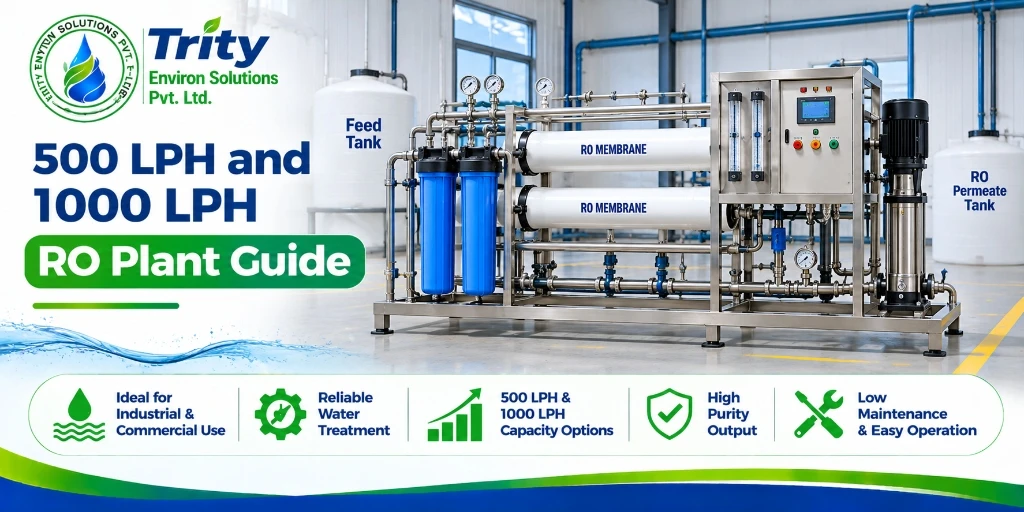
What Is Inside Each Plant
Membranes, Pump and Pressure Vessels
Most commercial plants of these sizes use spiral wound thin-film composite membranes of the 4040 size, about 4 inches by 40 inches. One 4040 element has a membrane area of roughly 7 to 8 m2, and at a typical design flux of 20 to 25 litres per m2 per hour it gives about 150 to 200 litres of permeate an hour.
- 500 LPH: commonly three to four 4040 membranes, in one or two pressure vessels
- 1000 LPH: commonly six to eight 4040 membranes in two or more vessels, or a smaller number of 8-inch elements, which are about 37 m2 each and can give several hundred litres an hour per element
These are typical arrangements, not fixed rules. Some suppliers use fewer membranes at higher flux, which saves money upfront and shortens membrane life. A conservative design uses more membrane area. Ask for the number, make and model of membranes, and the flux the design implies.
The high pressure pump pushes feed water through the membranes at roughly 10 to 15 bar for brackish water. A simple estimate shows the scale. For the 1000 LPH plant, feed flow is about 1,670 LPH, or 0.00046 m3/s. At 12 bar, which is 1.2 × 10⁶ Pa, the hydraulic power is 0.00046 × 1,200,000 = about 0.56 kW. With pump and motor efficiency of about 50 percent for small multistage pumps, the shaft power needed is about 1.1 kW, so a 1.5 to 2.2 kW motor is typical. The 500 LPH plant needs about half of that, so around a 1.1 kW motor. Small plants are less efficient, which is why their power use per cubic metre, often a few kWh, is higher than that of large industrial RO plants. Our guide to industrial RO vs commercial RO explains the differences.
Pressure vessels are FRP or stainless steel. Piping is UPVC, CPVC or stainless steel, and high pressure sections should be stainless steel or suitable high pressure plastic.
Pre-Treatment and Instrumentation
Pre-treatment protects the membranes, and it is where cheap plants cut corners. A well specified plant includes:
If feed water has iron, high turbidity or bacteria, add iron removal or ultrafiltration. Instrumentation should include feed and permeate pressure gauges, a flow meter on permeate and reject, a TDS or conductivity meter and low pressure protection. Larger and better plants add auto flush, pH and chlorine monitoring and a PLC.
Who Each Size Suits
Daily Output and Storage
Daily output depends on how many hours the plant runs. A 500 LPH plant running 10 hours gives about 5,000 litres a day, and a 1000 LPH plant running 10 hours gives about 10,000 litres, or about 20,000 litres in 20 hours. Do not run RO plants continuously without breaks and with no storage; a storage tank lets the plant run steadily while serving peak demand.
As a rough guide, a 500 LPH plant suits a small hotel or guest house, a clinic or small hospital for drinking and cooking, a school, a mid-size office or a small food unit. A 1000 LPH plant suits a larger hotel, a hospital, a bottling or packaged water start-up, a hostel or a factory's drinking and process needs. Drinking and cooking use per person is only a few litres a day, so these sizes serve many people, but laundry, boiler feed or process use change the arithmetic.
A Worked Sizing Example
A 60 room hotel uses RO water for drinking, cooking and kitchen washing, about 6,000 litres a day, with a morning peak. Choose a plant that works about 10 to 12 hours a day with storage, so the required average is 6,000 ÷ 12 = 500 LPH. A 500 LPH plant with a storage tank of about 2,000 litres covers it. If the hotel adds a restaurant and laundry in future, a 1000 LPH plant would give headroom, but an oversized plant that stops and starts often wears out sooner, so it is better to size close to need and plan for a second skid if growth is likely. Our guide to choosing a commercial RO plant for hotels, hospitals and industries covers sizing in more depth.
Buying, Running Costs and Checks
What to Check on the Specification Sheet
Compare quotations line by line:
- Rated permeate at your feed TDS and temperature, not only at standard conditions
- Recovery assumed and the resulting reject flow
- Membrane make, model and number, and the flux implied
- Pump make, power and material
- Pressure vessel and piping materials
- Pre-treatment included: filters, softener or antiscalant, cartridge
- Instrumentation and protection: meters, alarms, auto flush
- Storage tanks, transfer pumps and piping included or excluded
- Expected permeate TDS and the rejection percentage
- Warranty, spares and AMC terms
Running costs come from power, antiscalant and cleaning chemicals, cartridge filters, media, membrane replacement and service. Small plants have higher cost per cubic metre than large ones. For rupee figures and a worked cost model, read our guide to industrial RO plant cost in India, and use your own power and consumables rates.
Questions to Ask Before You Order
- Which feed water data did you design from, and what output do you guarantee at my TDS and temperature?
- How many membranes, of which make, and at what flux?
- What recovery do you set, and how is reject handled?
- What pre-treatment is included, and what protects the membranes from chlorine and scaling?
- What are the power, chemical and consumable costs per cubic metre?
- What is the warranty, and what does your AMC cover?
- How fast can your engineer reach my site?
Trity Enviro's commercial RO plant and industrial RO plant ranges include 500 and 1000 LPH skids and larger systems, and an annual maintenance contract covers cleaning, filters and checks.
Installation and Site Requirements
Plan the room before the plant arrives. A 500 or 1000 LPH skid needs a level floor, a power point of the rated load with proper earthing, a raw water tank and a feed pump so that the plant gets steady pressure, a floor drain for reject and flushing water, ventilation and clear access to change cartridges and open vessels. Keep the plant out of direct sun and away from chemicals. Provide a treated water tank with a cover and a drain, and mark pipes clearly. Trity Enviro engineers visit the site during installation to check these points, which prevents most early failures.
Industry Comparison / Operational Parameter Table
| Parameter / Stage |
Target Optimal Range |
Failure Impact / Risk |
Corrective Engineering Action |
| Output at site conditions |
Rated permeate stated at your feed TDS and lowest temperature |
Short output in winter or on high TDS water |
Ask for site-condition output, add membrane area |
| Recovery |
Commonly 50 to 70 percent for small plants, set by hardness and silica |
Scaling if too high, water waste if too low |
Add softener or antiscalant, adjust reject valve |
| Membrane flux |
Typically 20 to 25 L/m2/h for brackish water |
Fast fouling and short life if too high |
Use more membranes, improve pre-treatment |
| Residual chlorine at membranes |
Below about 0.1 mg/L |
Irreversible membrane damage |
Maintain carbon filter, test regularly |
Why Choose Trity Enviro
Trity Environ Solutions is an ISO 9001:2015 certified and QCI-approved commercial RO plant manufacturer and supplier in India, delivering robust, high-efficiency systems engineered for CPCB and SPCB regulatory compliance.
Every installation is supported by pan-India Annual Maintenance Contract and Operation and Maintenance services.