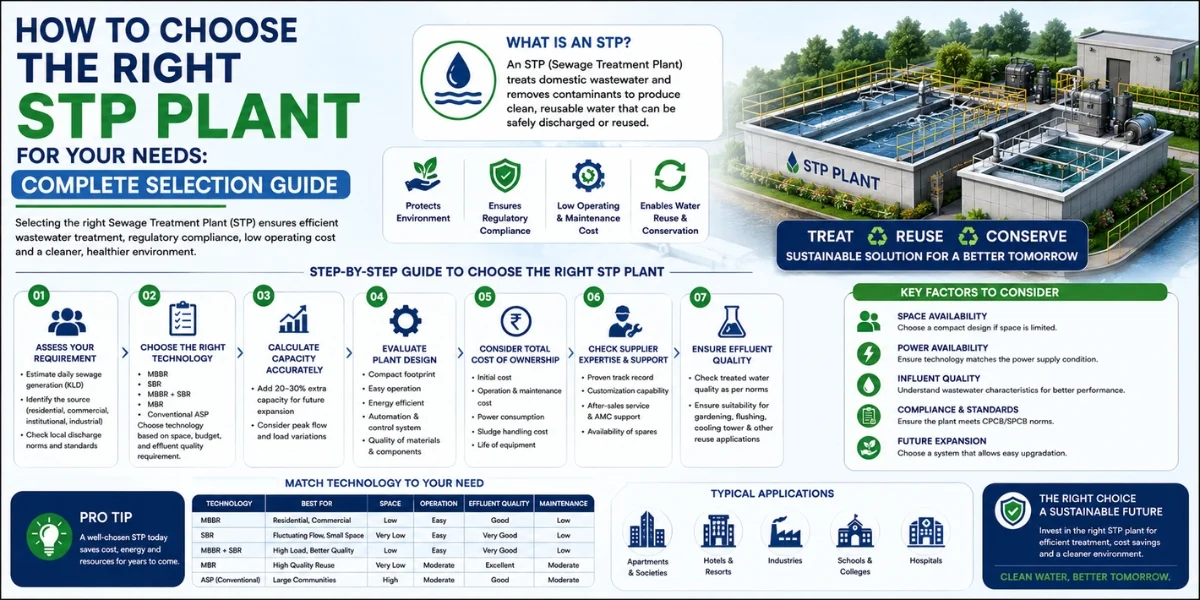
How to Choose the Right STP Plant for Your Needs: Complete Selection Guide
Compare STP plant types, capacity sizing, technology options, and cost factors to choose the right sewage treatment plant for your property.

 ISO 9001:2015 & QCI Approved
The label on the plant matters less than the job it has to do. Here is how to tell whether your site needs a commercial RO, an industrial RO or something in between.
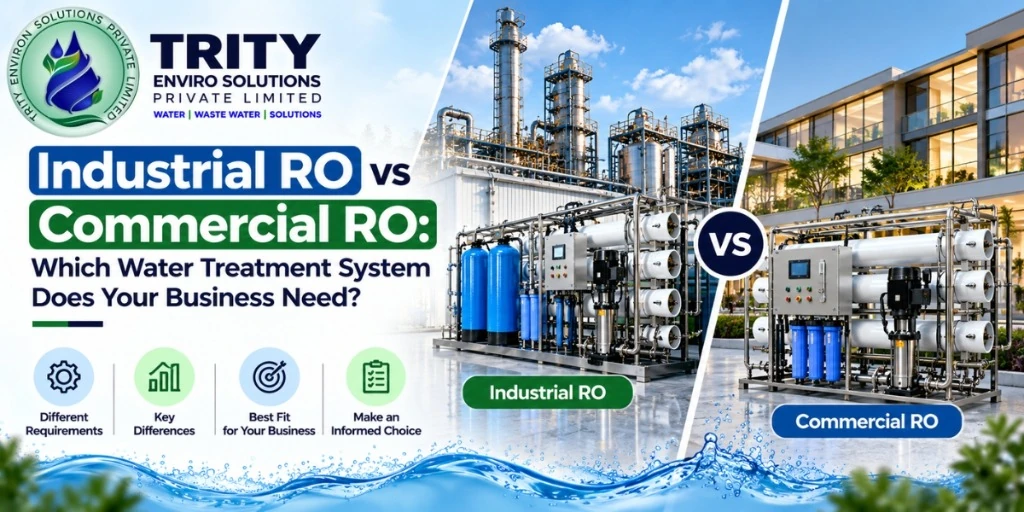
Many buyers treat "commercial RO" and "industrial RO" as marketing labels for the same machine in different sizes. It is a fair assumption, because both push water through semi-permeable membranes and both reject most dissolved salts. In practice, the two are designed for different duty, and choosing the wrong one costs money in both directions.
Buy a commercial plant for a factory that needs water around the clock, and you will replace pumps and membranes early. Buy an industrial plant for a 40 room hotel, and you will pay for instrumentation, materials and capacity you will never use. The decision is not about prestige. It is about how many hours the plant runs, how bad your feed water is, how pure the product must be and how much downtime you can tolerate.
This guide compares industrial RO vs commercial RO on the points that actually change the buying decision: capacity, construction, feed water, duty cycle, purity, control, cost of ownership and service. It is written for plant heads, facility managers and procurement teams who need to choose, justify and run the right plant.
Both plants share a principle, but they differ in how they are built and what they are expected to survive.
Commercial RO plants usually serve a few hundred to a few thousand litres per hour. They use 4 inch membranes in many designs, FRP or stainless steel vessels, a multistage centrifugal pump, a compact skid and a basic control panel with a few gauges and a TDS meter. They are meant to run for several hours a day, with breaks, and to be maintained by a small facility team.
Industrial RO plants generally start from around one thousand litres per hour and scale to tens of thousands or more. They commonly use 8 inch membranes in larger arrays, such as two stage or multistage layouts, heavy duty high pressure pumps, stainless steel or heavy FRP vessels, instrumentation for flow, pressure and conductivity at each stage, and a PLC with alarms and data logging. They are designed for continuous, 24 hour duty with planned shutdowns.
The capacity bands overlap, and some suppliers use the terms loosely. Do not rely on the name. Ask what duty cycle the plant is designed for and what materials the wetted parts use.
In a larger plant, membranes are arranged in stages so that reject from the first stage feeds the second. This raises overall recovery, often to 70 to 80 percent or more on suitable water, without running each membrane too hard. Small commercial skids use a single stage in many cases and operate at lower recovery, which wastes more water but keeps the design simple.
Feed water quality often separates the two more clearly than capacity. Commercial plants typically treat municipal or moderately brackish borewell water with TDS up to a couple of thousand mg/L. Industrial plants may deal with higher TDS brackish water, variable quality, silica and hardness that need careful scale control, and in some cases seawater, which requires high pressure seawater membranes and a different design.
Product quality matters too. A commercial plant aims for pleasant, safe drinking and cooking water. An industrial plant may need low conductivity for boiler feed, process or pharma related use, which can mean two pass RO or polishing with ion exchange or electrodeionisation afterward. When purity needs are very high, compare it with demineralisation in our guide on DM plant vs RO plant.
Instead of asking which type is better, ask which one matches your use pattern.
A commercial plant fits when demand is moderate and the plant is not critical to production. Typical buyers are:
If your water source is reasonably steady, your TDS is moderate and a day without the plant is an inconvenience rather than a crisis, a well built commercial RO plant with good pre-treatment is the right buy.
An industrial plant fits when the plant is part of production or compliance. Typical cases are boiler feed for steam systems, process water in pharma, beverage, food, textile and chemical units, cooling tower make-up where salts must be controlled, and reuse systems where treated effluent is polished for process use. If water stoppage halts production, you want the heavier pumps, better instrumentation and spare capacity of an industrial RO plant.
Industrial duty also makes sense when your feed water is challenging: high hardness, high silica, iron, organics or fluctuating TDS. These conditions need strong pre-treatment such as clarification, multi grade filters, activated carbon filters, softening and often ultrafiltration. A commercial skid with minimal pre-treatment will struggle.
The purchase order is only the first line of the cost story.
Industrial plants cost more per unit of capacity at the low end, because of heavier materials and instrumentation, but they often cost less per cubic metre of water treated at the high end, since larger pumps and staged arrays are more efficient. Energy for brackish water RO often falls in the range of roughly 0.5 to 2 kWh per cubic metre depending on salinity and pressure, so pump efficiency and recovery matter a great deal on a plant that runs all day.
Other running costs are antiscalant and cleaning chemicals, cartridge filters, membrane replacement and labour. A commercial plant running a few hours a day will see low consumables. An industrial plant running 24 hours will see higher, but they are spread over far more water.
Think also about reject water. At industrial scale, reject can be large and salty. If you cannot reuse it or discharge it freely, you may need evaporation or a zero liquid discharge system. Budget for this early, since it can change the economics of the project.
A PLC based industrial plant can start, stop, flush and alarm automatically, and it logs the data you need for audits. A commercial plant may rely on the operator to check readings by hand. Neither is wrong, but the second needs a trained person on site. Check how quickly the supplier can send an engineer, which spares they stock locally and whether membranes and pumps are standard sizes you can source from more than one vendor.
A planned operation and maintenance arrangement or annual maintenance contract is worth considering for both types, because many RO failures come from neglect rather than design.
When you strip away the labels, you are choosing a duty level.
Answer these questions honestly:
If the answers are moderate, steady and low risk, choose commercial. If any answer points to continuous operation, tough feed water, tight purity or high downtime cost, choose industrial or at least an industrial grade design in a smaller size. Our guide to how to choose a commercial RO plant for hotels, hospitals and industries goes deeper into sizing for the commercial side.
Sometimes the right answer sits between the two. A large hotel or hospital may need a commercial plant with industrial grade pumps and a PLC. A food unit may need a commercial sized plant with industrial pre-treatment. Where purity or capacity needs may grow, ask for a design that leaves room for a second skid. And if the goal is reuse of treated wastewater, look at a water recycling RO plant designed for variable feed.
Plan the room before you order. A commercial skid fits in a small utility space, but it still needs a levelled floor, a three phase or single phase supply as specified, a floor drain for reject and flushing water, ventilation and clear access to the panel. Industrial plants need more: a plant room with foundations for pumps, a cleaning in place tank, chemical storage for antiscalant and cleaning agents, larger drains and reject piping, and free length at the end of each pressure vessel so that 8 inch membranes can be pulled out for replacement. Add the power load of the high pressure pump to your electrical plan and confirm that your transformer and cabling can carry it, especially if the plant starts and stops frequently.
| Parameter / Stage | Target Optimal Range | Failure Impact / Risk | Corrective Engineering Action |
|---|---|---|---|
| Duty cycle | Commercial: part-day operation with storage. Industrial: continuous 24 hour duty | Early wear of pump, motor and membranes if duty exceeds design | Match pump, vessel and instrument grade to run hours |
| Feed TDS handled | Commercial: up to about 2,000 mg/L typical. Industrial: higher brackish water with staged design | Low recovery, scaling, high energy use | Choose staged array, scale control and suitable membrane type |
| Recovery | Single stage: lower. Multistage: commonly 70 to 80 percent on suitable water | Water waste or scaling if wrongly set | Calculate from hardness and silica, add antiscalant |
| Monitoring and control | Commercial: basic gauges and TDS meter. Industrial: PLC with stage-wise instruments | Faults go unnoticed, no audit data | Add online conductivity, flow and pressure with alarms |
Trity Environ Solutions is an ISO 9001:2015 certified and QCI-approved commercial and industrial RO plant manufacturer and supplier in India, delivering robust, high-efficiency systems engineered for CPCB and SPCB regulatory compliance.
Every installation is supported by pan-India Annual Maintenance Contract and Operation and Maintenance services.
Speak directly with our environmental engineering specialists for system sizing, CPCB/SPCB compliance review, or a tailored technical proposal.
Request Free Engineering ConsultationCall: +91-9821030072 | Email: enquiry@trityenviro.com
Compare STP plant types, capacity sizing, technology options, and cost factors to choose the right sewage treatment plant for your property.
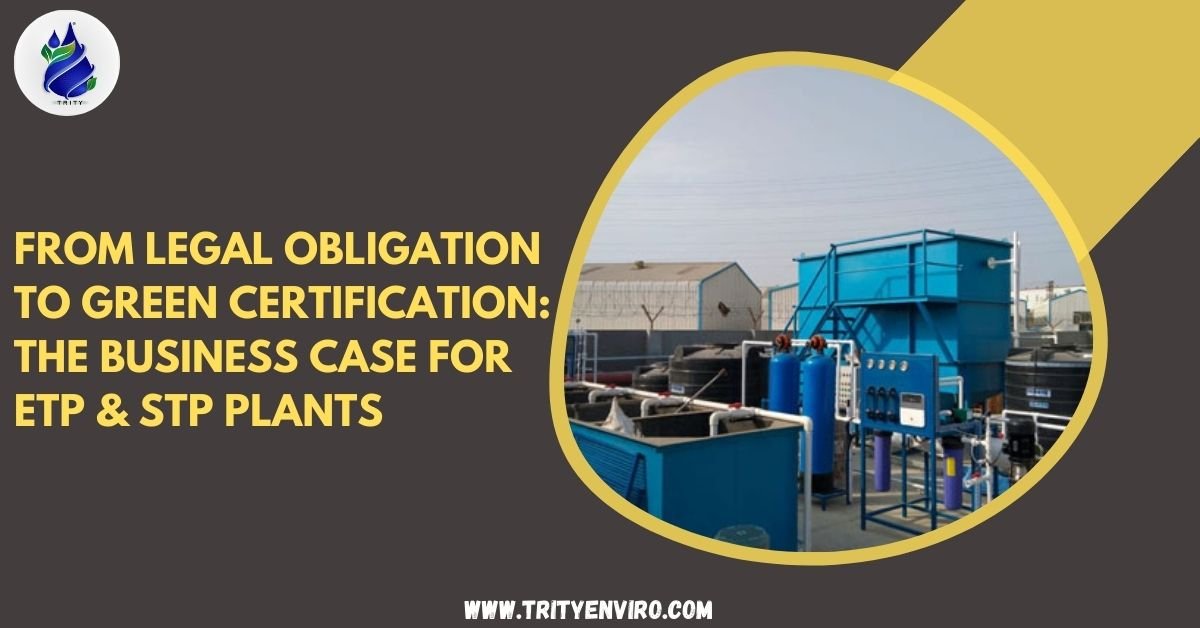
Discover how ETP & STP plants help businesses meet legal obligations, gain green certifications, reduce costs, and enhance brand value through sustainable wastewater treatment.
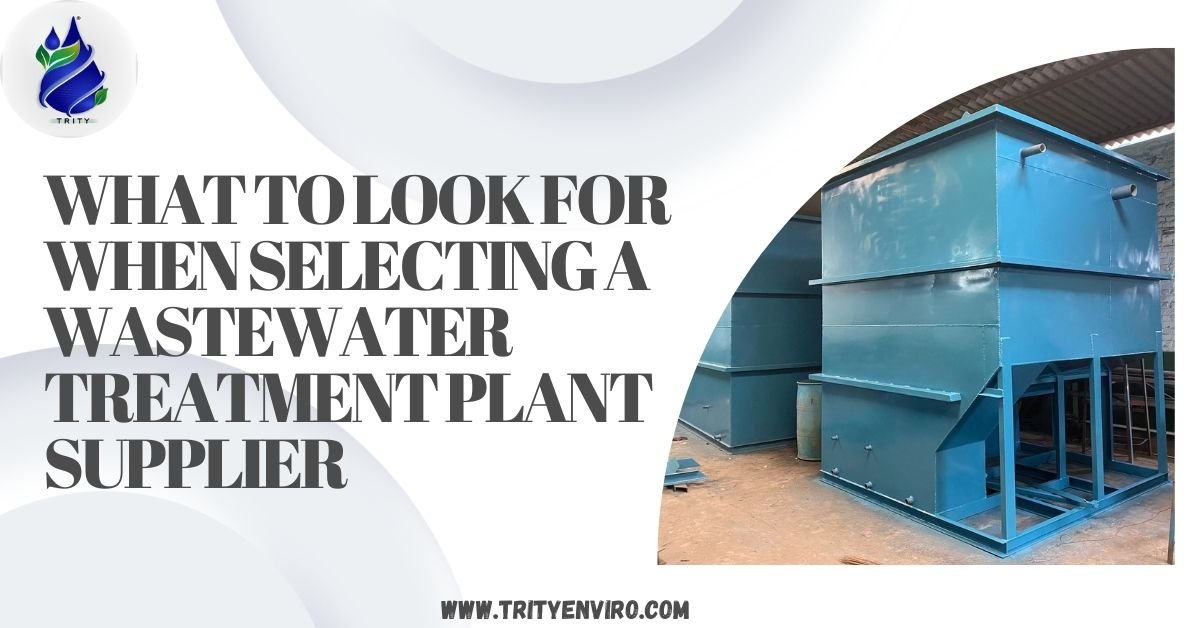
Learn what to consider when selecting a wastewater treatment plant supplier, including experience, certifications, technology, cost, and after-sales support.



Discuss your requirements with our engineering team and get practical guidance for your project.