ISO 9001:2015 & QCI Approved
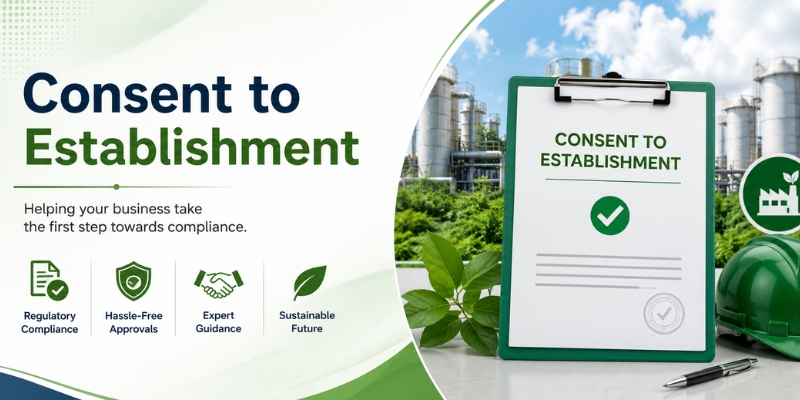
Consent to Establishment
Get expert help with Consent to Establish (CTE) under the Water Act and Air Act. Trity Environ Solutions handles SPCB documentation, ETP/STP design compliance, and 2026 guideline updates for industries across India.
Why Consent to Establish Is the First Compliance Step, Not an Afterthought
Every industrial, infrastructure, or commercial project in India that is likely to discharge trade effluent, emit air pollutants, or handle hazardous substances needs a Consent to Establish (CTE) before construction even begins. It is issued under Section 25 of the Water (Prevention and Control of Pollution) Act, 1974 and Section 21 of the Air (Prevention and Control of Pollution) Act, 1981 by the State Pollution Control Board (SPCB) of the state where the project is located. Trity Environ Solution is not just a name but a brand that industries across Uttar Pradesh, Delhi NCR, and beyond rely on when it's time to get this first approval right, because a rejected or delayed CTE application means a delayed foundation-laying, a delayed machinery order, and in many cases a delayed loan disbursement from the project's financing bank.
CTE is fundamentally a design-stage check. The SPCB does not look at what your unit is producing today, it looks at what your unit will produce once operational: how much wastewater, how much air emission, how close you are to a residential zone or a water body, and whether your planned pollution control infrastructure (your ETP, your STP, your air pollution control equipment) is actually adequate for the scale you've proposed. Getting this wrong at the CTE stage is expensive to fix later, because civil construction and equipment procurement usually follow the CTE approval, not precede it.
What Changed in January 2026
The Ministry of Environment, Forest and Climate Change (MoEFCC) amended the Uniform Consent Guidelines for both the Water Act and Air Act on January 23, 2026, with the amendments taking effect from January 27, 2026. Two changes matter directly to industries applying for CTE right now:
- Deemed CTE for Micro and Small Enterprises (MSEs): units located in government-notified industrial estates or industrial areas now receive deemed Consent to Establish immediately upon submission of a self-certified Form-I, provided the land use has already been pre-screened for that estate. This removes weeks of waiting time for smaller units in designated industrial parks.
- Consolidated single-step process: consent under the Air Act can now be combined with authorisations under the Hazardous and Other Waste Management Rules in a single application, instead of three separate filings.
- Registered Environment Auditors can now conduct site verification alongside SPCB officers, which is meant to speed up inspection backlogs that have historically slowed CTE processing in high-volume states.
For medium and large industries outside the deemed-consent category, the core process below still applies, just with the added option of the consolidated Air Act plus hazardous-waste filing.
Who Actually Needs a CTE
Any business planning a new industrial, infrastructure, or commercial project needs CTE if the activity falls into a regulated category under CPCB's Red, Orange, Green, or White classification. In practice, this covers manufacturing units of every scale, food and beverage processing plants, chemical and pharmaceutical units, hotels and hospitals above a certain bed or discharge threshold, textile and dyeing units, and any facility that will generate trade effluent or handle hazardous substances. Even units that consider themselves "low pollution" often fall under the Orange or Green category and still need consent, just with a lighter documentation burden than a Red category unit.
Step-by-Step CTE Application Process
- Register on the SPCB's online portal. Most states now run this through OCMMS-based systems; Uttar Pradesh industries file through UPPCB's online consent management portal, routed through the relevant regional office out of the Board's 28 regional offices across the state.
- Fill the application form and attach the project report, covering raw materials, manufacturing process, expected effluent and emission load, and the proposed pollution control system design.
- Submit proof of land ownership or lease, site layout plan, and (where applicable) NOC from the local development authority.
- Pay the consent fee, calculated based on capital investment and industry category, not a flat rate.
- Site verification, conducted by SPCB officers or, under the 2026 amendment, a Registered Environment Auditor.
- Grant of CTE, typically with conditions attached covering ETP/STP capacity, stack height for air emissions, and monitoring requirements you must meet before applying for Consent to Operate.
Documents Typically Required
| Document | Purpose |
|---|---|
| Duly filled CTE application form | Primary application, filed via SPCB/OCMMS portal |
| Project report / DPR | Details raw materials, process flow, expected pollution load |
| Land ownership or lease proof | Confirms legal right to establish at the proposed site |
| Site layout plan | Shows ETP/STP location, stack positions, buffer zones |
| Pollution control system design | ETP, STP, or air pollution control equipment specifications |
| Consent fee payment proof | Fee is investment-linked, not fixed |
| Board resolution (for companies) | Authorises the signatory to file on the company's behalf |
CTE vs CTO: They Are Not the Same Approval
A surprising number of first-time applicants assume CTE covers them through commissioning. It does not.
| Consent to Establish (CTE) | Consent to Operate (CTO) | |
|---|---|---|
| When it's needed | Before construction or machinery installation | After construction, before commercial production |
| What it checks | Site suitability, planned pollution control design | Actual commissioned ETP/STP performance, real emission and effluent data |
| Typical validity | 1 to 5 years depending on state, must cover the construction period | Renewed periodically based on industry category (1 to 5 years) |
| What happens if skipped | Construction is treated as unauthorised | Production is treated as unauthorised, even if CTE was granted |
Validity, Renewal, and What Happens If You Miss It
CTE validity varies by state but typically runs 1 to 5 years. If construction is not completed within this window, you need to apply for renewal before proceeding, and letting it lapse silently is a common, avoidable compliance gap that shows up later during CTO scrutiny.
Penalties for Operating Without Consent
Historically, Section 41 of the Water Act and Section 37 of the Air Act carried imprisonment provisions for establishing or operating without consent. The Jan Vishwas (Amendment of Provisions) Act reforms have since decriminalised many of these violations in favour of monetary penalties assessed by an adjudicating officer ranked at least at joint secretary level, with the inquiry required to conclude within six months of notice. This does not make non-compliance low-risk. SPCBs including UPPCB can still issue closure or stop-work directions under Section 33A of the Water Act, which halts a project outright until the consent gap is resolved, and undoing a stop-work order costs far more time than the original CTE application would have.
Uttar Pradesh's own enforcement has moved toward automated flagging: UPPCB's 2026 framework integrates AI-driven cross-referencing of Annual Environment Statement (Form V) filings and Cess Returns against declared production capacity, automatically flagging Red and Orange category units whose consumption patterns look inconsistent with what was declared at the CTE stage. Getting the numbers right at the application stage matters more now than it did even two years ago.
Why Industries Work With Trity Environ Solution for CTE
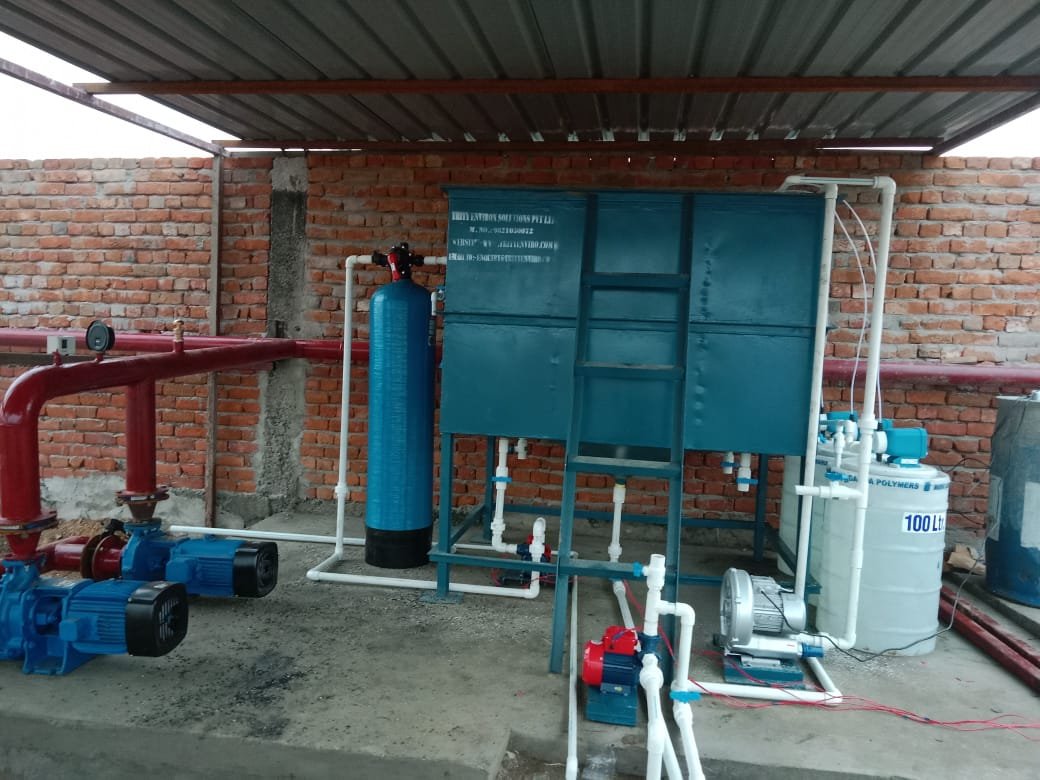
We at Trity Environ Solution don't just manufacture ETP and STP plants, we design the pollution control system that your CTE application is actually built around. Because we handle the engineering, the effluent load calculations, and the SPCB documentation together, applicants avoid the common failure mode where an ETP/STP design gets approved on paper but doesn't match what a contractor actually builds, forcing a fresh consent cycle. Our team assists with project report preparation, pollution control system sizing for your specific industry category, site layout planning, and coordination with your regional SPCB or UPPCB office through to grant of consent.
Frequently Asked Questions
How long does it take to get a Consent to Establish?
Timelines vary by state and industry category. Deemed-consent MSEs in notified industrial estates now receive CTE immediately on self-certified Form-I submission under the January 2026 amendment. Standard applications requiring site verification typically take several weeks, depending on SPCB backlog and completeness of the submitted documentation.
Can I start civil construction before receiving CTE?
No. Construction or installation of machinery without a valid CTE is treated as unauthorised establishment and can attract a stop-work direction under Section 33A of the Water Act, in addition to monetary penalties under the adjudication process.
Does CTE cover both water and air consent, or do I need separate applications?
Both Water Act and Air Act consent are typically applied for together in a combined CTE application. Under the 2026 amendment, Air Act consent can also be consolidated with hazardous waste authorisation in a single filing.
What happens if my CTE expires before construction is complete?
You must apply for renewal before continuing construction. An expired CTE with ongoing construction activity is treated the same as construction without consent.
Is CTE enough to start production?
No. CTE only authorises establishment. You need a separate Consent to Operate (CTO), granted after your ETP, STP, or air pollution control systems are commissioned and verified, before you can legally begin commercial production.
Do small units also need CTE?
Yes, though Micro and Small Enterprises in notified industrial estates now benefit from deemed CTE on self-certified Form-I filing, removing the wait for site inspection in most cases.
Scope Highlights
Why Choose Trity Enviro Solutions?
Industry-certified environmental engineers delivering compliant, high-efficiency turnkey systems across India.
100% SPCB/CPCB Compliance
Complete regulatory clearance & legal liaison support.
Certified Engineers
Over a decade of industrial wastewater expertise.
Turnkey Execution
End-to-end design, fabrication, setup & commissioning.
Pan-India AMC & Service
24/7 technical hotline, scheduled visits & spare parts.
Frequently Asked Questions
Q1. What is a MBBR Media?
Moving bed biofilm reactor (MBBR) is a type of wastewater treatment process that was first invented by Prof. Hallvard Ødegaard at Norwegian University of Science and Technology in the late 1980s. For more detail call us on 8802624956
Q2. What is a digester tank?
The wet anaerobic digestion process is applied to liquid waste streams that are conveyable by liquid pumping. Sometimes wet systems are called Low Solids AD (LSAD). The Wet AD process can be done in reactors of two main configurations, continuously stirred tank reactors (CSTR) and plug flow reactors.
Q3. Which air pollutant is produced in anaerobic decomposition of organic matter?
Methane is the largest natural source of hydrocarbons. It's produced by the anaerobic decomposition of organic matter in bodies of water. -Trees and plants produce most of the remaining natural VOC's called terpenes. Volatile Organic Compounds - VOCs -Petroleum is the key source of man-made VOC pollution.
Q4. What is a sewage treatment plant?
The Sewage Treatment Plant process is similar to the way that a Septic Tank works but mechanical components provide a process to help break down solids to produce a cleaner, more environmentally friendly effluent.
Q5. What is the tertiary treatment of sewage?
Tertiary treatment is the final cleaning process that improves wastewater quality before it is reused, recycled or discharged to the environment. The treatment removes remaining inorganic compounds, and substances, such as the nitrogen and phosphorus.
Related Service Solutions
Rainwater Harvesting System

Technical Assistance on Web
NOC from CGWA
Related Industry Insights
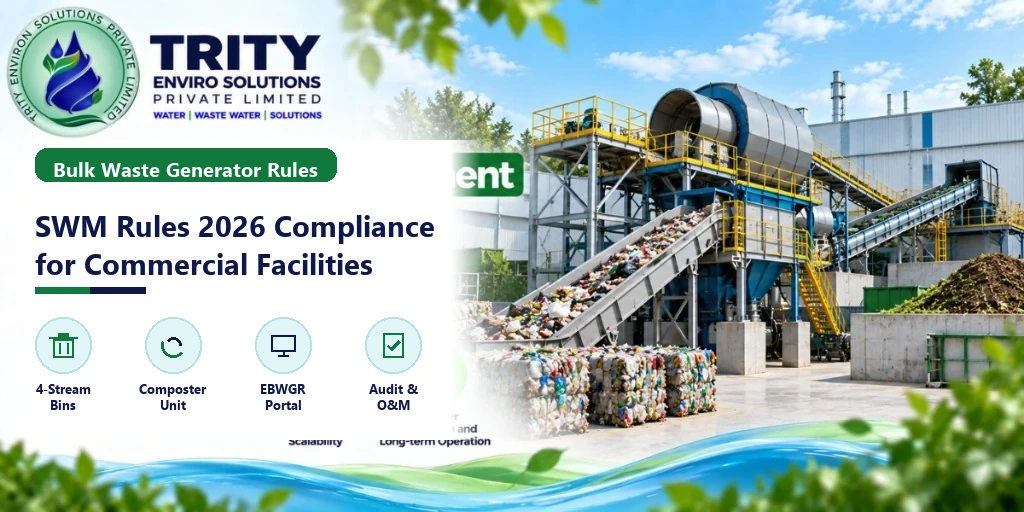
Bulk Waste Generator Compliance Under India's SWM Rules 2026: What Businesses Need to Set Up
A practical checklist for bulk waste generators under SWM Rules 2026: registration, four-stream segregation, on-site processing, EBWGR certificates and records.
Read Article
How to Design a Water Recycling System for Cooling Towers and Industrial Process Water
Design a water recycling system for cooling towers and process water: water balance, cycles of concentration, treatment train and payback, with an example.
Read Article
Tertiary Water Treatment for Industrial Reuse: When Filtration Alone Is Not Enough
Is filtration enough to reuse treated wastewater? Learn when you need UF, RO, softening or disinfection, and how to match tertiary treatment to each reuse.
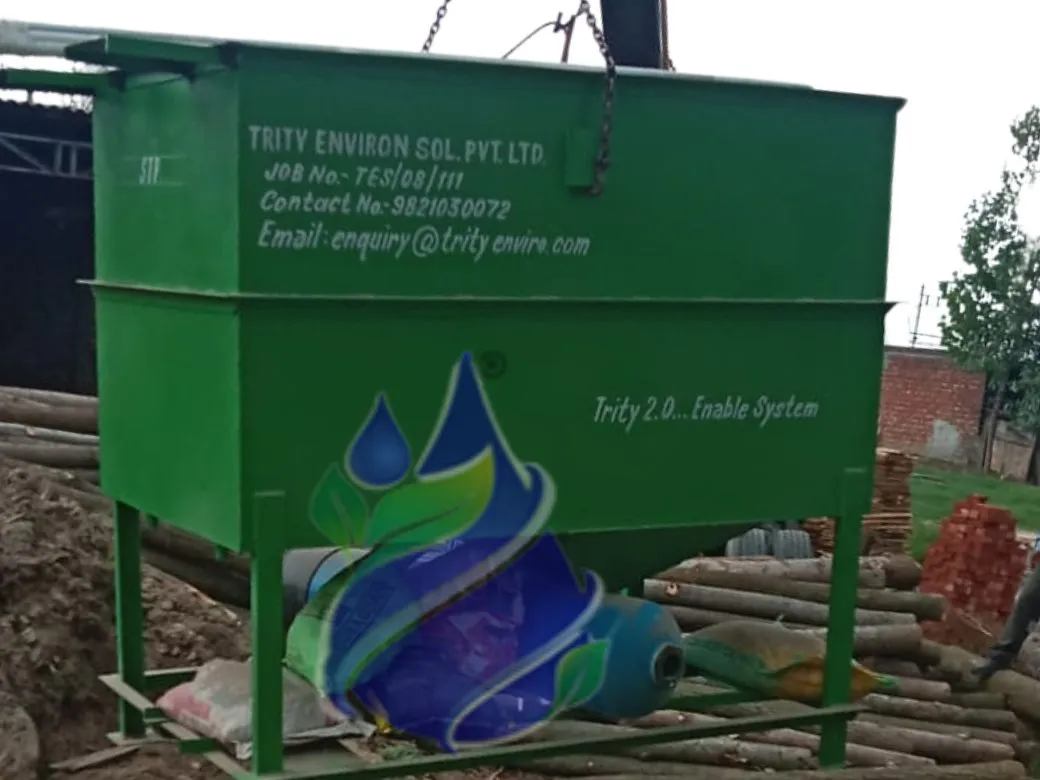
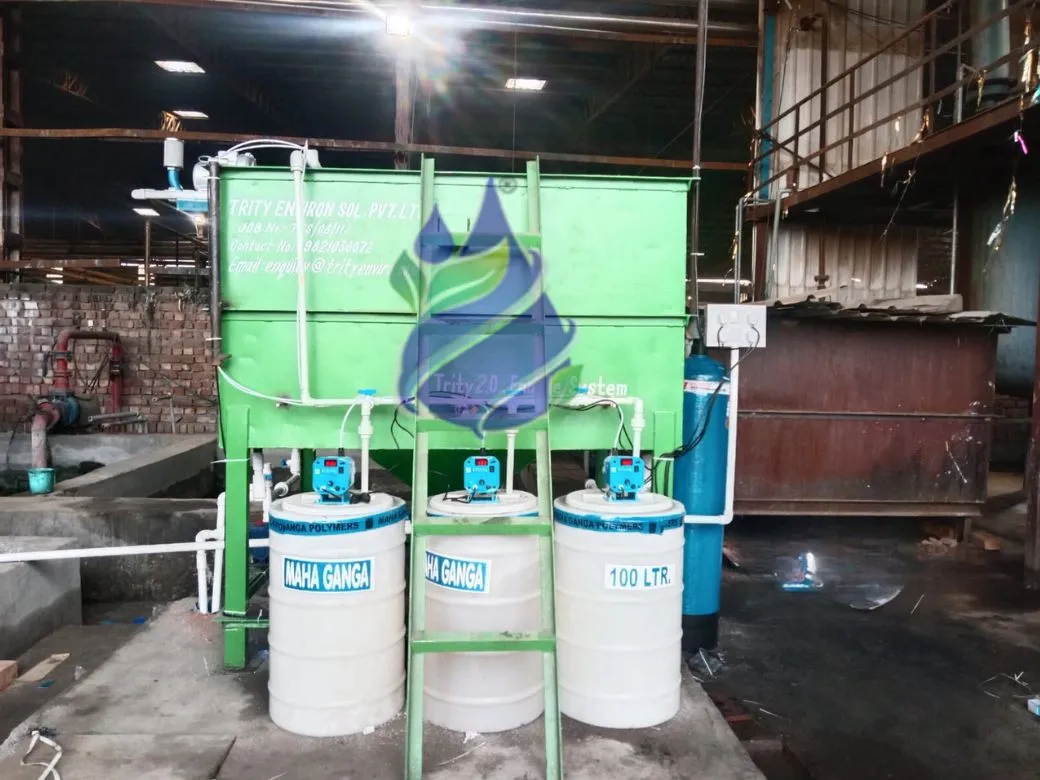
Read ArticleFeatured Turnkey Installations




Need Expert Support for Your Water Treatment Project?
From regulatory compliance to turnkey engineering and O&M, our certified environmental engineers are ready to assist.