ISO 9001:2015 & QCI Approved
Rainwater Harvesting System
Trity Enviro designs and installs rainwater harvesting and groundwater recharge systems compliant with CGWA norms, covering recharge pits, shafts, and borewell recharge for industries and housing societies.
Why This Is a Compliance System, Not Just a Sustainability Add-On
A Rainwater Harvesting (RWH) system is a mandatory condition attached to nearly every groundwater NOC issued by the Central Ground Water Authority (CGWA), not an optional environmental gesture. CGWA has specifically directed group housing societies, hotels, institutes, industries, and farm houses in the notified areas of Delhi, Faridabad, Gurgaon, and Ghaziabad to install rainwater harvesting wherever the groundwater table sits below 8 metres from the surface, and it stays a standing condition of your NOC from CGWA for as long as that approval remains valid, subject to inspection. Trity Environ Solution designs and installs RWH systems for exactly this reason: a facility that treats its RWH structure as a one-time construction checkbox rather than an ongoing compliance asset is the facility most likely to run into trouble at its next NOC renewal or SPCB inspection.
State building bylaws add another layer on top of the CGWA requirement. Many state and municipal building codes, including Uttar Pradesh's, mandate rainwater harvesting for new construction above a certain plot size, independent of whether the site is in a CGWA-notified area, which means a project can trigger the requirement from two different directions at once.
The Components That Make Up a Proper System
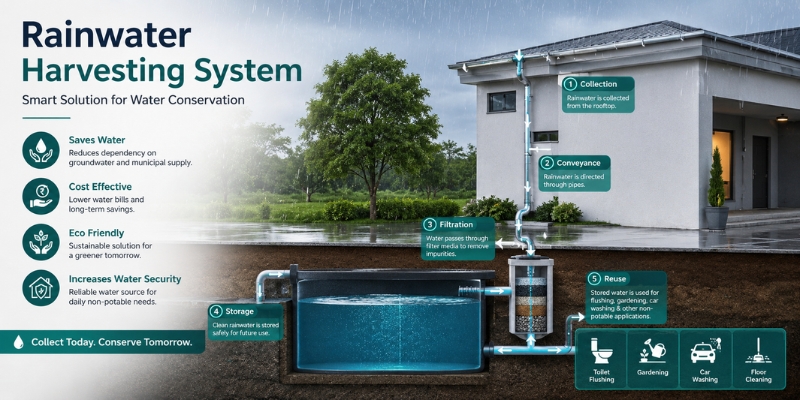
A rainwater harvesting system isn't just a pit dug in the ground, it's a sequence of components, and skipping or undersizing any one of them undermines the whole system:
- Catchment: the roof or paved surface area that collects rainfall, the starting point for sizing everything downstream
- Conveyance system: gutters and downpipes that channel collected water to the treatment and recharge components without loss
- First-flush diverter: discards the initial flow of runoff, which carries the highest concentration of dust, debris, and roof contaminants, so it doesn't enter the recharge structure
- Filter chamber: sand, gravel, and boulder media that removes suspended solids before water reaches the recharge structure, protecting the aquifer from silt clogging over time
- Storage or recharge structure: the component that either stores water for reuse or conducts it into the ground to recharge the aquifer, and the right type depends on site conditions
Recharge Structure Types and When Each Applies
| Structure | Typical Dimensions | Best Suited For |
|---|---|---|
| Recharge Pit | 1.5m to 3m wide, 2m to 3m deep | Shallow aquifers, smaller plots, residential and small commercial sites |
| Recharge Trench | Varies by site, filled with filter media, boreholes at intervals | Larger paved or open areas with moderate runoff volume |
| Recharge Shaft | More than 2m diameter, depth generally up to 8m | Deeper aquifers common across parts of UP, where a pit alone won't reach the water-bearing strata |
| Recharge Well / Borewell Recharge | Existing or dedicated borewell, filtered inlet | Sites with an existing borewell, or where high recharge volume needs to reach depth quickly |
Choosing the wrong structure for a site's actual soil and aquifer depth is one of the more common reasons an RWH system exists on paper but doesn't meaningfully recharge groundwater, which matters both for genuine water table impact and because CGWA can request chemical analysis data and functional verification of the system as part of ongoing NOC compliance.
Sizing the System Correctly
Correct sizing starts with the actual catchment area, not a generic assumption: roof area multiplied by expected rainfall and a runoff coefficient (accounting for surface type and losses) gives the volume the system needs to handle per rainfall event. Soil permeability and water table depth then determine which recharge structure, or combination of structures, can actually absorb that volume without overflow. A system sized to a generic plot-area formula rather than the site's real catchment and soil conditions tends to either overflow during heavy monsoon spells, defeating the purpose, or sit oversized and underused during a normal season.
Recharge vs Storage: Two Different Goals, Often Confused
Not every rainwater harvesting system is built to do the same job, and conflating the two leads to the wrong design being installed. A storage-focused system collects and filters rainwater into a tank for direct reuse, flushing, gardening, or floor washing, reducing dependence on freshwater or groundwater for non-potable use. A recharge-focused system is built to return water to the aquifer through a pit, trench, shaft, or well, which is what CGWA's NOC conditions are actually asking for. Many sites benefit from both, storage for immediate reuse and recharge for long-term aquifer replenishment, but a system installed purely for storage does not satisfy a CGWA recharge obligation, even though it looks like a complete rainwater harvesting setup from the outside.
Installation Process
- Site assessment: catchment area survey, soil percolation testing, and water table depth confirmation
- Sizing and structure selection: matching recharge pit, trench, shaft, or borewell recharge to the site's actual conditions, not a template
- Conveyance and first-flush installation: gutters, downpipes, and first-flush diverters sized to the catchment area
- Filter chamber construction: sand, gravel, and boulder media layered to remove suspended solids before water reaches the recharge point
- Recharge structure construction: pit, trench, shaft, or well construction per the selected design, including casing and safety covers where applicable
- Testing and handover: confirming the system functions during an actual rainfall event where possible, with documentation for CGWA compliance records
Why Maintenance Matters More Than Most Facilities Realise
An RWH system that isn't maintained silently stops working long before anyone notices. Filter media clogs with silt over successive monsoons, first-flush diverters need periodic clearing, and recharge pits or shafts can gradually lose percolation capacity without visible signs above ground. Since CGWA treats a functioning RWH system as a standing NOC condition, not a one-time construction item, a silently failed system puts your NOC compliance at risk even though nothing appears wrong from the surface. Periodic inspection and desilting is a small, predictable cost against the alternative of a compliance issue surfacing at NOC renewal.
Why Trity Environ Solution for Rainwater Harvesting
Our work in groundwater NOC compliance and treatment plant design means we approach RWH system sizing as part of a site's complete water picture, not an isolated construction item, since your recharge obligation, your extraction volume, and your overall water balance are all connected. We handle site assessment, structure design and selection, installation, and ongoing maintenance, so the system that gets built is the one that actually keeps your NOC compliant year after year, not just at commissioning.
Frequently Asked Questions
Is rainwater harvesting legally mandatory for my facility?
In CGWA-notified areas with a water table below 8 metres, including large parts of Delhi, Faridabad, Gurgaon, and Ghaziabad, it's a mandatory NOC condition. Many state building bylaws separately mandate it for new construction above a certain plot size, regardless of CGWA notification status.
What's the difference between a recharge pit and a recharge shaft?
A recharge pit is shallower (2 to 3 metres deep) and suited to shallow aquifers and smaller sites. A recharge shaft goes considerably deeper (up to 8 metres) and is used where the water-bearing strata sits deeper, which is common across parts of Uttar Pradesh.
How do I know which recharge structure is right for my site?
It depends on your soil permeability, water table depth, and available catchment area, determined through a site assessment and soil percolation test rather than a generic plot-size formula.
Does an existing but unused borewell count as an RWH structure?
An existing borewell can be converted into a recharge well with proper filtration on the inlet, but direct, unfiltered connection of rooftop runoff into a borewell is not recommended, since it risks contaminating the aquifer.
How often does an RWH system need maintenance?
At minimum, before and after each monsoon season, checking first-flush diverters, filter media, and recharge structure percolation capacity. Systems serving larger catchment areas or older installations may need more frequent inspection.
Can CGWA reject my NOC renewal over a poorly maintained RWH system?
Yes. Since RWH is a standing NOC condition, a non-functional or poorly maintained system is a compliance gap that can surface during renewal review or inspection, even if the original system was approved at installation.
Scope Highlights
Why Choose Trity Enviro Solutions?
Industry-certified environmental engineers delivering compliant, high-efficiency turnkey systems across India.
100% SPCB/CPCB Compliance
Complete regulatory clearance & legal liaison support.
Certified Engineers
Over a decade of industrial wastewater expertise.
Turnkey Execution
End-to-end design, fabrication, setup & commissioning.
Pan-India AMC & Service
24/7 technical hotline, scheduled visits & spare parts.
Frequently Asked Questions
Q1. What is a MBBR Media?
Moving bed biofilm reactor (MBBR) is a type of wastewater treatment process that was first invented by Prof. Hallvard Ødegaard at Norwegian University of Science and Technology in the late 1980s. For more detail call us on 8802624956
Q2. What is a digester tank?
The wet anaerobic digestion process is applied to liquid waste streams that are conveyable by liquid pumping. Sometimes wet systems are called Low Solids AD (LSAD). The Wet AD process can be done in reactors of two main configurations, continuously stirred tank reactors (CSTR) and plug flow reactors.
Q3. Which air pollutant is produced in anaerobic decomposition of organic matter?
Methane is the largest natural source of hydrocarbons. It's produced by the anaerobic decomposition of organic matter in bodies of water. -Trees and plants produce most of the remaining natural VOC's called terpenes. Volatile Organic Compounds - VOCs -Petroleum is the key source of man-made VOC pollution.
Q4. What is a sewage treatment plant?
The Sewage Treatment Plant process is similar to the way that a Septic Tank works but mechanical components provide a process to help break down solids to produce a cleaner, more environmentally friendly effluent.
Q5. What is the tertiary treatment of sewage?
Tertiary treatment is the final cleaning process that improves wastewater quality before it is reused, recycled or discharged to the environment. The treatment removes remaining inorganic compounds, and substances, such as the nitrogen and phosphorus.
Related Service Solutions

Technical Assistance on Web

Consent to Establishment
NOC from CGWA
Related Industry Insights
Bulk Waste Generator Compliance Under India's SWM Rules 2026: What Businesses Need to Set Up
A practical checklist for bulk waste generators under SWM Rules 2026: registration, four-stream segregation, on-site processing, EBWGR certificates and records.
Read Article
How to Design a Water Recycling System for Cooling Towers and Industrial Process Water
Design a water recycling system for cooling towers and process water: water balance, cycles of concentration, treatment train and payback, with an example.
Read Article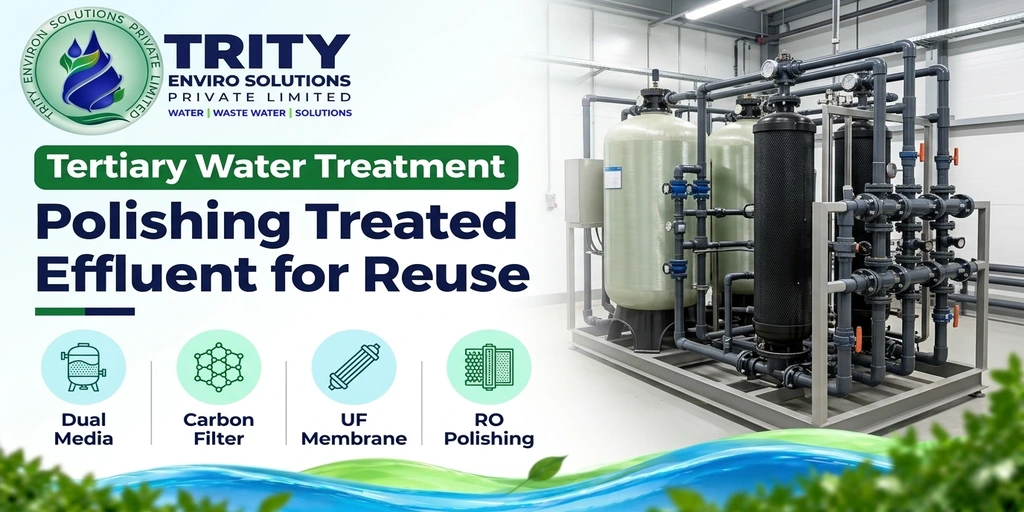
Tertiary Water Treatment for Industrial Reuse: When Filtration Alone Is Not Enough
Is filtration enough to reuse treated wastewater? Learn when you need UF, RO, softening or disinfection, and how to match tertiary treatment to each reuse.
Read ArticleFeatured Turnkey Installations





Need Expert Support for Your Water Treatment Project?
From regulatory compliance to turnkey engineering and O&M, our certified environmental engineers are ready to assist.