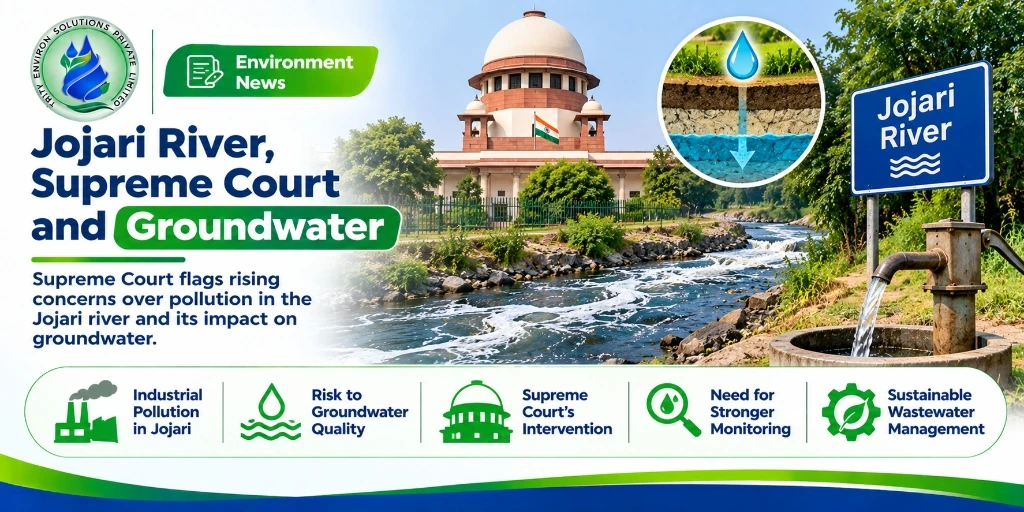
The Supreme Court has made the Central Ground Water Authority (CGWA) a party in the long-running Jojari river pollution case and asked it for an expert assessment of severe groundwater depletion in Balotra, Jodhpur and Pali districts.
The order, reported on November 9, also fixes river boundaries with a buffer, bars the most polluting industries near the rivers and sets up a special investigation team on illegal riverbed mining.
The Case in Brief
The matter is a suo motu case titled "In Re: 2 Million Lives at Risk: Contamination in Jojari River, Rajasthan". It concerns pollution of the Jojari river and, in this order, the linked Bandi and Luni rivers.
The bench is Justice Vikram Nath and Justice Sandeep Mehta, according to the supremetoday.ai report of November 9. That report does not state the date of the order, and we could not read the order text itself. Earlier Supreme Court judgments in this case have also been reported, including Bar and Bench's coverage of a court-appointed expert panel and special courts for polluting industries.
What the Court Directed
On groundwater
- CGWA is impleaded as a party
- It is to give an expert assessment of severe groundwater depletion in Balotra, Jodhpur and Pali
- The court wants restoration to rest on scientific data and not administrative convenience
- No deadline for the CGWA assessment is mentioned in the report
On river boundaries and industry
- Rivers are protected within their recorded geographical extent, plus a 100-metre buffer zone on each side
- Red-category industries are prohibited within 500 metres of these boundaries
- The state may not grant new industrial permissions near the rivers until high flood lines and buffer zones are scientifically determined
- The court rejected the Water Resources Department's plan to reduce river widths on the basis of sewage and treated wastewater flow. The state's counsel conceded the approach could not be sustained
On mining
- A special investigation team (SIT), led by an officer not below the rank of Inspector General of Police, is to investigate illegal sand mining networks and any official complicity or dereliction of duty
- The court criticised granting mining leases to legitimise illegal riverbed mining, saying lease regularity does not discharge the state's environmental obligations
- An anonymous grievance option is to be added to the existing public reporting portal for environmental violations
On industrial wastewater
- The state must frame a comprehensive financial assistance policy for industrial units moving to zero liquid discharge (ZLD) systems. Until then, applications are to be assessed case by case after technical appraisal
- The state must prepare a time-bound plan for a pipeline network to redistribute and reuse treated wastewater and reverse-osmosis permeate
- The burden of restoration cannot fall only on industrial clusters in Jodhpur, Pali and Balotra, and the state must bear its share
- Industrial parties may approach the National Green Tribunal (NGT) to challenge specific closure orders on their merits
What Is and Is Not Confirmed
Confirmed in the report we could read
- CGWA's role is to assess groundwater depletion in the three districts
- The 100 m and 500 m limits, the SIT and the ZLD directions
- The next hearing is on November 27, 2026, and the matter is part-heard
- Rajasthan must file status reports on the SIT's progress and on the industrial assistance policy
Not confirmed
- The order date. Not stated in the report
- A CGWA deadline. None is given, so none should be assumed
- Whether CGWA must report on industrial extraction specifically. The report says depletion. Other coverage may describe extraction and availability, which we could not verify
- The full text. This summary rests on one secondary report, so figures such as 100 m and 500 m should be checked against the order
Why Groundwater and Industry Are Linked Here
This section is general background and not part of the order.
Industrial clusters use water for processing and discharge effluent. Where treated or untreated wastewater reaches a river, it can also seep into groundwater. Where industry pumps heavily from aquifers, water tables fall. The two problems feed each other, since less groundwater means less safe dilution and more pressure on rivers.
Pali and Balotra are widely known for textile processing and Jodhpur has many small industries. The report does not name the sectors the court has in mind, so no link between a specific industry and the depletion should be assumed.
What It Means for Industrial Units
Location and permissions
Units near the Jojari, Bandi and Luni rivers should check their distance from the recorded river extent. Red-category units within 500 metres face a prohibition under the order as reported, and new permissions near the rivers are on hold.
Treatment and reuse
The court's emphasis on ZLD and reuse follows the logic of treating wastewater so that it is recovered and not discharged.
- Units with high-TDS or coloured effluent typically need an effluent treatment plant designed for their process
- A zero liquid discharge system recovers water and leaves solid residue for disposal
- Clusters often rely on a shared common treatment facility, and many treatment plants need a clear operation and maintenance regime to keep working
- Domestic sewage from towns also needs a sewage treatment plant, since the state's wastewater reuse plan includes treated wastewater
These are general points and are not directions from the court.
Records
Keep consent papers, water-use records and effluent-discharge data current. The court has signalled that it will look for scientific data.
The Wider Pattern
The Supreme Court has repeatedly used this case to push the state on river protection. The latest order moves from pollution control to the basin level: river boundaries, mining, groundwater and the finances of cleaner production. Its comment that the burden cannot fall only on industrial clusters is notable because it places part of the responsibility on the state.
What to Watch Next
- The hearing on November 27, 2026
- Whether and when CGWA files its assessment
- The SIT's progress and Rajasthan's status reports
- The shape of the ZLD financial assistance policy
- Any NGT challenges to closure orders
Official updates on Supreme Court orders are available on the Supreme Court website, and the National Green Tribunal publishes its own orders.