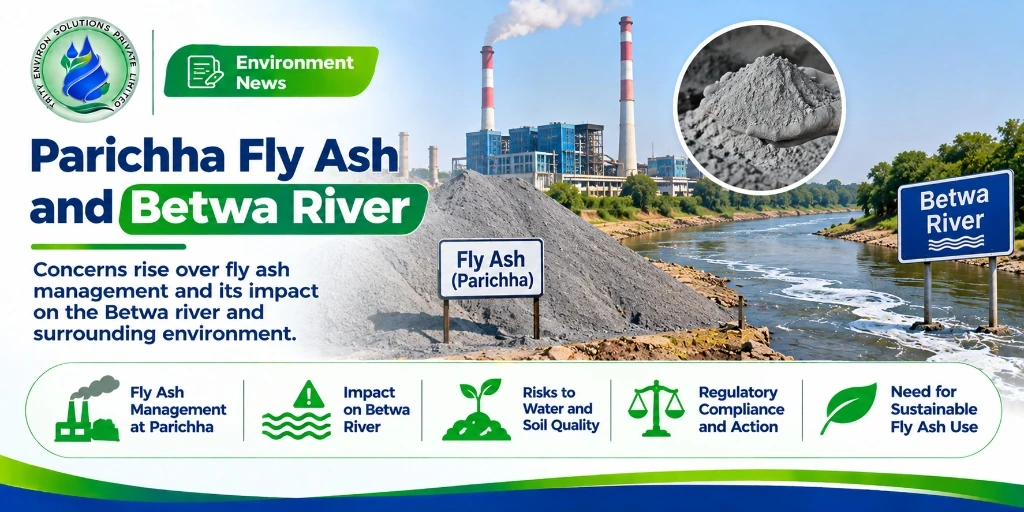
A report published on November 11 by the South Asia Network on Dams, Rivers and People (SANDRP) raises concerns about fly ash from the Parichha Thermal Power Plant in Jhansi, Uttar Pradesh, and its effect on the Betwa river.
The claims come from a petition before the National Green Tribunal (NGT), and the case is pending. They are allegations. They are not findings.
What the Report Says
The details below come from the opening excerpt of SANDRP's "Yamuna Manthan 1126" post, titled "Parichha Fly Ash Damaging Health of People and Betwa River". We could read only the excerpt and not the full report.
The allegations
- Continuous fly ash discharge has formed large ash islands in the riverbed that obstruct the river's natural flow
- Toxic heavy metals in the fly ash are harming aquatic ecosystems
- Air pollution from the ash is affecting the health of people living nearby
These are described as claims in the petition and in media reports. The excerpt does not confirm them.
The location
The report's feature image is Google Earth imagery from January 2025. It shows the power plant and fly ash dumps close to the Betwa near the Parichha dam in Jhansi district. Proximity in an image does not by itself show discharge into the river or any rule violation.
The case
The post links to an NGT order. The excerpt does not give the case number, bench, petitioners or order date, so we cannot describe the order's contents. Please see the NGT's website for its orders.
What Is Not Known
- Whether the claims are true. No finding by the NGT, a pollution control board or a court on these allegations was available to us
- The plant operator's response. None is reported in the excerpt
- Measured data. No water, sediment or air quality results are given in the part we could read
- The stage of the NGT case. The case is described as pending, but we have no hearing date
Until those are available, the safest reading is that a concern has been raised and is under examination.
Why Fly Ash Is a Pollution Issue
This section is general background and not a finding about Parichha.
Coal-fired power stations produce fly ash, a fine residue captured from flue gas. Fly ash can contain trace metals. When it is stored in ponds or dumped, it can create several problems.
- Water: ash slurry or leachate can reach rivers and groundwater, raising suspended solids and trace metals
- Air: dry ash can blow off exposed stockpiles as dust
- Land and rivers: deposits can change channels and bury habitat
- Health: fine dust can be inhaled by people living nearby
Fly ash is also a resource, and it is used in cement, bricks and road building. The regulatory aim has been to use more of it and store less of it.
The rule framework
A Down To Earth report from September 2020 explains that the Environment Ministry's fly ash notification required full utilisation, with a deadline of December 31, 2017 that was not extended. The NGT has directed plants that fail to comply to pay environmental compensation counted from that date, and it asked the Central Pollution Control Board (CPCB) to set the method. Those are general rules and do not show anything about Parichha.
Ash Management Failures Elsewhere in 2026
SANDRP's earlier post of September 5, 2026 documented ash dyke problems at other plants. It does not mention Parichha, Jhansi or the Betwa. We cite it only to show that ash management is a live concern, and not as evidence about this case.
- In Singrauli, Madhya Pradesh, part of an ash dyke wall subsided on August 14 and a local report estimated about 5,760 tonnes of ash spread. The district administration issued a show-cause notice on August 17
- In Raebareli, Uttar Pradesh, an ash dyke leak at NTPC Unchahar reportedly submerged hundreds of acres of paddy fields on August 31
- In Korba, Chhattisgarh, the state environment board imposed Rs 90 lakh in compensation for ash dumped at an unauthorised site
SANDRP also notes that fly ash dams are not listed in the National Register of Dams and that no agency clearly monitors them.
What Plants and Industry Can Learn
These are general good-practice points, and they are not claims about Parichha.
Keep ash away from water
- Store ash in lined, engineered ponds with freeboard and monitored dyke stability
- Keep ash handling and slurry lines in good repair and check them after heavy rain
- Maintain buffer distances between ash storage and watercourses
Control dust and leachate
- Keep dry ash moist or covered, and use dust suppression at stockpiles
- Collect leachate and runoff and treat them before release. Water from ash ponds and plant drains often needs a wastewater treatment plant sized for its solids and metals load
- Where regulators require it, zero liquid discharge removes the discharge route altogether
Measure and report
- Monitor groundwater and river quality upstream and downstream of storage
- Keep records of ash generation, utilisation and disposal
- Maintain monitoring and treatment systems through a routine operation and maintenance programme
Why the Betwa Matters
The Betwa is a tributary of the Yamuna. SANDRP files the post under its Yamuna category, which is how it links a local ash issue to the larger river system. Pollution entering a tributary can carry downstream, which is why such cases draw attention from river groups.
How a Case Like This Usually Moves
This describes the usual process and does not predict this case.
- The tribunal may seek reports from the pollution control board, the Central Pollution Control Board or an expert committee
- It may ask the plant operator to respond to each allegation
- It can order remedial steps, environmental compensation or closure of non-compliant operations if violations are established
- It can also dismiss the claims if the evidence does not support them
What to Watch Next
- The NGT's next hearing and any committee report
- A response from the plant operator and the Uttar Pradesh Pollution Control Board
- Any measured water or air data on the site
- SANDRP's full report, which may add detail we could not read
Careful reporting matters here. A petition tells us what is being asked of the tribunal. Only the evidence before it will tell us what is true.