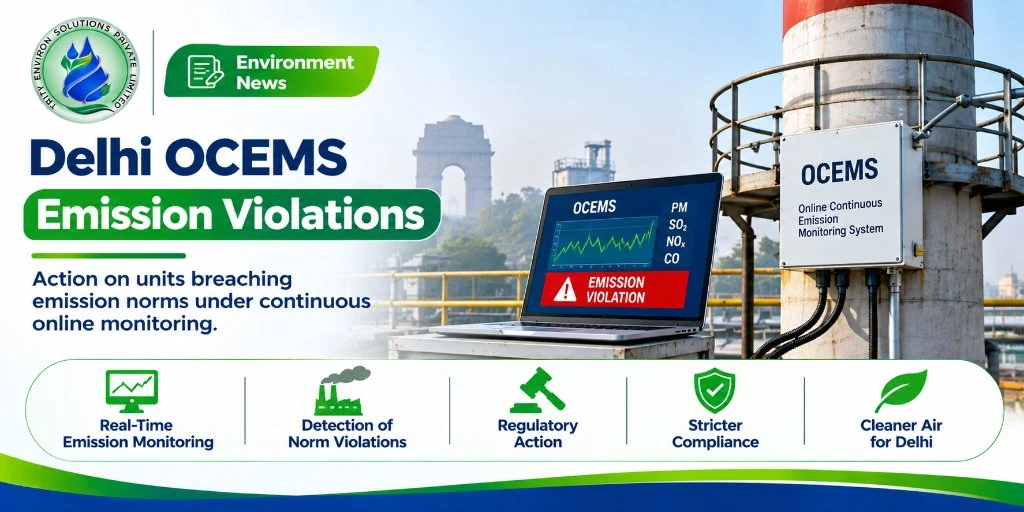
Delhi Pollution Control Committee (DPCC) data shows that about 54% of industrial units with working online emission monitors exceeded permissible limits. Of 87 Online Continuous Emission Monitoring Systems (OCEMS) installed in the capital, 39 were inactive.
The figures were reported on November 8, drawing on an Indian Express report that this article could not access directly. The details below come from a secondary summary and should be read with that in mind.
The Numbers
- OCEMS installed: 87
- Not working: 39
- Working: 48
- Working units found in violation: 26
- Violation rate among working units: about 54% (our check: 26 divided by 48 is 54.2%)
- Units required to install OCEMS: 128 highly polluting units, according to the summary
Metal-processing units
Metal units stand out. Of 16 operating metal units, covering metalworking, alloy manufacturing, foundries, brazing and die-casting, nine were flagged for violations. That is about 56% (our arithmetic).
What the Data Does and Does Not Show
What it shows
- A large share of monitors is out of action. 39 of 87 is about 45% (our arithmetic)
- Where monitors work, over half the units exceed limits
- Metal processing is a particular problem
What it does not show
- The limits themselves. The summary does not say which pollutant, what the limit was or by how much units exceeded it
- How long the breaches lasted. A momentary spike is different from a sustained exceedance
- Which units are involved. None is named
- Why 39 monitors are inactive. The summary gives no reasons, such as faults, power cuts or units being shut
The 54% applies to the 48 units whose data could be read. It does not cover the 39 units whose monitors were off, so it does not describe all 87.
Reading It Against Other Delhi Figures
Other recent reports give different totals, because they count different groups.
- Down To Earth, September 28: Delhi's winter plan targeted 2,354 industries for OCEMS and APCD compliance, and 2,197 (about 97.3%) were reported to have installed OCEMS. The 57 that had not were closed and could reopen only after installing it
- ETV Bharat, October 22: CPCB directed the sealing of 648 industries across northern states for failing to keep 85% of online emissions data available. Delhi accounted for 10 of them, with Haryana at 298, Uttar Pradesh at 260 and Rajasthan at 80
The 87 figure is therefore not Delhi's total OCEMS count. It most likely refers to a narrower group, such as the highly polluting units mentioned above. The summary does not say, so the groups should not be added or compared directly.
The Rules Behind the Data
The emission limit
CAQM directions of February 2026 cut the particulate limit for selected industries from 80 to 50 mg per normal cubic metre, effective October 1, as described in the Down To Earth report.
The data requirement
CPCB's OCEMS guidelines require continuous data transmission to pollution control board servers, with at least 85% of data available, per ETV Bharat. A monitor that is switched off records nothing, so the unit cannot show compliance.
The camera requirement
According to the summary, CAQM has directed industries to make OCEMS fully operational and to stream pan-tilt-zoom camera feeds in real time, with a deadline of November 30. The same direction led HSPCB to send notices to 751 Sonipat units on November 5, as covered in our earlier article.
What Happens to a Non-Working Monitor
A non-functional OCEMS creates two problems for a unit.
- It cannot prove it is meeting limits
- It may fall foul of the data-availability requirement, which in October led CPCB to direct action against 648 units regionally
That is why regulators treat an inactive monitor as a compliance issue and not just a technical one.
What Metal Units Should Do
Foundries, die-casting and alloy units generate fumes and particulate at furnaces and pouring areas. These are general steps and not from the report.
Control the source
- Check that fume extraction and capture hoods work and are positioned correctly
- Maintain bag filters or other control devices, and replace worn parts on schedule
- Use approved fuels and keep fuel records
Measure it
- Keep the OCEMS running and calibrated, and fix faults quickly
- Compare online data with periodic stack tests
- Keep SOx NOx gas analysers and other stack instruments calibrated for reliable readings
Keep it running
- Set up routine inspection of sensors, sampling lines and data loggers
- Keep spares for common failure points
- A structured operation and maintenance programme reduces downtime of both control devices and monitoring equipment
Prepare for cameras
- Plan camera positions at stacks, OCEMS sampling points, furnace feeding points and fuel stores
- Arrange backup power and a reliable internet connection
- Test the stream before the deadline
Why It Matters for Delhi's Air
Industrial emissions are one source among several. The Decision Support System source shares reported in November put industries in Delhi and nearby areas at about 4.2% of PM2.5 on one day, with transport much higher. That share is small, but industry is one of the few sources where regulators can demand continuous measurement. A unit whose monitor is off is a gap in that picture.
Questions the Data Raises
- Are the 39 inactive monitors faulty, switched off or attached to units that have stopped operating?
- Which pollutants and limits were breached, and for how long?
- How does the 87-monitor group relate to the larger lists of units covered by Delhi's winter plan?
- Will the regulator publish unit-wise data so the public can check the claim?
Regulators publish national guidance and monitoring updates on the CAQM and CPCB APCD portals, which are the places to look for the formal position.
What to Watch Next
- The November 30 deadline for working OCEMS and camera streams
- Whether DPCC publishes the unit-wise list of violators
- Whether closure or penalty action follows for the 26 units
- Whether the 39 inactive monitors are restored or the units are closed
The data shows a gap between having a monitor and using it. Closing that gap is now a compliance priority.