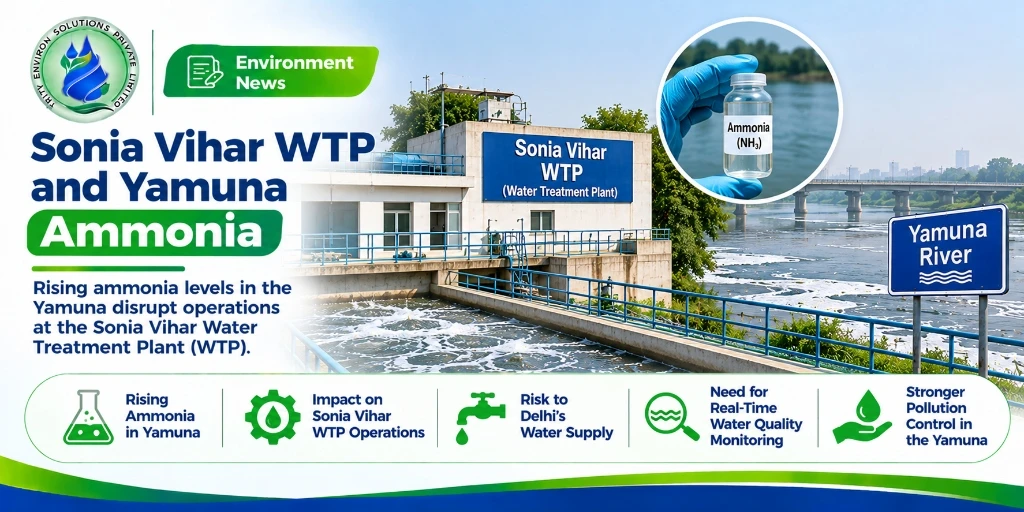
A rise in ammonia in the Yamuna forced the Sonia Vihar Water Treatment Plant to curtail production on the morning of Wednesday, November 11, disrupting water supply across parts of Lutyens' Delhi.
The Delhi Jal Board (DJB) said ammonia rose above 1 part per million (ppm) for a few hours, and that the situation is now under control with all plants running at normal capacity.
What Happened
The account below comes from an Indian Opinion report of November 11, which draws on syndicated copy from Deccan Herald and Mathrubhumi. We could not open the Deccan Herald page, and the Indian Opinion page is itself a summary, so details should be checked against the original reports.
- Ammonia rose above 1 ppm in the Yamuna for a few hours on Wednesday morning, according to DJB officials
- DJB says it cannot treat raw water that has ammonia above 1 ppm
- Sonia Vihar WTP therefore curtailed production
- DJB officials said the situation was under control and all plants were operating at normal capacity. No exact time of restoration is given
- The cause of the pollution is not stated. The report notes that the New Delhi Municipal Council (NDMC) has not said what caused it
Areas Affected
NDMC listed the following localities as affected, as relayed in the report.
- Khan Market, Lodhi Estate, Golf Links and Jor Bagh
- Rabindra Nagar, Bharti Nagar and parts of Lodhi Road
- High Court, President's Estate, Pandara Road and Pandara Park
- Lodhi Colony, B K Dutt Colony and Amrita Shergil Marg
- Janpath, Kidwai Nagar, Laxmibai Nagar and New Moti Bagh
- Kaka Nagar, JJ camps near the Safdarjung flyover and the Delhi Flying Club
Guidance to residents
NDMC advised residents to call 011-23360683 or 1533 for water tanker services, and to contact officials about booster pumps.
What Is Not Known
- How much output fell. The report gives no percentage or volume
- The cause of the spike. None is stated, so no source should be assumed
- The exact duration of the shortage. Ammonia was high for a few hours, but supply may have taken longer to recover in some areas
- The reading beyond "above 1 ppm". No peak value is given
Your own tap's condition may differ from the area-wide account, so local advice from NDMC or DJB should be followed.
Why 1 ppm Is the Line
DJB says it cannot treat raw water with more than 1 ppm of ammonia. A 2024 Tribune report quoted DJB's Vinay Mishra as saying safe treatment needs levels at or below 0.5 ppm, and that 0.9 ppm was "extremely hazardous". Those numbers come from that event and from an official's statement, and they show that the threshold DJB cites has varied between reports.
The treatment problem
This section is general background and not a finding about this event.
Ammonia in raw water reacts with chlorine, the usual disinfectant, and uses it up. Operators then need much more chlorine to maintain a safe residual. That can leave taste and odour problems and may form unwanted by-products. Standard conventional treatment does not remove ammonia well, so plants limit intake or reduce production when levels are high.
A Recurring Problem
The Yamuna's ammonia spikes are not new.
- On October 28, 2024, The Tribune reported that ammonia at 0.9 ppm stopped the Sonia Vihar and Bhagirathi plants from treating water, and that the city's output fell by 25 to 30 per cent. Mishra attributed the ammonia to industrial waste from Haryana, a claim the report did not verify. The Upper Ganga Canal's maintenance had also forced the plants to rely on the Yamuna
- The 2026 event, as reported, was shorter and has no stated cause
The two events differ in scale, and we have no evidence linking them.
What Usually Drives Ammonia in Rivers
This is general background and not a finding about this event.
- Untreated or poorly treated sewage: ammonia is a main nitrogen form in domestic wastewater
- Industrial effluent: some processes discharge ammonia or nitrogen compounds
- Low flow: when river flow is low, there is less dilution, and the same discharge produces a higher concentration
- Decomposing organic matter: this also releases ammonia
Which of these applied on November 11 has not been reported. Source identification needs data from monitoring points upstream of the plant.
What Pollution Control Looks Like
Treat sewage properly
Towns and cities along the river need sewage treatment plants that remove nitrogen and not only organic load, and that are operated well. A plant that is running but not nitrifying will still release ammonia. Regular operation and maintenance is what keeps performance steady.
Control industrial discharge
Industries releasing nitrogenous effluent need an effluent treatment plant designed for that load. Where required by regulators, zero liquid discharge prevents release to drains and rivers.
Monitor upstream
Real-time monitoring of ammonia, dissolved oxygen and flow upstream gives treatment plants warning, so they can adjust intake or draw from other sources. The Central Pollution Control Board publishes water quality information for rivers.
These are general measures and not directions for this case.
What Residents Can Do
These are general suggestions and not official advice.
- Store some water for emergencies, especially if you live in an area that has had outages
- Use tanker and booster pump information from NDMC and DJB
- Avoid relying on untreated supply for drinking if the water smells strongly of chlorine or looks unusual, and report it to the agency
- Use water carefully while supply is recovering
For Large Water Users
These are general points and not official advice.
- Hotels, hospitals and institutions in affected areas can keep a small storage buffer for short outages
- Facilities with their own treatment or storage should check pumps and tanks before winter low-flow weeks
- Keep tanker contacts and NDMC or DJB helplines handy
What to Watch Next
- Whether DJB or NDMC explains the cause
- Ammonia readings from monitoring points at the Yamuna intake
- Whether the spike recurs in the dry winter months, when river flow is low
- Any action by the pollution control authorities against sources, if identified
The episode shows how closely Delhi's drinking water depends on the river's condition. When pollution rises upstream, the treatment plant's limits decide how much water reaches the tap.