Introduction
A decanter centrifuge is not a small purchase, and it is not one you replace every couple of years. Once installed, it runs continuously, often for a decade or more, handling solid-liquid separation for sludge dewatering, wastewater treatment, or industrial process needs. That long operating life is exactly why the supplier you choose matters as much as the machine specification sheet. A well-built centrifuge from a supplier with weak after-sales support can still end up costing more over time than a slightly pricier machine backed by proper service, spares availability, and technical expertise, which is why this guide focuses on the evaluation criteria that actually predict long-term satisfaction rather than the headline numbers on a spec sheet.
What a Decanter Centrifuge Actually Does
Before evaluating suppliers, it helps to be clear on what the equipment itself is doing across a typical treatment process.
| Stage |
Role of the Decanter Centrifuge |
| Primary treatment |
Separates bulk solid content from raw sewage or industrial wastewater, reducing load on later treatment stages |
| Secondary treatment support |
Works alongside biological treatment processes that generate additional sludge needing separation |
| Sludge dewatering |
Removes water from sludge produced during primary and secondary treatment, reducing volume for disposal or reuse |
| Final clarification |
Removes fine suspended particles from treated effluent before discharge, improving final water quality |
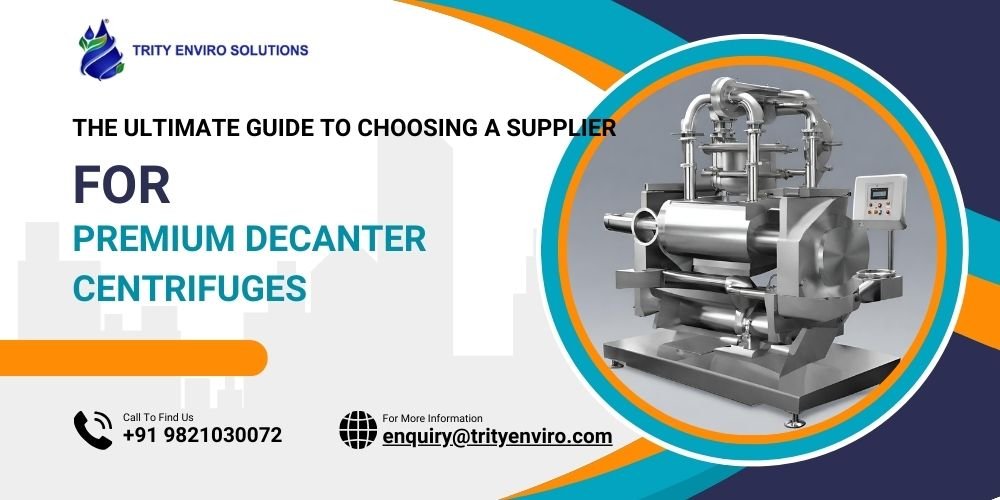
The core mechanism relies on centrifugal force: A rotating bowl spins liquid-solid mixtures at high speed, and the density difference between solids and liquid causes solids to separate outward against the bowl wall while a screw conveyor moves the separated solids toward a discharge point, continuously, without needing to stop the process.
Key Criteria for Evaluating a Decanter Centrifuge Supplier
Choosing the right supplier comes down to a handful of factors that genuinely affect long-term performance and cost, not just the initial quote.
- Build quality and material specification: The bowl, screw conveyor, and other wear-prone components should be constructed from appropriate grade stainless steel or wear-resistant alloys suited to the specific application, since undersized material specifications lead to premature wear, especially in abrasive or corrosive sludge applications.
- Separation efficiency for your specific application: A supplier who can demonstrate separation performance data relevant to your actual sludge type, rather than generic marketing figures, gives a far more reliable basis for comparison than headline efficiency claims alone.
- Bowl and conveyor design suited to your throughput: Bowl length-to-diameter ratio and conveyor differential speed both affect capacity and separation quality, and a supplier who properly sizes these to your actual flow rate and solids content avoids the common mistake of forcing a generic model onto a mismatched application.
- Energy efficiency of the drive system: Since a decanter centrifuge runs continuously, drive motor efficiency and any variable frequency drive integration meaningfully affect long-term operating cost, and this is worth asking about directly rather than assuming all suppliers offer comparable efficiency.
- After-sales service and spare parts availability: A centrifuge running continuously for years will need scheduled maintenance and eventual wear part replacement, and a supplier without reliable local service and spares access turns routine maintenance into extended downtime.
- Customisation capability for specific sludge characteristics: Different industries generate sludge with very different characteristics, and a supplier able to adjust bowl design, conveyor configuration, and operating parameters to your specific application tends to deliver better real-world performance than a one-size offering.
- Certifications and quality standards: ISO certification and relevant Indian or international quality standards compliance give a baseline signal of manufacturing discipline, though this should be verified alongside actual project references rather than taken at face value alone.
- Installation and commissioning support: Proper commissioning, including initial calibration to your specific sludge characteristics, significantly affects how quickly a centrifuge reaches its expected performance level after installation.
Red Flags to Watch For When Evaluating Suppliers
A few warning signs tend to correlate with disappointing long-term outcomes, even when the initial quote looks attractive.
- Reluctance to share application-specific performance data: A supplier who only offers generic efficiency claims without discussing your specific sludge type and throughput requirements is either inexperienced with your application or unwilling to commit to a verifiable performance standard.
- No clear local service and spare parts infrastructure: If a supplier cannot clearly explain how maintenance visits and spare part delivery will work after installation, budget for extended downtime whenever something eventually needs attention.
- Pricing significantly below the market range with no clear explanation: Unusually low pricing without a clear rationale, such as a genuinely simpler configuration suited to a lighter application, often correlates with compromised material specification or reduced quality control.
- Vague or unverifiable project references: A supplier unwilling or unable to provide specific, checkable references from comparable applications is harder to evaluate confidently than one with a documented installation history.
- No willingness to discuss warranty terms in detail: Warranty coverage scope, duration, and what specifically is and is not covered should be a straightforward conversation, and evasiveness here is worth treating as a signal.
Comparing Suppliers: A Practical Evaluation Framework
Rather than comparing suppliers purely on quoted price, a side-by-side evaluation across the factors that actually matter gives a clearer picture.
| Evaluation Factor |
Questions to Ask |
| Build quality |
What material grade is used for the bowl and conveyor? Is it matched to my sludge's abrasiveness and corrosiveness? |
| Performance data |
Can you show separation efficiency results from a comparable application, not just a generic spec sheet? |
| Sizing and customisation |
How was this specific model or configuration sized to my actual throughput and sludge characteristics? |
| Energy efficiency |
What is the rated power consumption, and is VFD integration available or included? |
| After-sales support |
Where is your nearest service centre, and what is your typical response time for a breakdown? |
| Spare parts |
Which wear parts are commonly replaced, and what is typical lead time for each? |
| References |
Can I speak with an existing customer running a similar application? |
| Warranty |
What exactly is covered, for how long, and what would void it? |
Working through this table with each supplier under consideration turns a comparison that might otherwise default to price alone into a more complete picture of long-term value.
Why Application-Specific Sizing Matters So Much
A decanter centrifuge that performs excellently in one application can underperform significantly in another, purely because sludge characteristics differ.
- Solids concentration and particle size vary widely by source: Municipal sewage sludge, industrial effluent sludge, and food processing byproducts all present very different separation challenges, and a machine optimised for one may need meaningful reconfiguration for another.
- Abrasiveness affects wear part longevity: Sludge carrying grit, sand, or other abrasive particulate accelerates wear on the bowl and conveyor considerably faster than cleaner biological sludge, making material specification a genuinely application-specific decision rather than a fixed default.
- Chemical conditioning needs differ by sludge type: Some applications benefit significantly from polymer conditioning ahead of the centrifuge to improve separation efficiency, and a supplier who understands this interaction can help optimise overall dewatering performance rather than treating the centrifuge as an isolated piece of equipment.
- Capacity requirements should reflect peak, not average, load: As with most treatment equipment, sizing for average sludge generation rather than genuine peak volume leads to a system that struggles exactly when it is needed most.
The Cost Picture: Beyond the Initial Quote
Total cost of ownership over a decanter centrifuge's operating life looks quite different from the upfront purchase price alone.
- Energy consumption accumulates significantly over years of continuous operation: A modest difference in drive efficiency between two supplier options compounds meaningfully across a decade of continuous running, often outweighing a small difference in initial purchase price.
- Wear part replacement frequency depends on build quality: A centrifuge with appropriately specified materials for your specific sludge application needs less frequent bowl and conveyor replacement than an undersized or generically specified alternative.
- Downtime cost is easy to underestimate: Every hour a centrifuge is offline for lack of available spares or service support has a real operational cost, particularly at facilities where sludge handling is central to ongoing treatment plant operation.
- Polymer and conditioning chemical costs vary by machine efficiency: A more efficient separation process sometimes reduces the polymer dosing needed to achieve target dryness, offsetting some of the operating cost difference between supplier options.
Industries That Depend on Decanter Centrifuges
Understanding where this equipment gets used helps contextualise why supplier expertise in your specific sector matters.
- Municipal and industrial wastewater treatment: Sludge dewatering at sewage and effluent treatment plants is one of the most common applications, where consistent, reliable operation directly affects overall plant compliance and disposal cost.
- Oil and gas drilling operations: Decanter centrifuges separate solids from drilling mud, supporting mud recovery and disposal management, an application with its own specific abrasiveness and chemical compatibility requirements.
- Food processing: Separating solids from liquid byproducts across various food processing operations requires equipment built to relevant hygiene and material standards, distinct from industrial wastewater applications.
- Chemical manufacturing: Process streams carrying suspended solids in chemical production often need centrifuge-based separation, sometimes with specific material requirements for chemical compatibility.
- Mining and mineral processing: Separating fine particulates from process water in mining operations is another established application area, typically involving higher solids loading than typical wastewater applications.
A supplier with genuine experience across your specific industry, rather than only general wastewater treatment, tends to anticipate application-specific challenges more effectively than one applying a purely generic approach.
Common Mistakes When Selecting a Decanter Centrifuge Supplier
A few recurring errors show up across procurement decisions for this kind of equipment.
- Comparing quotes without standardising the specification first: Two quotes at very different price points sometimes reflect meaningfully different material specifications or capacity ratings, making a like-for-like comparison essential before drawing conclusions about value.
- Underestimating the importance of local service presence: A supplier based far from your facility, without a genuine local service network, can turn a routine maintenance visit into a multi-day wait, an easy detail to overlook when focused primarily on equipment specifications.
- Skipping a site-specific sludge sample test: Where possible, having a prospective supplier test or evaluate an actual sample of your sludge before finalising equipment specification reduces the risk of a mismatch between equipment capability and real-world performance.
- Focusing purely on capacity rating without considering separation quality: A higher throughput rating means little if the resulting cake dryness or centrate clarity does not meet your actual downstream requirements, making both figures worth evaluating together rather than capacity alone.
Getting the Most From Your Decanter Centrifuge After Installation
Supplier selection is only the first step. A few practices help ensure the equipment performs to its potential over its full operating life.
- Follow the manufacturer's recommended maintenance schedule: Skipping scheduled maintenance to save short-term cost typically leads to more expensive repairs and reduced equipment lifespan down the line.
- Monitor separation performance against expected benchmarks: Tracking cake dryness and centrate clarity over time helps catch gradual performance decline before it becomes a significant operational problem.
- Keep commonly needed spare parts in stock where lead times are long: For critical wear parts with extended delivery times, holding a small buffer stock avoids extended downtime waiting for a single part.
- Maintain a working relationship with your supplier beyond the initial sale: Suppliers who remain engaged after commissioning, offering periodic performance reviews or optimisation suggestions, tend to deliver better long-term value than a purely transactional relationship.
Our decanter centrifuge range is engineered and sized around actual sludge characteristics and throughput requirements, backed by installation support and ongoing service, and often works alongside our sludge dewatering systems as part of a complete dewatering solution for treatment plants of varying scale.
If you are evaluating decanter centrifuge options for a specific application, reach out through our services page or contact us at enquiry@trityenviro.com or +91-9821030072 for a technical consultation based on your actual sludge characteristics.
Frequently Asked Questions
What is the most important factor when choosing a decanter centrifuge supplier?
There is no single most important factor, but build quality matched to your specific sludge characteristics, combined with reliable after-sales service and spare parts availability, together determine whether the equipment delivers consistent performance over its full operating life rather than just at commissioning.
How do I know if a decanter centrifuge is correctly sized for my application?
Correct sizing depends on your actual sludge characteristics, including solids concentration, particle size, and abrasiveness, matched against peak throughput requirements rather than average flow. A supplier who requests this data and explains how it informed the specific model or configuration recommended is generally more reliable than one offering a generic recommendation without this discussion.
Why does after-sales support matter as much as the equipment itself?
A decanter centrifuge runs continuously for years and requires scheduled maintenance along with eventual wear part replacement. A supplier without reliable local service and spare parts access turns routine, predictable maintenance into extended downtime, which can cost more over the equipment's operating life than any difference in upfront purchase price.
Should I choose the lowest-priced decanter centrifuge quote I receive?
Not without evaluating what the price difference reflects. Unusually low pricing without a clear explanation often correlates with reduced material specification, weaker after-sales support, or a machine not properly sized to your actual application, any of which can cost more in downtime and premature wear than the initial savings.
Can a decanter centrifuge be reconfigured if my sludge characteristics change over time?
Some reconfiguration is often possible, particularly around conveyor differential speed and operating parameters, but significant changes in sludge characteristics may require more substantial modification or a different bowl configuration. Discussing this flexibility with your supplier at the time of purchase, particularly if you anticipate process changes, is worth doing upfront rather than discovering the limitation later.
Does the industry my facility operates in affect which supplier I should choose?
Yes, to a meaningful degree. A supplier with established experience in your specific sector, whether that is municipal wastewater, food processing, or chemical manufacturing, is more likely to anticipate application-specific challenges around material compatibility, hygiene standards, or abrasiveness than one whose experience lies mainly in a different industry, even if the underlying centrifuge technology is broadly similar.


 ISO 9001:2015 & QCI Approved