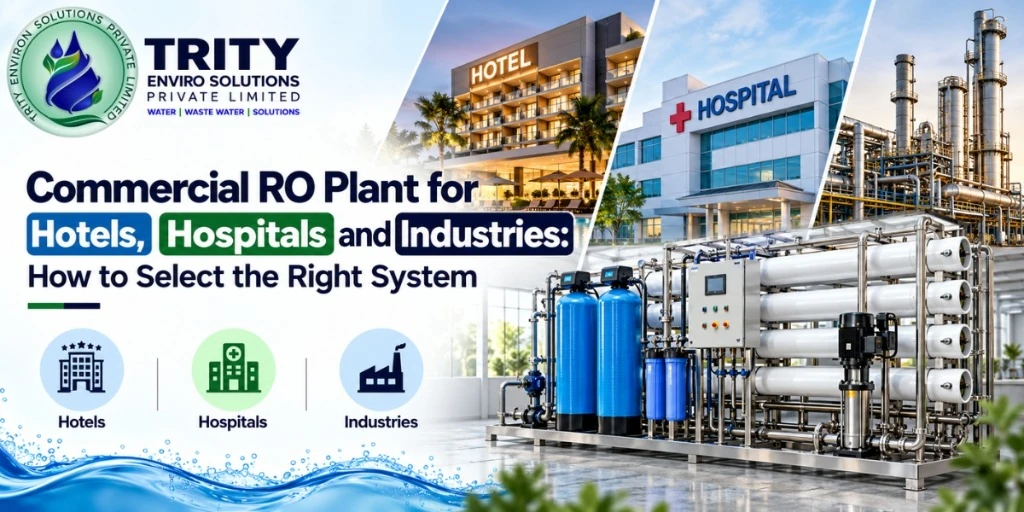
Commercial RO Plant for Hotels, Hospitals and Industries: How to Select the Right System
Choosing a commercial RO plant for a hotel, hospital or industry? Learn how to size capacity, read feed water reports, compare quotes and plan maintenance.

 ISO 9001:2015 & QCI Approved
Most factories install an ETP because the law says so. The factories that gain the most treat it as a water, risk and reputation asset. Here are the five benefits that actually show up on the balance sheet.
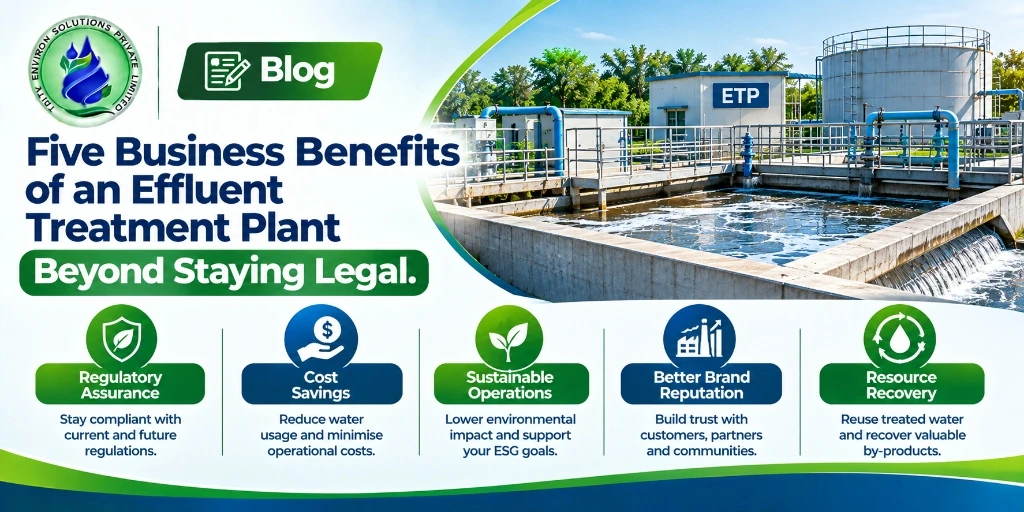
An effluent treatment plant (ETP) treats wastewater from industrial processes so it can be safely discharged or reused. It removes suspended solids, oils, chemicals, metals and organic load according to the industry's specific pollutants.
ETPs are not a niche. A 2020 CPCB report to the National Green Tribunal counted 64,484 Indian industries required to have one, of which 62,653 had operating systems.
The five benefits below explain why those industries, and the ones still catching up, are better off with a well-designed plant than a minimum-compliance one.
Industrial wastewater is regulated under the Water (Prevention and Control of Pollution) Act, 1974:
The Water (Prevention and Control of Pollution) Amendment Act, 2024 replaced many jail terms with monetary penalties:
A functioning ETP is the cheapest insurance against all of these.
Treated effluent can substitute for fresh water in many places:
A wastewater recycling system designed for the target quality turns the ETP into a second water source.
Reuse savings are easy to estimate:
Our guides on the economic payback period of ETP and STP investment and the operational costs of ETP and STP systems show how to build the full picture.
Loss of consent stops production. A reliable ETP:
A well-run plant also reduces day-to-day surprises:
Large buyers audit their suppliers:
Sustainability reporting is moving down the supply chain:
Untreated effluent carries chemicals and pathogens. Treating it reduces:
Treatment can turn waste into value:
The benefits depend on the plant matching the effluent:
| Industry | Typical Effluent Challenge | Core ETP Approach |
|---|---|---|
| Textile and dyeing | Colour, salts, COD | Coagulation, biological, RO or ZLD |
| Pharma and chemical | High COD, solvents, toxic loads | Pretreatment, biological, advanced oxidation |
| Food and dairy | Fats, high BOD | DAF, biological |
| Metal finishing | Heavy metals | Chemical precipitation, filtration |
| Engineering and automotive | Oil and coolant | Oil separation, physico-chemical |
| Benefit | Where It Matters Most | What to Measure |
|---|---|---|
| Compliance | All regulated units | Discharge vs standard, consent status |
| Water reuse | Water-stressed districts | KL reused per day, avoided cost |
| Risk reduction | Units near homes or rivers | Inspection history, notices |
| Market access | Exporters and branded suppliers | Audit results, certifications |
| Safety | Wet processes, chemical units | Incident and complaint records |
Trity Environ Solutions is a trusted effluent treatment plant manufacturer in Ghaziabad, delivering ETPs, ZLD systems and recycling plants for industries across Delhi NCR and India. Trity Enviro starts every project with an effluent analysis, then designs the treatment train, from physico-chemical to biological and reuse stages, around your actual pollutants.
As an experienced ETP manufacturer and supplier, we back every plant with an Annual Maintenance Contract so the benefits above continue after commissioning. We are ISO 9001:2015 certified, QCI approved, and deliver CPCB-compliant engineering nationwide.
Speak directly with our senior environmental engineers for technical guidance, sizing calculations, or a tailored project proposal.
Call +91-9821030072 or email enquiry@trityenviro.com
Choosing a commercial RO plant for a hotel, hospital or industry? Learn how to size capacity, read feed water reports, compare quotes and plan maintenance.

The real innovations shaping RO plant technology in 2026: graphene membranes, ultra-low-pressure RO, AI optimization, and next-gen ZLD integration.

Commercial RO (Reverse Osmosis) plants have become increasingly popular in recent years as a reliable solution to provide clean drinking water.











Discuss your requirements with our engineering team and get practical guidance for your project.

