Introduction: Dust Is the Whole Problem
A stone crushing unit does not discharge process wastewater or stack gases in the way a chemical factory does. Its pollution problem is simpler and harder to hide: dust. Every time a truck unloads rock, a jaw crusher breaks it, a screen shakes it and a conveyor drops it onto a pile, fine particles lift into the air. They travel to nearby homes, fields and roads, and they settle on leaves, on vehicles and in lungs.
This is why regulators have focused on crushers. The Central Pollution Control Board (CPCB) issued Environmental Guidelines for Stone Crushing Units in July 2023 and circulated them to state boards. Submissions before the National Green Tribunal show that state boards and CPCB now use these guidelines as a compliance checklist, with units asked to report their status against each measure. In the National Capital Region, the Commission for Air Quality Management (CAQM) has gone further. Its August 2026 review recorded a direction to bring the CPCB guidelines into the conditions of the Consent to Operate for stone crushers in the NCR.
For a crusher owner, this changes the question from "should we control dust?" to "will our consent be renewed if we do not?" This guide explains what the CPCB guidelines expect, how enclosures, water mist, dust extraction and housekeeping work together, what to buy and what to maintain. It is written for owners and managers of stone crushing, screening and aggregate units, and for the consultants who advise them. It is a practical overview, not legal advice, so read the full guideline and your consent conditions.
What the CPCB Guidelines Expect
Measures by Crushing Stage
The July 2023 guidelines describe measures stage by stage, in a checklist format that state boards use to inspect units. The main points, as reflected in compliance reports filed before the Tribunal, are:
- Unloading and storage of raw material: Water sprinkling with adequately designed nozzles to wet material and suppress dust.
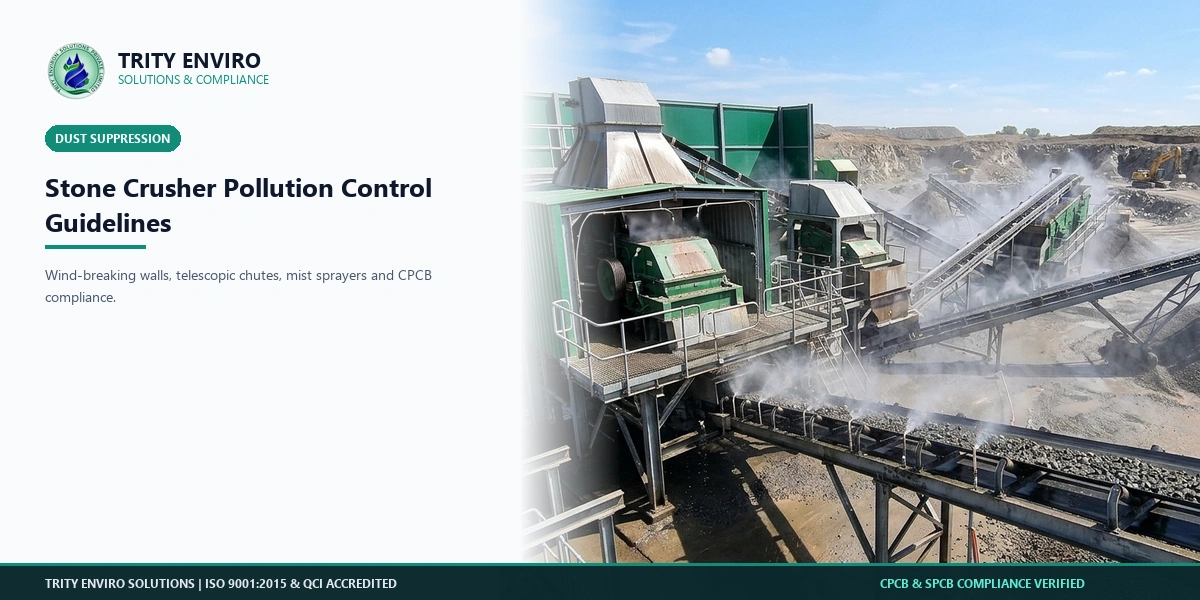
- Primary crushing (jaw crushers): Crushers placed in a covered section, with enclosure by GI or MS sheets on top and sides, and water spray or mist systems at the feed and discharge points.
- Secondary crushing and screening: Enclosed crushers and screens, with a dust extraction system where required and water mist sprinkling.
- Tertiary crushing: Enclosure, dust extraction and mist sprinkling for units that produce fine products such as stone dust and sand.
- Conveyors: Covered belts without side gaps, with sprinkling arrangements on each belt and at transfer points.
- Transport and roads: Paved internal roads, regular sweeping or washing and water sprinkling on roads to limit resuspension of dust. Trucks should be covered.
Water, Green Belt and Housekeeping
The guidelines also set expectations on water and boundary measures. Water used for sprinkling is expected to be measured, with records, and units that use groundwater need the required permission from the Central Ground Water Authority or the state authority. Settling and recycling of water from sprinkling and washing is encouraged to cut consumption. A green belt of several rows of trees is expected around the unit, in line with the plan approved by the board, with attention to upwind and downwind sides. Units are also expected to keep stockpiles wetted or covered, to clean accumulated dust, to maintain records and to meet applicable emission or ambient air norms.
New crushers are also expected to meet siting conditions, such as distance from habitation, as set by the guideline and state rules. Check the full text for the figures that apply to your state.
Dust Control Technologies and How They Work
Enclosures and Covered Conveyors
The first rule of dust control is to stop dust escaping. An enclosure around a crusher or screen traps the dust cloud near its source so that it can be captured or settled. Enclosures can be made of GI or MS sheet, with access doors, sealed joints and rubber skirts at feed and discharge points. Conveyor covers prevent wind from stripping dust off moving stone. Cover joints must be tight, since gaps let dust escape and defeat the purpose.
Enclosures work best together with capture. An enclosure without extraction or spray simply holds dust that then leaks out at every opening.
Water Mist, Fogging and Dust Extraction
- *Water sprinkling and mist systems** wet the stone and capture airborne particles. The guidelines point to nozzles that produce fine droplets, since large drops fall too fast and miss fine dust. Fine mist and fogging systems, and in some cases anti-smog guns for yards, are more effective and use less water than coarse sprays. Nozzles must be positioned at each dust source, protected from clogging with filters and kept in working order. Some compliance reports mention interlocking the spray system with the crusher so that the crusher cannot run without water.
- *Dust extraction systems pull dusty air from hoods at crushers, screens and transfer points through ducts to a dust collector**, usually a pulse jet bag filter, where the dust is captured and returned to the process or stored. This is the most effective method for fine dust, and it is the best option where water is scarce or where wet material would harm the product, such as in the production of manufactured sand. It needs correct hood design, duct velocity, filter sizing and maintenance. Our industrial dust collector selection guide explains how to size the system, and our comparison of bag filter vs wet scrubber vs ESP helps you choose between technologies.
Many units use both: water for coarse dust and wetting, and extraction for fine dust at the dustiest points. Choose the mix by dust source, water availability and product needs.
Making the System Work Day to Day
Operation, Maintenance and Records
A dust control system is only as good as its daily operation. Check nozzles for blockage every shift. Keep water tanks full and pumps in good condition. Replace damaged enclosure sheets, door seals and conveyor covers quickly. Empty dust collector hoppers on schedule, check bags and cleaning air and keep a log of differential pressure readings. Sweep and wash roads on a fixed routine. Fix leaks at transfer points, since a small gap can produce a visible plume.
Keep records. A simple register can note the date of nozzle checks, water use, collector maintenance, bag replacement, road cleaning and green belt maintenance. Photographs with dates help to show the status of each measure. Install a water meter and an energy meter on the sprinkler system if the guidelines or your board require it.
Inspection Readiness
Inspectors typically walk through the plant, compare what they see with the checklist and check records. They look for visible dust at crushers, screens and conveyors, working sprinklers at each point, covered conveyors, paved roads, a living green belt, water records and permissions. A unit that has the measures in place but not working, such as blocked nozzles or torn covers, will score as poorly as one that does not have them. Do a self-audit before each consent renewal and before the dry season, when dust problems peak. Where your unit is in the NCR, also read our article on GRAP rules for industries, since dust control is a recurring item at every stage.
Cost, Planning and Choosing a Supplier
Budgeting the Dust Control Package
A complete package includes enclosures and covers, spray and mist nozzles with pumps, tanks and piping, dust extraction hoods, ducting and a bag filter with fan and hopper, paved roads, a water treatment or recycling arrangement, a green belt and monitoring. Prices depend on the plant capacity, number of crushers and screens and layout. Running costs include water, power for pumps and fans, bag replacement, manpower and maintenance.
Weigh this against the cost of non-compliance: notices, environmental compensation, closure and lost production. In dry or water scarce areas, extraction may cost more to buy but less to run than heavy water use, and it avoids problems with muddy yards and wet product.
Questions to Ask Before You Order
- Which guideline items and consent conditions does your design address, point by point?
- How did you size the extraction airflow and the water system for my crusher and screen capacities?
- What outlet dust level do you guarantee from the collector, and how is it measured?
- What is the water consumption, and can the water be recycled?
- What spares, service and training do you provide?
- Can you provide a compliance checklist and photographs for the board?
- What is the delivery and installation time?
Our products page lists our air pollution control equipment, our project execution team can handle design and installation, and an annual maintenance contract keeps filters, pumps and nozzles in working order.
Water Management and Recycling in a Crusher Unit
Dust suppression uses water, and in dry regions water supply can limit how well it works. Collect runoff and wash water in a settling pit or tank, let the fines settle and recycle the clear water to the sprinklers and fog nozzles. Keep pits cleaned so that they do not fill with silt. Meter the water drawn from borewells or tankers, and check whether your site needs groundwater permission. A simple recycling loop can cut freshwater use sharply and keeps the spray system running during dry spells, when dust is at its worst.
Industry Comparison / Operational Parameter Table
| Parameter / Stage |
Target Optimal Range |
Failure Impact / Risk |
Corrective Engineering Action |
| Crusher and screen enclosure |
Fully covered with sealed joints and skirts |
Visible dust plumes, notices |
Repair sheets, seal gaps, add skirts at feed and discharge |
| Water mist at dust points |
Fine droplets at every source, working at all times the plant runs |
Dust escapes, wet product or heavy water use |
Fit proper nozzles, filters, interlocks and pump backup |
| Dust extraction and bag filter |
Designed airflow, steady pressure drop, low outlet dust |
Dust leaks at hoods, blinded bags |
Resize fan, fix ducts, tune cleaning, replace bags |
| Roads and green belt |
Paved, cleaned and sprinkled roads, several rows of trees |
Resuspended dust, boundary complaints |
Pave and sweep roads, replant and maintain the green belt |
Why Choose Trity Enviro
Trity Environ Solutions is an ISO 9001:2015 certified and QCI-approved dust collector and air pollution control equipment manufacturer and supplier in India, delivering robust, high-efficiency systems engineered for CPCB and SPCB regulatory compliance.
Every installation is supported by pan-India Annual Maintenance Contract and Operation and Maintenance services.
Free Engineering Consultation
Stone Crusher Pollution Control: CPCB 2023 Guidelines, CAQM Conditions and Dust Collection Systems
Looking to upgrade, size, or install a high-performance system? Speak directly with our senior environmental engineers today for expert sizing calculations, CPCB/SPCB compliance support, and turnkey execution. Call +91-9821030072 or email enquiry@trityenviro.com.
Request a Free Site Assessment