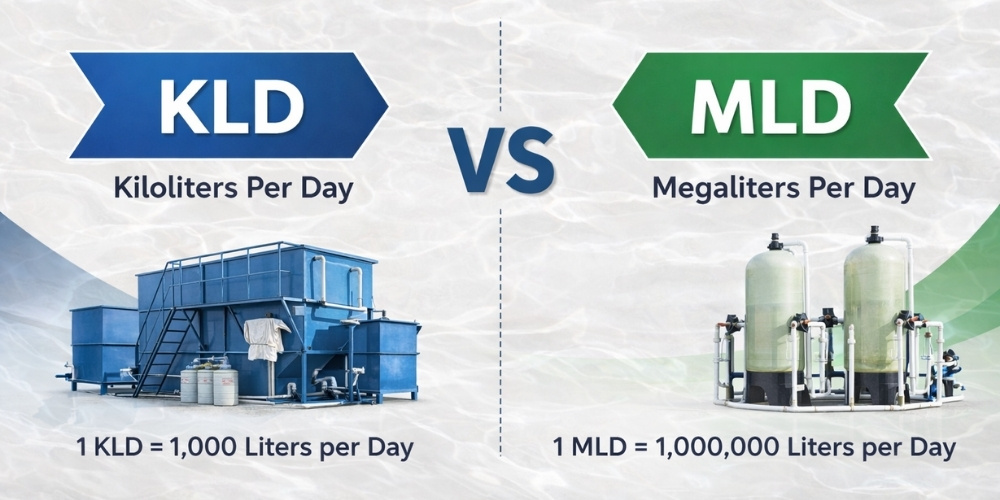
What are KLD and MLD in Water and Wastewater Treatment? Complete Guide
Confused about KLD and MLD in water treatment? Learn their full forms, key differences, conversion formula, and how they impact STP and ETP plant design in India.

 ISO 9001:2015 & QCI Approved
The right choice depends on your dust, your gas temperature and your site, not on which technology sounds most advanced. Here is a clear comparison to help you decide.
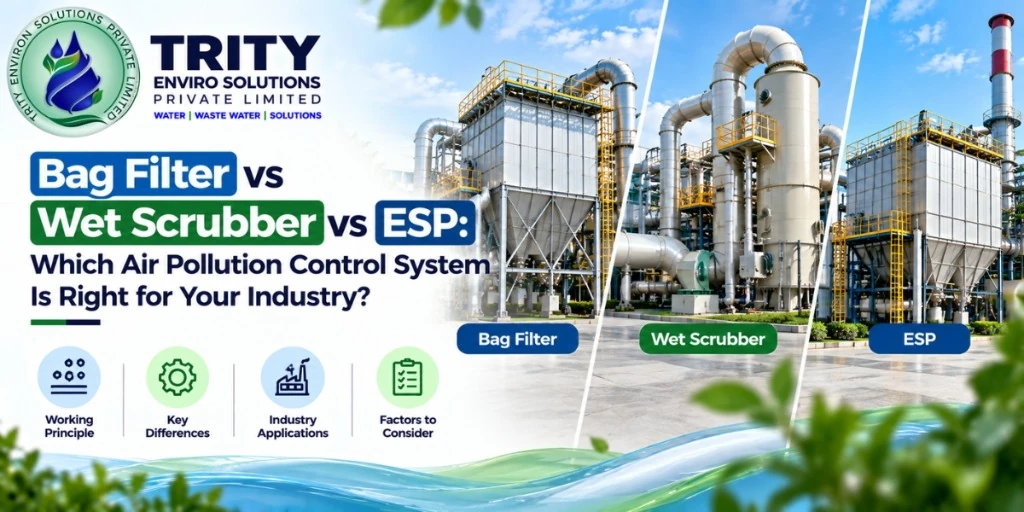
If you ask three suppliers how to meet a dust emission limit, you will often hear three different recommendations: a bag filter, a wet scrubber or an electrostatic precipitator (ESP). Each supplier is sincere, and each recommendation may be correct for the supplier's favourite application. The question you need answered is different: which one is right for your gas?
The three technologies work in different ways. A bag filter strains dust through fabric. A wet scrubber washes dust and gases out with liquid. An ESP charges dust particles with high voltage and pulls them onto collecting plates. Because the physics differ, so do the limits. Temperature, moisture, dust resistivity, stickiness, explosion risk, wastewater, footprint and operating cost all shift the balance.
This guide compares the three on the points that matter for a real purchase. It is written for plant heads and EHS officers in boiler, furnace, cement, steel, foundry, chemical, food and process industries who need to pick a system and defend the choice in a design review or a board meeting.
In a bag filter, dust laden gas passes through fabric bags or cartridges. Dust collects on the outside of the fabric, forming a layer called the dust cake that does much of the actual filtering. Periodically, a short burst of compressed air pulses through the bags and knocks the cake into a hopper. Bag filters reach outlet dust levels well below 50 mg/Nm³ in most applications and can go far lower with the right media, which makes them a strong option for modern emission limits.
They work best on dry, non-sticky dust at moderate temperatures. Their weak points are moisture, acid dew point and fire risk. If gas cools below dew point, wet dust blinds the fabric and corrodes the housing. Hot embers can burn bags unless a spark arrestor or cooling stage protects them.
A wet scrubber brings gas into contact with liquid, usually water or a chemical solution. Types include spray towers, packed towers and venturi scrubbers. A venturi scrubber accelerates gas through a narrow throat where water droplets collide with dust particles, and it can capture fine dust at the cost of a high pressure drop. Packed and spray towers are better for gas absorption and coarser dust.
Scrubbers shine where gas is hot, wet, sticky or flammable, and where acid gases need removal along with dust. They do not suffer from bag blinding or ignition. Their drawbacks are water use, scrubber liquor that has to be treated, corrosion in acid service, plume visibility and sludge handling.
An ESP gives dust particles an electric charge as they pass through a field between discharge electrodes and collecting plates. The charged particles migrate to the plates, and rappers shake the dust into hoppers. ESPs handle very large gas volumes at low pressure drop and tolerate high temperatures, so they suit large boilers, cement kilns and metallurgical plants.
Performance depends on dust resistivity, which changes with fuel, temperature and moisture. Very high resistivity dust, such as fly ash from low sulphur coal, can cause back corona and poor collection, and very low resistivity dust can slip off the plates. ESPs also need careful electrical maintenance and a larger footprint.
All three can achieve high efficiency when properly designed. Bag filters and ESPs typically reach 99 percent or more, and a well chosen fabric filter often gives the lowest and most consistent outlet dust, including fine particles. Venturi scrubbers can approach comparable numbers on particles above about one micron, but they need high pressure drop, so energy cost rises quickly. For tight limits such as the 50 mg/Nm³ standard now applicable to covered industries in Delhi-NCR, explained in our article on the Delhi-NCR PM emission standard, a bag filter or a well sized ESP is the usual route for dry dust.
Gas temperature limits the media in a bag filter. Common polyester felt serves up to roughly 130 °C, PPS up to around 190 °C, and higher temperature media such as P84 or glass fibre with membranes go well above that. Always check the manufacturer's rating and leave margin for upsets. ESPs and scrubbers are far less constrained by temperature, though scrubbers cool the gas as a side effect.
Moisture and stickiness favour scrubbers. Combustible or explosive dust also pushes designers toward scrubbers, or toward bag filters with proper explosion protection and spark control. Abrasive dust wears bags and ducts, so a cyclone ahead of a bag filter often extends life.
Resistivity is the electrical resistance of the dust layer. ESPs work best in a middle range, roughly 10^4 to 10^10 ohm-cm. Outside that band, performance drops. Gas conditioning with moisture or chemical additives can bring resistivity back into range, and this is one reason ESP design needs fuel and ash data, not just gas volume.
A pulse jet bag filter typically runs at a pressure drop in the range of 100 to 200 mm water column. An ESP runs far lower, often in the range of 10 to 20 mm. A venturi scrubber can run several times higher than a bag filter. Higher pressure drop means a stronger fan and more power every hour of operation.
A scrubber consumes water and produces wastewater, which must be treated before reuse or discharge. A properly planned effluent treatment plant closes that loop. Bag filters and ESPs produce dry dust that needs safe handling and disposal. ESPs take the most space, scrubber towers the most height and bag filters sit in between.
Typical matches, with the usual caveat that your own gas data decides:
Many plants use more than one device. A cyclone ahead of a bag filter removes coarse dust and protects the fabric. A bag filter followed by a scrubber removes dust first and then absorbs acid gases. A scrubber ahead of a mist eliminator is common on high humidity streams. Do not accept a single-device answer by default, since the right system may be a train.
For a broader process to follow before any purchase, see our guide on how to choose an air pollution control system for your factory.
Whatever device you choose, you end up with something to handle. Bag filters and ESPs collect dry dust that can be combustible, irritating or hazardous, so hoppers need safe discharge through rotary valves or sealed containers, and operators need dust masks and clear procedures. Scrubbers produce slurry or liquor that may be acidic or alkaline and needs corrosion resistant piping, controlled dosing and safe sampling points. Fire risk is highest in bag filters collecting combustible dust or receiving hot embers, so ask about spark arrestors, temperature alarms and, where needed, explosion venting. Whichever system you pick, decide in advance where the collected dust or sludge will go and who will transport it, because storage problems often appear within weeks.
In broad terms, a bag filter has moderate capital cost, with running cost from fan power, compressed air and bag replacement. An ESP has high capital cost and low pressure drop, with lower fan power but skilled electrical maintenance. A scrubber often has lower capital cost for small flows, with running cost from pumps, water, chemicals and liquor treatment.
Look at five year cost, not purchase price. Include fan power, spares such as bags, cages, valves, rappers and nozzles, water and chemical use, wastewater treatment and manpower. A system that costs less to install but demands constant attention seldom wins on total cost.
Our team can assess your gas data and propose the right system, and you can explore related equipment on our products page. Continuous monitoring through a SOx-NOx gas analyzer helps you prove performance after commissioning, and an annual maintenance contract keeps bags, valves and fans on schedule.
| Parameter / Stage | Target Optimal Range | Failure Impact / Risk | Corrective Engineering Action |
|---|---|---|---|
| Bag filter pressure drop | Typically 100 to 200 mm water column, steady | Blinded bags, low airflow, high outlet dust if bags tear | Tune pulse cleaning, replace bags, keep gas above dew point |
| ESP dust resistivity | Roughly 10^4 to 10^10 ohm-cm | Back corona, low collection, high stack dust | Condition gas, adjust fuel or temperature, upgrade fields |
| Scrubber liquor pH and flow | Set for the pollutant, with steady flow and nozzle pattern | Poor gas absorption, scaling, corrosion | Automate dosing, clean nozzles, treat blowdown properly |
| Gas temperature at device inlet | Within media or material rating | Burnt bags, plate warping, scrubber damage | Add cooling, spark arrestor or quench, select suitable material |
Trity Environ Solutions is an ISO 9001:2015 certified and QCI-approved air pollution control equipment manufacturer and supplier in India, delivering robust, high-efficiency systems engineered for CPCB and SPCB regulatory compliance.
Every installation is supported by pan-India Annual Maintenance Contract and Operation and Maintenance services.
Speak directly with our environmental engineering specialists for system sizing, CPCB/SPCB compliance review, or a tailored technical proposal.
Request Free Engineering ConsultationCall: +91-9821030072 | Email: enquiry@trityenviro.com
Confused about KLD and MLD in water treatment? Learn their full forms, key differences, conversion formula, and how they impact STP and ETP plant design in India.

STPs and ETPs help companies achieve CSR goals, reduce pollution, conserve water, and comply with regulations, contributing to a sustainable future and better brand image.

Learn how machine learning optimizes aeration in sewage treatment plants, cutting energy use, improving compliance, and supporting sustainability




Discuss your requirements with our engineering team and get practical guidance for your project.