Compact STP Design Strategies That Actually Work in Dense Urban Sites
Compact STP design strategies for urban areas with real space-saving data: MBBR, MBR technology, basement integration, and odour control.

 ISO 9001:2015 & QCI Approved
Learn how economic valuation of wastewater works in India, from CPCB-driven ZLD mandates to replacement cost and shadow pricing methods for industries.

For most Indian industries, wastewater still shows up on the balance sheet as a cost line: effluent treatment plant operation, sludge disposal, compliance testing, and the occasional penalty. What rarely shows up is the other side of the ledger, the value wastewater creates or destroys once you actually measure it.
Economic valuation of wastewater is the practice of assigning a monetary figure to used water based on what it costs to treat, what it saves when reused, what it damages when discharged untreated, and what it could earn if managed as a resource rather than a waste stream. This is not an academic exercise anymore. With India tightening Zero Liquid Discharge (ZLD) mandates, state governments rolling out water reuse policies, and freshwater becoming measurably more expensive, the economic value of wastewater has become a real line item that affects capital planning, compliance strategy, and operating cost.
This guide breaks down how that valuation actually works, the methods economists and regulators use to calculate it, and what it means in practical terms for an industrial facility operating in India today.
Economic valuation of wastewater means quantifying the full cost and benefit profile of a wastewater stream across its lifecycle: extraction, use, treatment, discharge or reuse, and downstream impact. It covers three distinct categories of value.
Direct use value captures what treated wastewater is worth when substituted for freshwater in irrigation, industrial process water, cooling towers, or construction. This is the easiest value to measure since it has a market price benchmark, the cost of freshwater it replaces.
Avoided cost value captures what a facility saves by not paying for freshwater procurement, not paying disposal or transport charges for untreated effluent and sludge, and not incurring regulatory penalties for non-compliance.
Non-market value captures the harder-to-price impacts: damage to river ecosystems from untreated discharge, public health costs from contaminated groundwater, and the loss of ecosystem services that healthy water bodies provide. These effects are real but do not appear in any invoice, which is exactly why economists developed specific methods to estimate them.
India holds roughly four percent of the world's freshwater resources while supporting close to eighteen percent of the global population, a structural imbalance that puts sustained pressure on every sector competing for water. That scarcity is precisely what has pushed policymakers to stop treating wastewater purely as a disposal problem and start treating it as a supply source.
The shift is visible in recent policy. The National Mission for Clean Ganga has published a National Framework for Safe Reuse of Treated Wastewater, intended to help states build reuse policies and functioning economic models around treated effluent rather than simply mandating its discharge. Under the Namami Gange programme's Arth Ganga component, monetisation and reuse of treated wastewater and sludge is one of the explicit intervention areas, with sludge being converted into pavers, bricks, and manure for direct revenue generation rather than land-filled as waste.
State-level policy has moved even further. Uttar Pradesh's cabinet approved a Safe Reuse of Treated Water Policy in 2026 targeting fifty percent reuse of treated wastewater by 2030 in cities where sewage treatment infrastructure already exists, explicitly framing the shift as a move from a treat-and-dispose model to a circular water economy. Prayagraj alone has proposed projects worth roughly sixteen hundred crore rupees to enable reuse of over a hundred million litres of treated water per day. Separately, Maharashtra has piloted a Wastewater Reuse Certificate framework, effectively creating a tradeable market instrument for treated effluent, an approach that only works once wastewater has an agreed economic value attached to it.
Independent research from the Council on Energy, Environment and Water estimated the market value of treated wastewater available in India at over sixty three crore rupees in 2021, projected to rise past eighty three crore rupees by 2025 as reuse infrastructure and demand both expand. These are not abstract academic estimates. They represent real revenue potential that most Indian industrial and municipal facilities are currently leaving untapped by treating wastewater purely as a compliance cost.
Environmental economists rely on a small set of established methods to convert wastewater's costs and benefits into comparable monetary terms. Each method answers a slightly different question, and most rigorous valuation exercises combine two or three of them.
Replacement cost method: This estimates value based on what it would cost to replace the function that treated wastewater provides. If reused effluent substitutes for freshwater in a cooling tower, its value is benchmarked against the cost of sourcing, treating, and delivering an equivalent volume of freshwater. This is the most commonly used method for industrial wastewater valuation because it relies on real, verifiable market prices rather than surveyed opinions.
Shadow pricing: Used when no direct market price exists for a resource, shadow pricing estimates the true opportunity cost of water based on its next best alternative use. For water-stressed regions, the shadow price of freshwater diverted to industrial use, instead of agriculture or municipal supply, is typically far higher than the metered tariff a facility actually pays. Shadow pricing is often used in policy analysis to demonstrate why treated wastewater reuse creates more social value than its accounting cost suggests.
Avoided cost method: This calculates the direct costs a facility avoids by treating and reusing wastewater instead of discharging it and disposing of the resulting sludge and effluent. It includes avoided freshwater procurement costs, avoided Common Effluent Treatment Plant usage fees, avoided Treatment, Storage, and Disposal Facility charges for sludge, and avoided regulatory penalties. Because every input in this method is a real invoice line rather than a survey response, it is the method most industrial finance teams find persuasive when building an investment case for treatment upgrades.
Contingent valuation method: This estimates non-market value by surveying what people would be willing to pay to prevent water pollution, or willing to accept as compensation for degraded water quality. It is used primarily by researchers and government bodies assessing the broader social cost of untreated discharge into rivers like the Ganga and Yamuna, where health and ecosystem impacts are real but have no direct market transaction attached to them.
Hedonic pricing method: This infers value indirectly through its effect on related market prices, most commonly property values near polluted versus clean water bodies. Riverside or lakeside properties near heavily polluted stretches consistently sell at a discount compared to equivalent properties near clean water, and that price gap is used to estimate the implicit cost of water pollution on the local economy.
For an industrial plant, the most immediately usable form of economic valuation is avoided cost, because it converts abstract environmental economics into numbers a finance team already tracks.
Freshwater procurement savings: A facility that recovers ninety to ninety five percent of process water through a properly designed treatment and reuse system, the standard performance band for a well-engineered ZLD system, directly cuts its freshwater intake by the same margin. For a plant consuming five hundred kilolitres per day, that translates to recovering roughly four hundred fifty to four hundred seventy five kilolitres daily that would otherwise need to be sourced, transported, and paid for.
Sludge disposal cost avoidance: This is one of the most underestimated components of wastewater economics. Wet sludge at ninety five to ninety eight percent moisture is charged by both weight and volume for transport and disposal. Treatment, Storage, and Disposal Facility charges in India currently range from roughly three thousand to twelve thousand rupees per tonne depending on waste classification, and reducing sludge moisture from ninety five percent to seventy five percent through proper dewatering can cut disposable tonnage by seventy to eighty percent. For a mid-sized facility, that single change can move a recurring six to seven figure annual expense into a fraction of its previous size, and the capital cost of the dewatering system is frequently recovered within eighteen to thirty six months from disposal savings alone.
Avoided CETP and effluent disposal charges: Facilities discharging into a Common Effluent Treatment Plant pay ongoing fees based on volume and pollutant load. A facility that treats and internally reuses its own wastewater removes this recurring cost from its operating budget entirely, converting a variable liability into a fixed, depreciating capital asset.
Avoided regulatory penalties: Non-compliance with the Water Act carries fines, daily penalties for continuing violations, and in serious cases, Consent to Operate cancellation. Avoiding a single show-cause notice or forced closure event routinely exceeds the annual operating cost of a compliant treatment system, which is why regulatory risk avoidance is now treated as a quantifiable economic benefit in most industrial wastewater investment cases.
Beyond the numbers a facility's own ledger captures, there is a broader economic value that shows up at the river basin or city level rather than the plant level.
Untreated or poorly treated discharge degrades downstream water quality, raising treatment costs for every municipality and industry drawing water further downstream. It reduces the productivity of fisheries and agriculture dependent on that water source, and it increases public health expenditure linked to waterborne disease in communities using contaminated groundwater. None of these costs appear on the discharging facility's books, but they are real economic costs borne elsewhere in the system, which is exactly the gap that contingent valuation and shadow pricing studies are designed to expose and quantify for policymakers.
On the benefit side, treated wastewater reused for groundwater recharge, urban landscaping, or agricultural irrigation preserves freshwater stocks for higher-value uses and reduces the rate of groundwater depletion in water-stressed districts. Given that India's National Framework for Safe Reuse of Treated Wastewater explicitly aims to build market and economic models around this reuse, facilities that adopt reuse early are positioning themselves ahead of a regulatory direction that is clearly accelerating rather than slowing down.
The economic case for valuing wastewater is being reinforced from the regulatory side as much as the market side. The Central Pollution Control Board has mandated Zero Liquid Discharge for specific high-pollution sectors, including textile dyeing and printing, pharmaceutical and bulk drug manufacturing, tanneries, sugar mills, distilleries, and paper and pulp units, particularly in water-stressed regions. This is not a blanket requirement across all industry, but the scope has expanded steadily and State Pollution Control Boards are enforcing it with increasingly aggressive monitoring, including mandatory Online Continuous Emission Monitoring Systems for medium and large facilities.
Facilities operating under these mandates face a direct financial choice: absorb the recurring cost of non-compliance, or make the capital investment in treatment and reuse infrastructure that converts a compliance obligation into a documented, recoverable economic asset. Export-oriented manufacturers face an additional commercial pressure here, since ZLD certification and documented water reuse increasingly factor into ESG scoring and supply chain due diligence required by international buyers.
Turning wastewater from a cost center into a measurable economic asset follows a fairly consistent sequence in practice.
Start with effluent characterisation. Every valuation method above depends on knowing exactly what is in your wastewater, its volume, TDS, BOD, COD, and contaminant profile. Without this baseline data, neither avoided cost calculations nor treatment system sizing can be done accurately.
Size the treatment stack to your actual reuse target. A facility aiming for internal process water reuse typically needs an ultra filtration system or effluent treatment plant stage ahead of a commercial RO plant, while facilities targeting near-total ionic purity for boiler feed or pharmaceutical use should also evaluate a DM water plant downstream of RO.
Address sludge dewatering early, not as an afterthought. Given how disproportionately sludge disposal cost inflates when moisture content is left unmanaged, a properly specified sludge dewatering system is frequently the single fastest payback item in an entire wastewater economics case.
Evaluate ZLD as a capital decision, not just a compliance one. For facilities already facing mandatory ZLD requirements, running the full replacement cost and avoided cost analysis, freshwater savings, disposal savings, and penalty avoidance, against the capital cost of a properly engineered Zero Liquid Discharge system typically shows a materially different payback picture than looking at ZLD purely as a regulatory expense.
| Cost Factor | Treat and Discharge | Treat and Reuse |
|---|---|---|
| Freshwater procurement | Full ongoing requirement | Reduced by 70-95% depending on system design |
| Sludge disposal | Full TSDF/landfill charges on wet or partially dewatered sludge | Same charges, but on 70-80% less tonnage after proper dewatering |
| CETP/effluent disposal fees | Ongoing, scales with volume and load | Eliminated or sharply reduced |
| Regulatory compliance risk | Ongoing exposure to CTO revocation and penalties | Reduced, particularly under ZLD mandates |
| Capital cost | Lower upfront | Higher upfront, offset by avoided recurring costs |
| ESG and export market positioning | Neutral to negative | Positive, supports compliance documentation for buyers |
| Long-term operating economics | Recurring liability that grows with regulation | Converts to a depreciating capital asset over time |
Independent analysis estimates the market value of treated wastewater available in India at over sixty three crore rupees in 2021, projected to exceed eighty three crore rupees by 2025 as reuse infrastructure expands. At the facility level, value is typically measured through avoided freshwater and disposal costs rather than a direct sale price.
The Central Pollution Control Board has mandated ZLD for specific high-pollution sectors including textile dyeing and printing, pharmaceutical and bulk drug manufacturing, tanneries, sugar mills, distilleries, and paper and pulp units, particularly in water-stressed regions. The requirement is not universal across all industries but continues to expand in scope.
The replacement cost method values treated wastewater based on what it would cost to source an equivalent volume of freshwater for the same purpose. It is the most commonly used method in industrial contexts because it relies on real, verifiable market prices rather than surveys or estimates.
Wet sludge is charged by weight and volume for transport and disposal. Reducing moisture content from around 95% to 75% through proper dewatering can cut disposable sludge tonnage by 70 to 80%, directly and substantially lowering the largest recurring cost in most industrial wastewater treatment budgets.
Contingent valuation surveys what people would be willing to pay to prevent pollution or accept as compensation for it, used to estimate non-market environmental costs. Hedonic pricing infers value indirectly through its effect on related market prices, most commonly the discount on property values near polluted water bodies compared to clean ones.
Viability depends on effluent volume, TDS levels, and current disposal costs, since ZLD carries a materially higher upfront capital cost than conventional treatment. Facilities already facing significant CETP fees, TSDF charges, and freshwater procurement costs typically see a stronger payback case, particularly where CPCB mandates ZLD directly and non-compliance risk is factored into the comparison.
Putting an accurate number on your wastewater starts with proper effluent and sludge characterisation. Contact our engineering team with your current water consumption and disposal cost data for a technical assessment of where treatment and reuse can convert a recurring cost into a measurable saving.
Compact STP design strategies for urban areas with real space-saving data: MBBR, MBR technology, basement integration, and odour control.
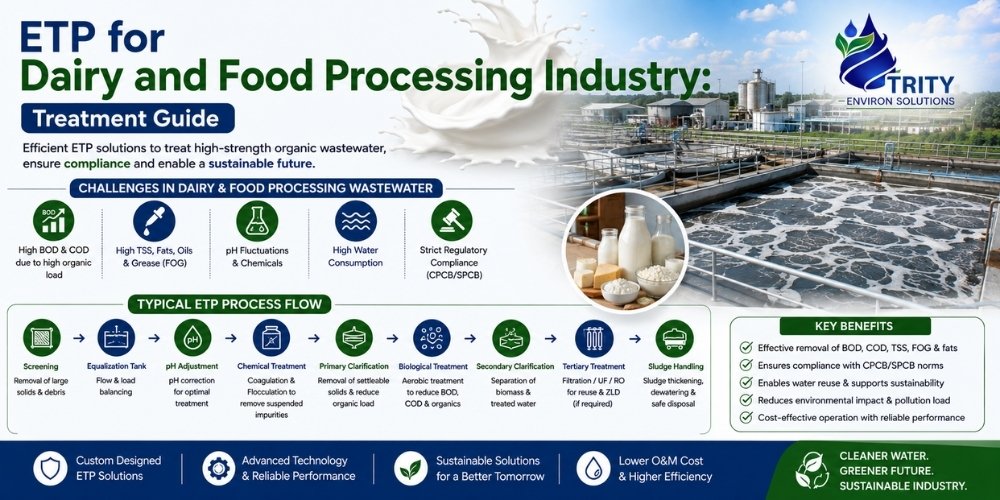
Dairy and food processing effluent carries high BOD, COD, and FOG that standard ETPs struggle with. See the treatment stages and technology choices that actually work.

How membrane bioreactors (MBR) improve wastewater treatment efficiency over conventional activated sludge, with real footprint and quality data.




Discuss your requirements with our engineering team and get practical guidance for your project.