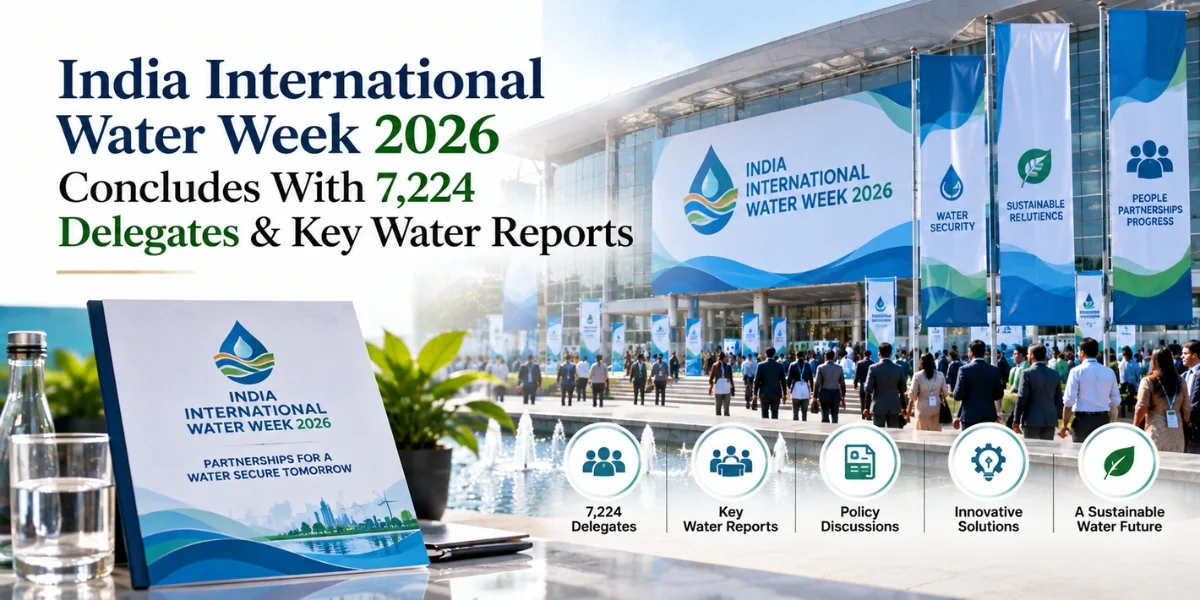
The 9th India International Water Week (IIWW) 2026 wrapped up its main deliberations with a Valedictory Session on September 25 at Bharat Mandapam, New Delhi, closing out a four-day conference that drew 7,224 delegates, 227 exhibitors and 119 research paper presentations under the theme "Climate Resilient Water Management." A day of study tours on September 26 rounded out the official programme, giving delegates on-the-ground exposure to selected water-management projects.
What Actually Got Released, Not Just Discussed
Conferences are easy to write off as talk-heavy, but IIWW 2026's closing session backed up its discussions with a genuine stack of concrete outputs. The Valedictory Ceremony saw the release of several publications, technical protocols and capacity-building modules, including books on sustainable irrigation, a new protocol for monitoring riverine macroplastics, and eight capacity-building modules developed under the Jal Jeevan Mission.
Perhaps more significant for anyone who actually works with water-sector data: the event also released results from the 1st Census of Major and Medium Irrigation Projects, the 7th Minor Irrigation Census, the 2nd Census of Water Bodies, and the 1st Census of Springs. These are the kind of baseline datasets that policy planning actually depends on, and having several of them land at once, tied to a single high-profile event, is a meaningfully different outcome than another round of panel discussions with no deliverables attached.
What the Ministers Actually Said Mattered
Union Jal Shakti Minister C.R. Patil, who chaired the Valedictory Ceremony, framed the week's takeaways around three priorities: greater public participation in water conservation, taking science and technology out of research papers and onto the ground, and strengthening both international and institutional cooperation. He also pointed to the Jal Jeevan Mission's continuing impact on expanding rural household tap water access as evidence that these priorities aren't abstract.
Additional Secretary and NJJM Mission Director Kamal Kishore Soan used his closing remarks to highlight outcomes from the Second WASH Conference held alongside IIWW, which brought together academic, research and field perspectives specifically on water, sanitation and hygiene. He emphasised continuous learning, data-driven governance and community-led assessment as the things that actually determine whether a water-sector intervention delivers lasting service outcomes, not just a successful launch event. A separate speaker at the ceremony stressed something that applies well beyond any one government programme: that the real test is whether investments get completed on time and effectively utilised, translating into measurable outcomes for people, agriculture, the economy and ecosystems, rather than stopping at ribbon-cutting.
Where This Fits in India's Broader 2026 Water-Sector Calendar
IIWW wasn't operating in isolation this year. It followed IFAT India 2026, a trade-focused water and waste infrastructure exhibition held in Mumbai from September 9 to 11 that drew over 20,000 business visitors and 500-plus exhibitors from more than 30 countries. Seeing a major policy-and-research event like IIWW follow close on the heels of a major trade-and-technology event like IFAT, within the same month, suggests India's water sector calendar for 2026 has been unusually dense, which is itself a signal of how much institutional and commercial attention water security is currently commanding.
On the specific theme of wastewater reuse, one of the seven broad areas IIWW's deliberations covered, the week's discussions reinforced a point that keeps surfacing across India's water-sector news this year: treated water, properly captured and distributed rather than discharged and forgotten, is increasingly central to how the country plans to close its water-security gap. That's as true for a wastewater treatment plant operator deciding what to do with treated effluent as it is for a national irrigation census trying to map where water actually goes.
Key Highlights
- IIWW 2026's main deliberations concluded with a Valedictory Session on September 25, 2026, at Bharat Mandapam, New Delhi.
- The four-day conference and exhibition drew 7,224 delegates, 227 exhibitors and 119 research paper presentations.
- Major outputs released included a riverine macroplastics monitoring protocol, eight Jal Jeevan Mission capacity-building modules, and four national census reports on irrigation, water bodies and springs.
- Union Minister C.R. Patil highlighted public participation, applied science and technology, and institutional cooperation as the week's three core priorities.
- Study tours on September 26 closed out the official IIWW 2026 programme, following the Valedictory Session.
Sources & Further Reading
This article is based on the official PIB press release on IIWW 2026's Valedictory Ceremony, and reporting from OpenGov Asia and Indian Masterminds.