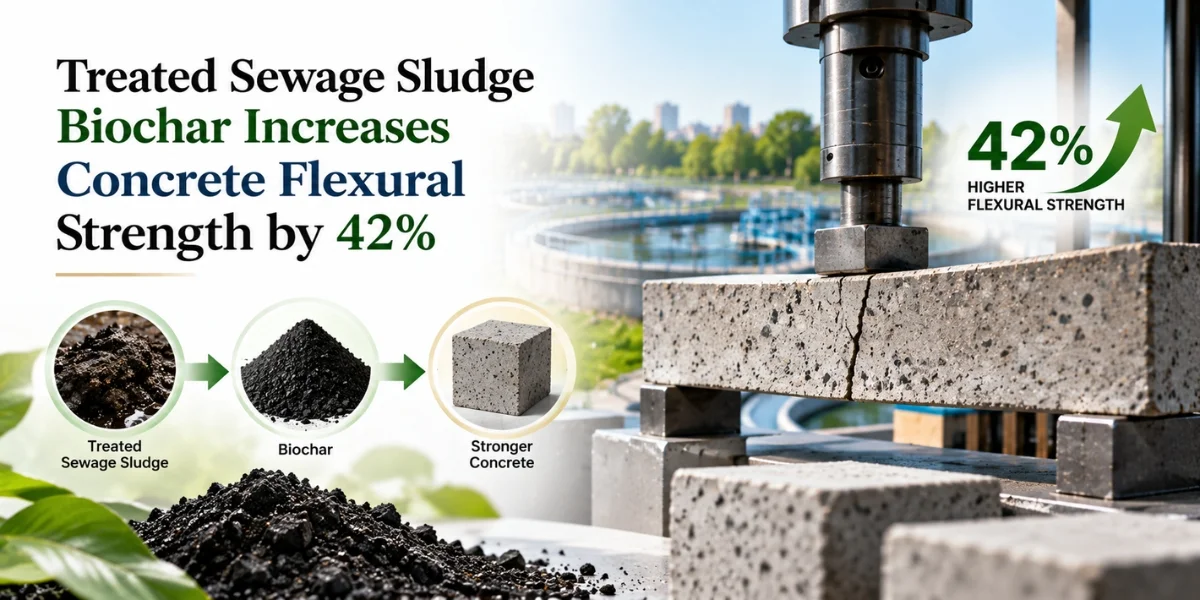
Here's a sentence you don't get to write often in a wastewater industry publication: scientists have made concrete stronger by mixing in human waste, and the data actually backs it up. A team led by civil engineer Raghuvesh Tiwari at Manipal University Jaipur has shown that biochar made from treated fecal sludge, when used to partially replace cement, can increase concrete's compressive strength by up to 21 percent and its flexural strength by as much as 42 percent. The study, accepted for publication in the journal Scientific Reports, was published September 5, 2026.
Where the Sludge Came From, and What Happened to It
The biochar used in this study wasn't pulled from just anywhere; it came from fecal sludge collected at a treatment facility in Warangal, Telangana, already a product of India's sanitation system rather than raw waste. The team dried and heated that sludge in an oxygen-limited environment at roughly 350 to 450 degrees Celsius, a process called pyrolysis, which converts organic material into a stable, carbon-rich solid. That biochar was then ground into a fine powder, sieved, and used to replace 5, 10 and 15 percent of the cement in otherwise standard concrete mixes.
The resulting specimens went through the full battery of tests you'd want before taking any concrete additive seriously: compressive strength, flexural strength, water absorption, drying shrinkage and porosity, tracked at 28, 56 and 91 days of curing, along with microscopic analysis of the concrete's internal structure.
The Numbers: Where the Sweet Spot Actually Is
The results weren't a simple "more biochar is better" story, which is exactly what you'd hope to see from rigorous testing rather than a press-release-driven headline. At the 5 percent cement replacement level, the concrete showed a 20 percent increase in compressive strength and a 36 percent increase in flexural strength after 91 days. Push the replacement up to 10 percent, and flexural strength climbed further, to that widely-cited 42 percent gain, while compressive strength settled at a 21 percent increase.
But at 15 percent replacement, the trend reversed. Microscopic analysis showed more cracking, more pores and weaker internal bonds at that higher substitution level, and overall strength fell behind both the 5 and 10 percent mixes. The researchers attribute the improvements at lower replacement levels partly to the biochar's porous structure, which can absorb water and gradually release it as the concrete cures, and partly to silica in the biochar reacting with curing products to form additional calcium silicates, the compounds that give concrete much of its strength in the first place. At 5 percent replacement specifically, the resulting concrete also showed a denser, more tightly bonded microstructure than conventional mixes, which tracks with why that ratio performed so consistently well across multiple tests.
The Question Everyone Should Be Asking: What About Heavy Metals?
This is the part of the story that deserves more attention than the headline strength figures usually get. Sewage sludge, even after treatment, can carry residual heavy metals, and turning it into a construction material raises an obvious question about whether those metals end up locked safely into the concrete matrix or pose a longer-term leaching risk. Reporting on the study notes the researchers found decreasing heavy-metal concentrations as biochar content increased in their specimens, an encouraging early signal, but the team has also explicitly flagged that performance under extreme temperatures, salt exposure and other environmental stresses, along with the possible release of heavy metals from sewage-based materials, will require further study before this moves anywhere near commercial-scale use.
That caveat matters more than it might seem. A material can be stronger in a 91-day lab curing test and still fail a longer-term environmental safety standard, and it's genuinely to the researchers' credit that they've flagged this gap themselves rather than letting the "42% stronger" headline stand unqualified.
Why This Matters Beyond the Lab
Step back from the specific numbers, and this research sits at an interesting intersection for anyone working in wastewater treatment: it's one more example of sludge, historically treated as a disposal problem, being reframed as a potential input for an entirely different industry. Cement production carries a well-documented, heavy carbon cost, and construction materials research has been actively hunting for viable partial replacements for years. If fecal-sludge biochar can clear the remaining durability and safety hurdles, it offers treatment plants a genuinely novel sludge-management pathway beyond the usual options of landfilling, incineration or agricultural land application, each of which carries its own tradeoffs.
For now, this remains firmly a research finding rather than a construction-ready product, but it's exactly the kind of work that could eventually reshape how facilities handling sewage treatment and sludge management think about what happens to solids after the water's been cleaned, not as waste to be disposed of, but as a material with a second life waiting to be properly validated.
Key Highlights
- Manipal University Jaipur researchers converted treated fecal sludge from a Warangal, Telangana treatment plant into biochar for use as a partial cement replacement.
- At 10% cement replacement, concrete showed a 21% increase in compressive strength and a 42% increase in flexural strength after 91 days.
- At 5% replacement, gains were 20% in compressive strength and 36% in flexural strength; at 15%, performance declined due to increased cracking and porosity.
- Heavy-metal concentrations reportedly decreased with higher biochar content in the tested specimens, though researchers flagged this needs further study.
- The study, published in Scientific Reports on September 5, 2026, stops short of recommending commercial use pending further testing under real-world environmental stresses.
Sources & Further Reading
This article is based on the study "Mechanical, durability, and microstructural performance of biochar-modified concrete using faecal sludge-derived biochar," published in Scientific Reports (September 5, 2026), and reporting from ScienceAlert and Illustrarch.