
Everything Maharashtra Projects Need to Know About MPCB's STP Rules
A guide to MPCB's sewage treatment plant requirements in Maharashtra, covering current discharge norms, mandatory reuse rules, and compliance steps.

 ISO 9001:2015 & QCI Approved
Sedimentation and decantation aren't just two separation methods, they're two connected stages of the same process. Here's the actual physics, the four types of settling, and where each is used in real treatment plants.
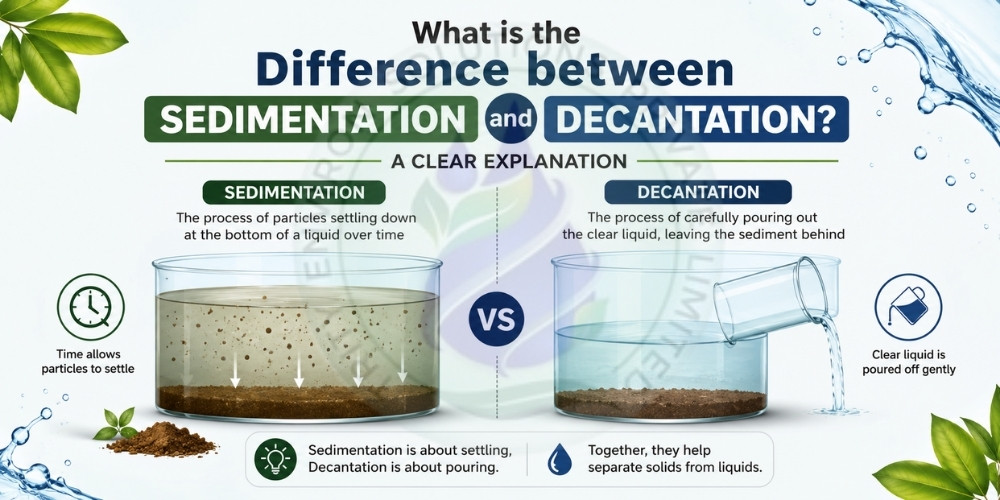
Sedimentation and decantation get treated as interchangeable terms often enough that the actual distinction gets lost, and that's a problem, because in a real treatment plant, mixing them up isn't just a vocabulary mistake, it reflects a misunderstanding of how solid-liquid separation actually works. Sedimentation is a physical process, particles settling under gravity. Decantation is an action, the deliberate withdrawal of the clarified liquid once settling has happened. One describes what happens to the water. The other describes what you do about it afterward.
Sedimentation is the gravitational settling of suspended particles in a liquid, governed for ideal spherical particles by Stokes' Law, which relates a particle's settling velocity to its size, density, and the viscosity of the surrounding fluid. In practice, water and wastewater treatment rarely deal with the kind of uniform, non-interacting particles Stokes' Law assumes cleanly. Real suspended solids interact with each other, aggregate, and behave differently depending on their concentration, which is why engineers classify sedimentation into four distinct types rather than treating it as one uniform process.
Type I, discrete particle settling: individual particles settle independently, each following its own path to the bottom without interacting meaningfully with neighbouring particles. This is the closest real-world case to ideal Stokes' Law behaviour, typically seen with grit and sand at low concentrations.
Type II, flocculant settling: particles collide and aggregate as they settle, forming larger flocs that fall faster than their individual components would. This is the type most relevant to primary clarifiers treating wastewater after coagulant dosing, since coagulation and flocculation exist specifically to push particles into this settling behaviour.
Type III, hindered or zone settling: once particle concentration rises above roughly 500 mg per litre, individual particles can no longer settle independently, they interfere with each other and settle as a collective mass, or "blanket," moving downward at a shared rate. This is the characteristic settling behaviour of activated sludge in secondary clarifiers, where biomass concentration is high enough that zone settling, not discrete particle settling, actually governs performance.
Type IV, compression settling: at the very bottom of a settling tank, accumulated solids compress under their own weight, squeezing out remaining water as sludge consolidates. This governs how efficiently sludge can be thickened before it heads to dewatering.
Understanding which type of settling actually applies to your effluent matters, because a clarifier designed around discrete particle assumptions will underperform badly on activated sludge, which behaves according to zone settling instead.
Decantation is the controlled removal of clarified liquid from above a layer of settled solids, leaving the sediment undisturbed at the bottom of the vessel. It's not a separation mechanism on its own, it's the retrieval step that follows separation. In a laboratory, that might mean carefully tilting a beaker. In an industrial treatment plant, it typically means a mechanical decanter, often a floating or telescoping arm, withdrawing clear supernatant from just below the water surface without disturbing the settled sludge layer beneath it.
Decantation depends entirely on sedimentation having already happened properly. You can't decant a liquid where solids haven't settled out, since there's no clear layer to withdraw from. This dependency is the core of the real relationship between the two processes, decantation is downstream of sedimentation, not a competing alternative to it.
| Factor | Sedimentation | Decantation |
|---|---|---|
| What it is | A physical settling process | A controlled withdrawal action |
| Driving force | Gravity acting on particle density difference | Mechanical or manual liquid removal |
| Timeframe | Requires time for particles to settle | Happens once settling is already complete |
| Equipment | Clarifiers, settling tanks, lamella or tube settlers | Decanter arms, siphons, pumps |
| Role in treatment | Removes suspended solids from liquid | Recovers the clarified liquid for further treatment or discharge |
| Dependency | Can occur independently | Depends on sedimentation having already occurred |
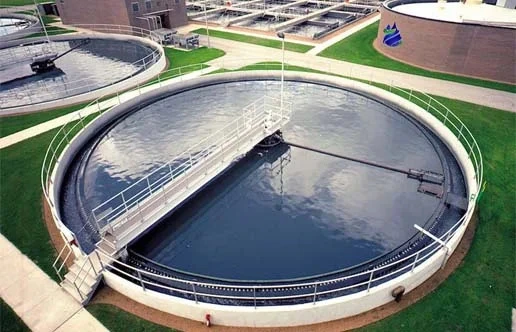
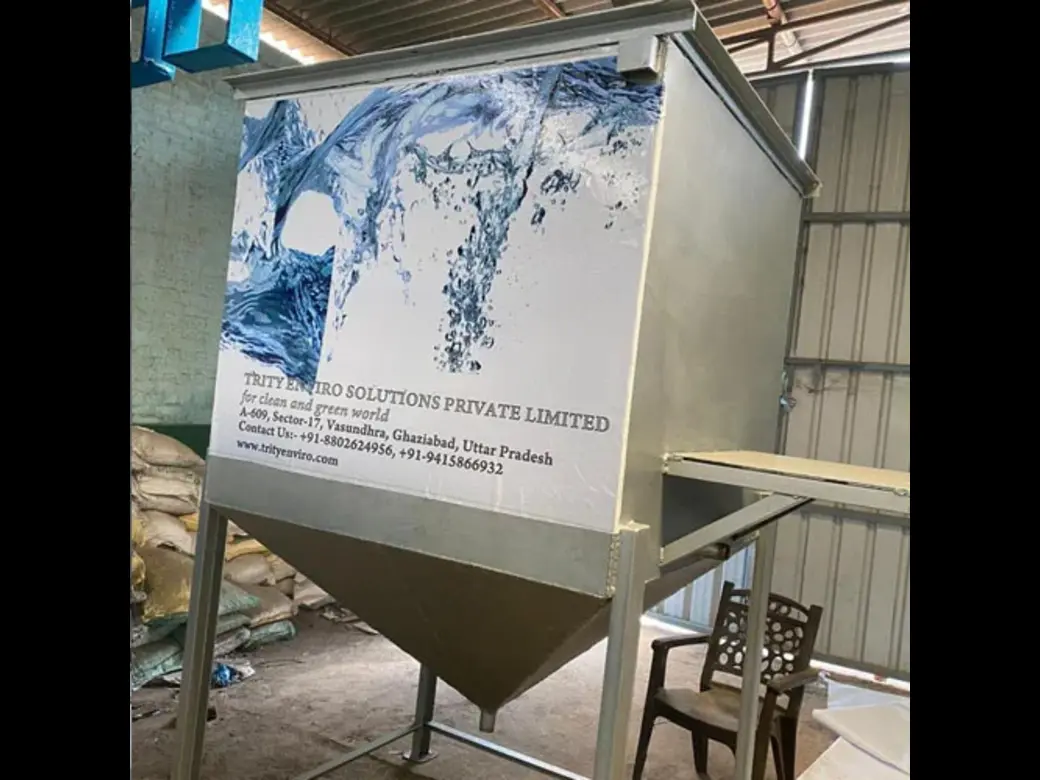
Plain gravity settling in an open tank works, but it's slow and space-intensive. Lamella clarifiers and tube settlers use inclined plates or tubes to dramatically increase effective settling surface area within the same tank footprint, since particles only need to travel the short vertical distance between plates rather than the full depth of the tank. The performance difference is substantial: lamella clarifiers typically achieve a surface overflow rate of 10 to 25 metres per hour, compared to just 1 to 3 metres per hour for a conventional clarifier of equivalent footprint. That's roughly an order of magnitude more throughput from the same physical space, which is exactly why compact treatment plants, where land is expensive or simply unavailable, lean heavily on this technology rather than oversized conventional basins.
The trade-off is that inclined plate systems need more careful maintenance, since plate fouling from accumulated biosolids reduces efficiency over time and requires periodic cleaning that a simple open basin doesn't demand to the same degree.
One place decantation isn't just a general concept but a literal, formally named stage is in Sequencing Batch Reactor (SBR) technology, a treatment approach used extensively across residential, institutional, and industrial STP and ETP systems. An SBR operates in a repeating cycle with five distinct phases: Fill, React, Settle, Decant, and Idle. During the Settle phase, biomass and treated water separate through Type III zone settling, exactly the hindered settling behaviour described above. During the Decant phase that follows, a mechanical decanter arm withdraws the clarified supernatant from the top of the tank without disturbing the settled sludge blanket beneath it, and that withdrawn water becomes the plant's treated effluent.
This is a genuinely direct, practical illustration of the relationship between the two processes: sedimentation is the Settle phase, decantation is the Decant phase, and the entire cycle only works because each stage properly sets up the next one. A poorly designed Settle phase, one that doesn't allow proper zone settling to complete, leads directly to a Decant phase that pulls some suspended solids along with the clear water, degrading effluent quality.
Getting sedimentation and decantation confused isn't just an academic issue. In practical plant design and operation, it affects real decisions:
A properly functioning sedimentation and decantation sequence depends on a few practical details that are easy to overlook during design or operation.
Short-circuiting reduces effective settling time. If water flows through a clarifier via a direct path from inlet to outlet rather than spreading evenly across the tank, a portion of the flow gets far less residence time than the tank's rated capacity suggests. Baffles and properly positioned inlet diffusers exist specifically to prevent this, forcing more uniform flow distribution so the tank's actual settling performance matches its design assumptions.
Hydraulic overloading defeats even well-designed settling infrastructure. Every clarifier and lamella system has a rated surface overflow rate, exceed it, whether through a sudden flow surge or simply undersizing the unit for actual peak demand, and particles that would otherwise settle get carried out with the flow instead. This is the same undersizing problem that affects treatment plants generally, applied specifically to the settling stage.
Weir loading affects the quality of what gets decanted, or overflows. In continuous-flow clarifiers, the outlet weir's length relative to flow rate determines exit velocity near the surface. An overloaded weir creates localised turbulence that can resuspend settled solids right before they'd otherwise be safely separated from the outgoing water.
Temperature affects settling velocity more than most designs account for. Colder water is more viscous, which slows particle settling according to the same relationship Stokes' Law describes. A clarifier performing well in warm conditions can underperform during a cold snap purely due to this viscosity effect, not any equipment fault.
Raw wastewater often contains colloidal particles too small and too stable in suspension to settle within any practical timeframe on their own, these particles carry surface charges that keep them apart rather than aggregating naturally. Coagulation neutralises these surface charges, typically using aluminium or iron-based coagulants, allowing particles to begin clumping together. Flocculation follows, using gentle mixing and often a polymer flocculant to build these small clumps into larger, faster-settling flocs.
This chemical pretreatment step is what pushes raw wastewater from behaving like discrete, slow-settling particles (Type I) toward the faster, more efficient flocculant settling behaviour (Type II) that clarifiers are actually designed around. Skipping or under-dosing coagulation and flocculation ahead of a clarifier is one of the more common reasons a properly sized settling tank still produces poor-quality, high-turbidity effluent, the tank itself isn't undersized, the particles arriving at it simply aren't in a settleable form yet.
Not every facility needs the same settling configuration, and the right choice depends on effluent characteristics and available space more than on any single technology being universally superior.
High suspended solids with limited plot space generally favours lamella or tube settlers, given their significantly higher throughput per unit of tank footprint compared to conventional clarifiers. Facilities in dense urban or hillside locations, where land is expensive or genuinely unavailable, tend to lean this direction by necessity.
Activated sludge systems need clarifiers specifically designed around Type III zone settling behaviour, since biomass concentration in these systems routinely exceeds the threshold where particles interact and settle collectively rather than independently. A clarifier sized using discrete particle assumptions will consistently underperform here.
Batch-process facilities, particularly those already using SBR technology, get sedimentation and decantation handled within the same tank and cycle, removing the need for separate dedicated clarifier infrastructure entirely. This compact, integrated approach is part of why SBR technology has become common across residential, institutional, and industrial STP applications where plot space is at a premium.
Effluent with fine, stable colloidal particles needs coagulation and flocculation ahead of any settling stage, regardless of which clarifier design follows, since no amount of tank capacity fixes particles that haven't been chemically prepared to settle in the first place.
While water and wastewater treatment are where these processes matter most for industrial operations, both appear elsewhere too. Winemaking uses decantation to separate clarified wine from sediment and pulp after natural settling. Laboratory separations of insoluble precipitates from a solution rely on the same basic sequence, allow settling, then carefully pour or withdraw the clear liquid. The underlying physics and logic are identical across every one of these applications, even though the scale and equipment involved look completely different.
No. Decantation is the retrieval of already-clarified liquid from above settled solids. Without sedimentation separating the solids from the liquid first, there's no distinct clear layer to decant, so the two processes are sequentially dependent rather than independent alternatives.
Type III, hindered or zone settling, applies once biomass concentration rises above roughly 500 mg per litre, which is typical for activated sludge systems. At this concentration, particles settle as a collective mass rather than independently, which is why secondary clarifiers are designed around zone settling behaviour rather than discrete particle assumptions.
Inclined plates or tubes inside a lamella clarifier dramatically increase the effective settling surface area within the same tank footprint, since particles only travel the short vertical distance between plates rather than the tank's full depth. This typically achieves a surface overflow rate several times higher than a conventional clarifier of equivalent size.
Decant is one of the five phases in a Sequencing Batch Reactor cycle (Fill, React, Settle, Decant, Idle), where a mechanical decanter arm withdraws clarified water from the top of the tank after the preceding Settle phase has allowed biomass to separate out, without disturbing the settled sludge blanket beneath it.
Decanting too early pulls unsettled suspended solids along with the clear water, degrading effluent quality and potentially causing a plant to fail its discharge standard. This is a common and correctable operational issue, usually fixed by adjusting cycle or retention timing rather than replacing equipment.
The underlying separation is always gravity-driven, but real plants actively enhance it through coagulation and flocculation, which encourage Type II flocculant settling, and through inclined plate or tube settler designs, which increase effective settling area without changing the basic physics involved.
If turbidity and suspended solids remain high despite adequate retention time in the clarifier, the problem is often upstream, insufficient or poorly dosed coagulation and flocculation leaving particles too small and too stable to settle effectively, rather than a fault in the settling tank itself. Checking coagulant dosing and floc formation before assuming the clarifier is undersized often identifies the actual cause faster.
Looking for clarifier, tube settler, or SBR-based treatment equipment for your facility? Get in touch with our team, or explore our full product range.
A guide to MPCB's sewage treatment plant requirements in Maharashtra, covering current discharge norms, mandatory reuse rules, and compliance steps.

Is RO water good for cooking and nutrition? An honest, evidence-based look at mineral loss, real health impact, and when remineralization matters.

Modern sewage treatment plants reduce water pollution, conserve freshwater, cut greenhouse gases, improve soil, protect aquatic life, and promote public health.





Discuss your requirements with our engineering team and get practical guidance for your project.