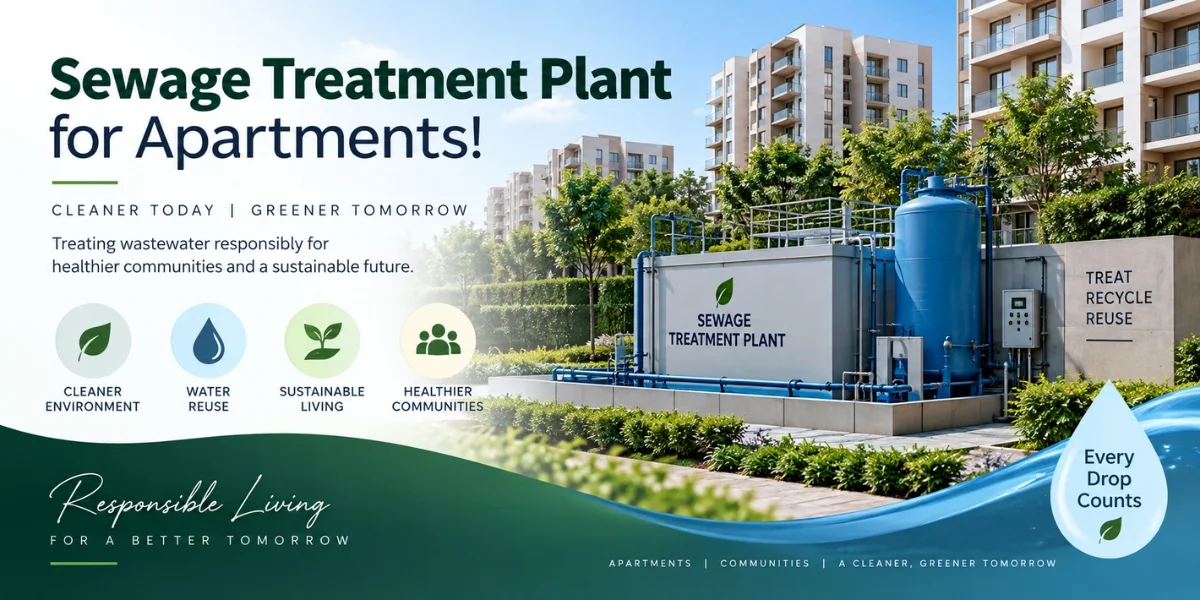
Sewage Treatment Plant for Apartments: Rules, Sizing, Cost & Technology Guide
Everything housing societies need to know about a sewage treatment plant for apartments: legal rules, sizing, cost, and choosing the right STP manufacturer.

 ISO 9001:2015 & QCI Approved
Municipal water reaching a commercial building may look and taste fine, yet still carry dissolved solids, chlorine byproducts, and hardness that quietly affect health, equipment, and guest experience. This guide covers exactly why RO has become the standard fix.
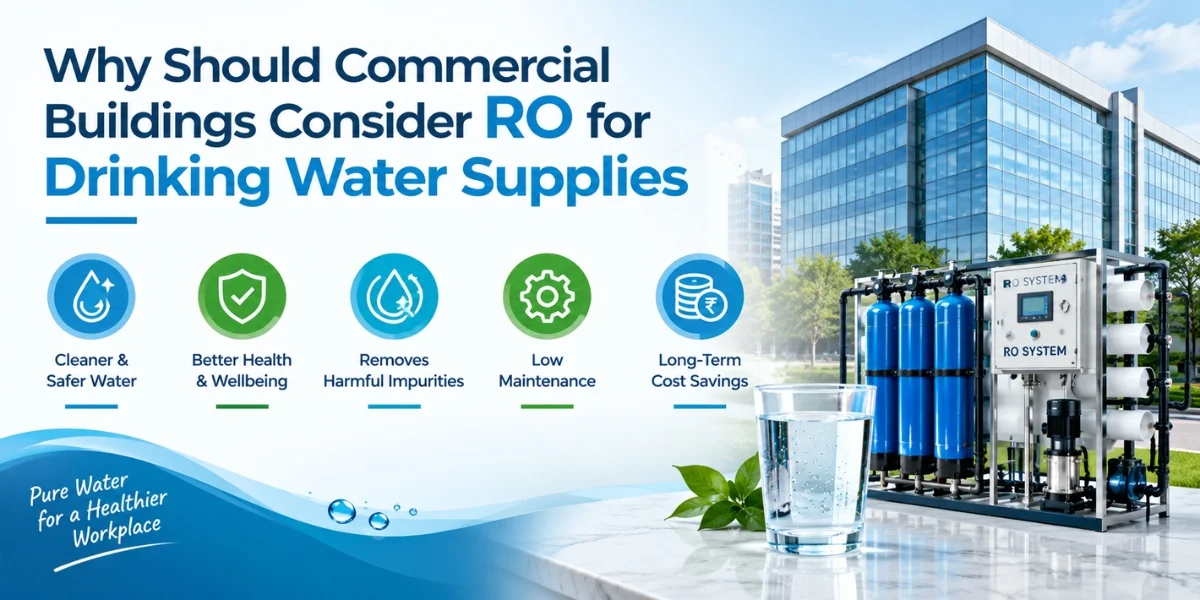
Clean, safe drinking water is a basic expectation in any commercial building, whether it is a hotel serving guests, an office supporting hundreds of employees, or a hospital where water quality can directly affect patient care. Municipal water supply is generally treated to a safe baseline, but it can still carry dissolved solids, chlorine, sediment, and other contaminants that affect taste, health, and the performance of the equipment that depends on it daily. A commercial RO (reverse osmosis) system addresses this at scale, purifying water through a semi-permeable membrane far more thoroughly than basic filtration, and this guide covers exactly why that difference matters for a commercial property.
The primary reason to install RO in a commercial building is straightforward: health protection. RO systems are capable of removing a wide range of contaminants from water, including heavy metals, nitrates, and microorganisms, that basic municipal treatment does not always fully eliminate. Removing these contaminants directly reduces the risk of waterborne illness among employees, guests, patients, or students who rely on the same water source daily, which matters more in commercial settings simply because of the sheer number of people affected by any water quality issue.
Beyond drinking water quality, dissolved minerals and hardness in untreated water cause scale buildup inside coffee machines, ice makers, boilers, and other equipment that commercial buildings depend on daily. This scale buildup is one of the leading causes of equipment failure and reduced lifespan in exactly this kind of appliance. Feeding this equipment with RO-purified water instead of raw municipal supply extends its working life significantly and reduces the frequency of repairs, directly lowering long-term maintenance cost even though RO installation carries an upfront investment.
Many commercial buildings still rely heavily on bottled water for staff and visitors, an ongoing recurring cost that adds up considerably over a year, along with a growing sustainability concern for organizations trying to reduce single-use plastic. A properly sized commercial RO system with a dispensing point eliminates most of this dependency, cutting bottled water spend while also supporting an organization's broader environmental commitments, an increasingly relevant factor as employees and clients pay closer attention to a company's sustainability practices.
For any commercial establishment where water is part of the product itself, cafes, restaurants, bars, and hotel kitchens, water quality consistency directly affects product quality. Inconsistent water chemistry from unfiltered municipal supply can lead to noticeably different coffee extraction, tea flavor, or beverage taste depending on seasonal fluctuations in the municipal supply. RO systems create a stable, consistent water profile, so the same recipe or process produces the same result every time, regardless of what is happening with the municipal source that week.
A common and costly mistake is installing a domestic-grade RO purifier in a commercial setting simply because it is cheaper upfront. Domestic RO systems are built for intermittent, low-volume household use and are not designed to handle the continuous, high-volume demand of a commercial building. Using one in a commercial setting typically leads to premature membrane failure, inconsistent output during peak hours, and a system that needs replacing far sooner than a properly specified commercial unit would.
Commercial RO systems are typically specified by output capacity in Litres Per Hour (LPH), and the right size depends entirely on actual daily consumption and peak-hour demand rather than the size of the building alone. Small offices, shops, or cafes may only need a compact system in the 25-100 LPH range, while hotels, hospitals, and larger institutional buildings need proportionally higher capacity, along with adequate storage to buffer peak demand periods like morning check-out or lunch service. Getting a proper site assessment before finalizing capacity avoids both an undersized system that runs dry during peak hours and an oversized one that wastes capital on unused capacity.
Hotels operate around the clock and need a steady, reliable water supply for guest drinking water, kitchen use, and cleaning operations. A properly sized commercial RO plant ensures this supply never becomes a point of failure during high-occupancy periods, when demand spikes sharply and inconsistently across the day.
Healthcare settings depend on water quality for patient care, lab work, cleaning, and specific medical applications, where even minor water quality fluctuations can affect daily operations. RO treatment reduces dissolved salts and particles that could otherwise interfere with sanitation standards or sensitive equipment used in clinical settings.
Educational institutions and office buildings serve large numbers of people from the same water source every day, drinking, cooking, hand washing, and general cleaning. A reliable commercial RO system reduces the operational burden of manual water management while giving staff and students confidence in the water quality they depend on daily.
Manufacturing units often need clean water for processing, cooling, and equipment maintenance, where excessive dissolved solids can affect both product quality and machine longevity. A commercial or industrial RO plant helps keep process water stable and predictable, supporting both output quality and equipment lifespan across continuous production cycles.
RO systems are genuinely reliable when properly installed and maintained, requiring comparatively minimal ongoing intervention for the consistency of clean water they deliver. Routine sediment and carbon pre-filter replacement, typically every 3-6 months depending on usage and source water quality, protects the RO membrane and keeps output quality consistent. Buildings that skip this routine maintenance schedule tend to see gradually declining output and shortened membrane life, which is why pairing a commercial RO installation with a scheduled maintenance plan from the outset is far more cost-effective than reactive repairs later.
| Building Type | Primary RO Benefit | Typical Capacity Range |
|---|---|---|
| Small offices, shops, cafes | Consistent drinking water, reduced bottled water cost | 25-100 LPH |
| Hotels and hospitality | Round-the-clock guest and kitchen water supply | Mid to high capacity, with storage buffer |
| Hospitals and healthcare | Patient safety, sanitation, and lab-grade water quality | Sized to occupancy and clinical need |
| Manufacturing facilities | Process water stability, equipment protection | Sized to production water demand |
Trity Environ Solutions is a trusted commercial RO plant manufacturer and industrial RO plant manufacturer in India, designing systems sized to your building's actual consumption pattern and peak demand rather than a generic capacity slab. As an experienced RO system manufacturer and supplier, our engineering team helps commercial buildings avoid the common mistake of under-specifying capacity or installing domestic-grade equipment in a commercial setting. Every installation is backed by pan-India Annual Maintenance Contract and operation and maintenance support, so your building's water supply stays reliable for years, not just at commissioning. We are ISO 9001:2015 certified, QCI approved, and deliver CPCB-compliant engineering nationwide.
Everything housing societies need to know about a sewage treatment plant for apartments: legal rules, sizing, cost, and choosing the right STP manufacturer.
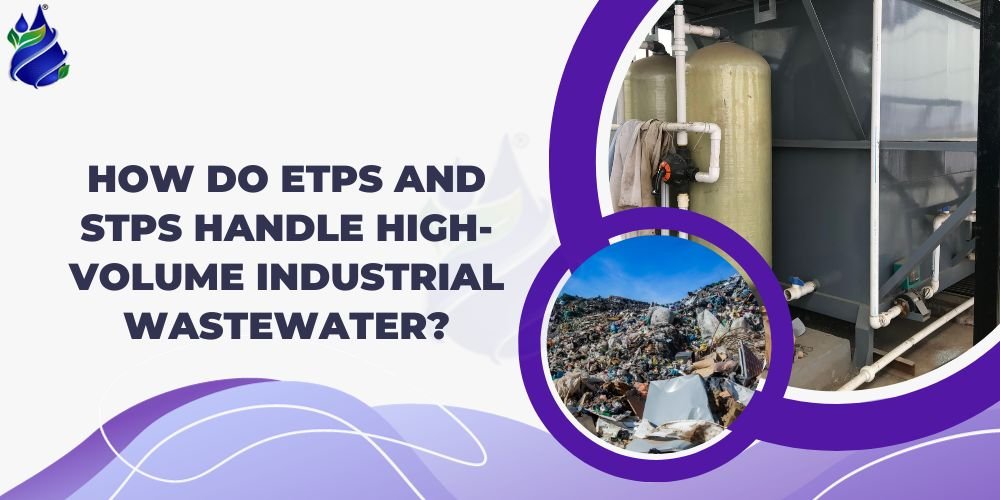
Explore how Effluent Treatment Plants (ETPs) and Sewage Treatment Plants (STPs) manage high-volume industrial wastewater. Uncover sustainable solutions for effective environmental stewardship.
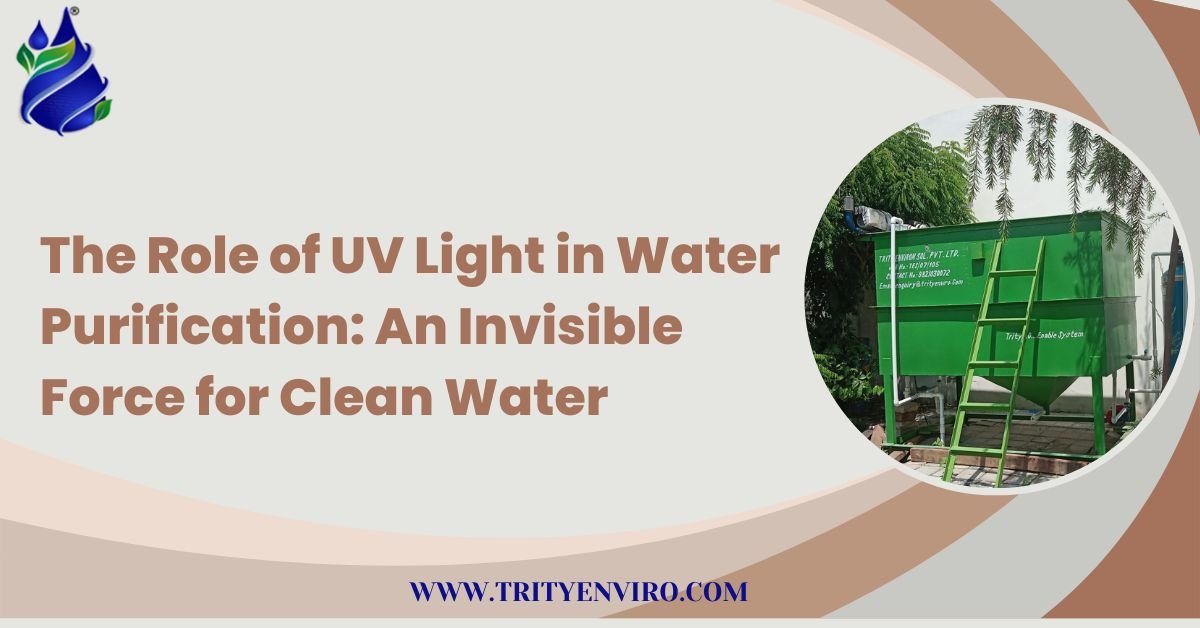
UV light disinfects water by eliminating harmful microorganisms, ensuring safe, chemical-free drinking water. A fast, eco-friendly, and effective purification method.




Discuss your requirements with our engineering team and get practical guidance for your project.