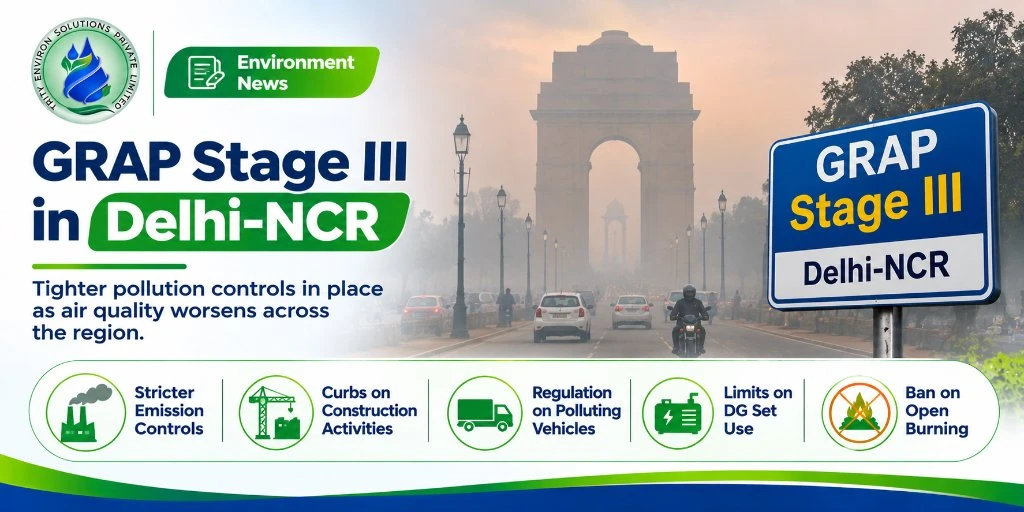
The Commission for Air Quality Management (CAQM) has invoked Stage III of the Graded Response Action Plan (GRAP) across Delhi-NCR, even though the city's average Air Quality Index (AQI) had not yet reached that stage's range.
Delhi's AQI was 382 on Thursday, November 5, in the "very poor" category. The commission acted on forecasts that pollution could reach "severe" between November 7 and 9. The decision came on Friday, November 6, two days before Diwali.
What CAQM Decided
A precautionary move
CAQM's GRAP sub-committee said on X that it had decided to invoke Stage III in Delhi-NCR "as a precautionary measure". The Pioneer reported the details on November 6. The News Mill, citing ANI, said the trigger was forecasts from the India Meteorological Department (IMD) and the Indian Institute of Tropical Meteorology (IITM), aimed at acting before the AQI passes 401.
Where the stages sit
As described by The Pioneer, the AQI bands are:
- Stage I: 201 to 300
- Stage II: 301 to 400
- Stage III: 401 to 450
- Stage IV: above 450
Stage II had been in force since November 2. Stage III is therefore the third step up this season, after Stage I on October 21.
The Restrictions
The reports differ slightly in detail. The measures below are those on which they agree or that are clearly attributed.
Construction and dust
- Non-essential construction and demolition work is banned across Delhi-NCR
- Earthwork, piling, trenching and other dust-generating work face curbs
- Open-air ready-mix concrete plants are prohibited
- Movement of sand and cement is restricted in specified areas
- Essential projects may continue if they follow strict dust-mitigation rules
- Authorities must step up mechanical road sweeping and water sprinkling
Industry and mining
- Stone crushers and mining operations remain suspended
- Hot-mix plants that do not use approved clean fuels must shut
The News Mill said the article it relied on did not detail Stage III industrial curbs and mentioned wider industrial limits only under Stage IV. The Pioneer listed the crusher, mining and hot-mix measures. Business Standard, on November 9, said Stage III "adds curbs on industry". This article therefore lists only the items The Pioneer named, and readers should check CAQM's notice for the full text.
Vehicles
- BS-III petrol and BS-IV diesel four-wheelers are barred in Delhi and specified NCR districts: Gurugram, Faridabad, Ghaziabad, Gautam Buddha Nagar and Sonipat
- Certain diesel goods vehicles registered outside Delhi face restrictions
- Older light and medium goods vehicles face tighter rules
Schools and offices
- Authorities can direct schools up to Class 5 to run classes online or in hybrid mode
- Government and private offices may be told to operate at 50% staff attendance
- State governments and Delhi's government decide how to implement these
Why the Commission Did Not Wait
GRAP stages normally follow readings. In this case CAQM moved on forecasts. The reason is visible in the week's data.
- October 30: AQI 78 after record rain
- November 2: AQI 324, Stage II
- November 4: 373, with 21 stations severe
- November 5: 382, as reported by The Pioneer
When forecasts show pollution building, waiting for the AQI to cross 400 means several hours or a day of avoidable exposure while restrictions take effect. A forecast-based trigger removes that lag. CAQM adopted a revised GRAP on September 29, 2026 that acts on forecasts, according to the fact sheet reported by Outlook on November 3.
What Happened Next
The forecast proved right. Business Standard reported on November 9, the day after Diwali, that the city AQI was 368 at 7 am.
- Of 54 stations with valid data, all were above 200, 50 were above 300 and 15 were in the severe range
- Burari Crossing and Sonia Vihar were highest at 441 each
- PM2.5 was the main pollutant
- NCR cities: Bahadurgarh 389, Ghaziabad 366, Noida 340, Gurugram 316
- Firecrackers were burst beyond the Supreme Court's 10 pm deadline, in some areas using conventional crackers, according to the report
- The Air Quality Early Warning System expected severe air from November 9 and for several days
Stage III had been in force since November 6. The reports reviewed do not say whether CAQM has since moved to another stage, so the current stage should be checked on the CAQM website.
What Stage III Means for Industry
Stage III is mainly aimed at dust, vehicles and mining, but industrial units are not exempt from scrutiny during such periods.
Check these points
- Fuel: units with boilers or furnaces should confirm they are using approved fuels, since clean-fuel rules are enforced more strictly in winter
- Dust sources: material stockpiles, unpaved yards and loading areas need wetting or covering
- Stack emissions: keep emissions within consent limits and keep monitoring running. Calibrated SOx NOx gas analysers help a unit see deviations as they happen
- Records: keep monitoring data, fuel records and consent papers ready for inspection
These are general steps and are not part of the CAQM order.
Why compliance matters now
On October 30, the Central Pollution Control Board directed boards in Delhi-NCR to issue closure notices to units with no air pollution control device orders. CAQM has also asked industries to make online monitoring fully operational. The stage-based restrictions and the closure directions together mean that units with weak compliance face the most risk this winter.
What Residents Can Do
- Limit outdoor exertion, especially children, older people and those with heart or lung disease
- Keep windows closed during peak pollution hours and use air purifiers where possible
- Wear a well-fitting N95-type mask outdoors on severe days
- Avoid burning waste, leaves or firewood
- Use public transport and avoid short car trips
What to Watch Next
- Whether the AQI crosses 450, which could trigger Stage IV
- CAQM's next notices on any change of stage
- Enforcement at construction sites and borders
- Daily stubble-burning share estimates and weather forecasts
GRAP slows the rise of pollution. It cannot remove the sources, which is why the same pattern returns each winter.