Introduction: Why Private STP Registration Suddenly Matters in Hyderabad
Ask any facility manager in Hyderabad about their sewage treatment plant and you will hear the same story. The plant was built to satisfy a building approval, it runs day to day with one or two operators, and the paperwork sits in a folder nobody has opened in a year. That comfortable arrangement is ending.
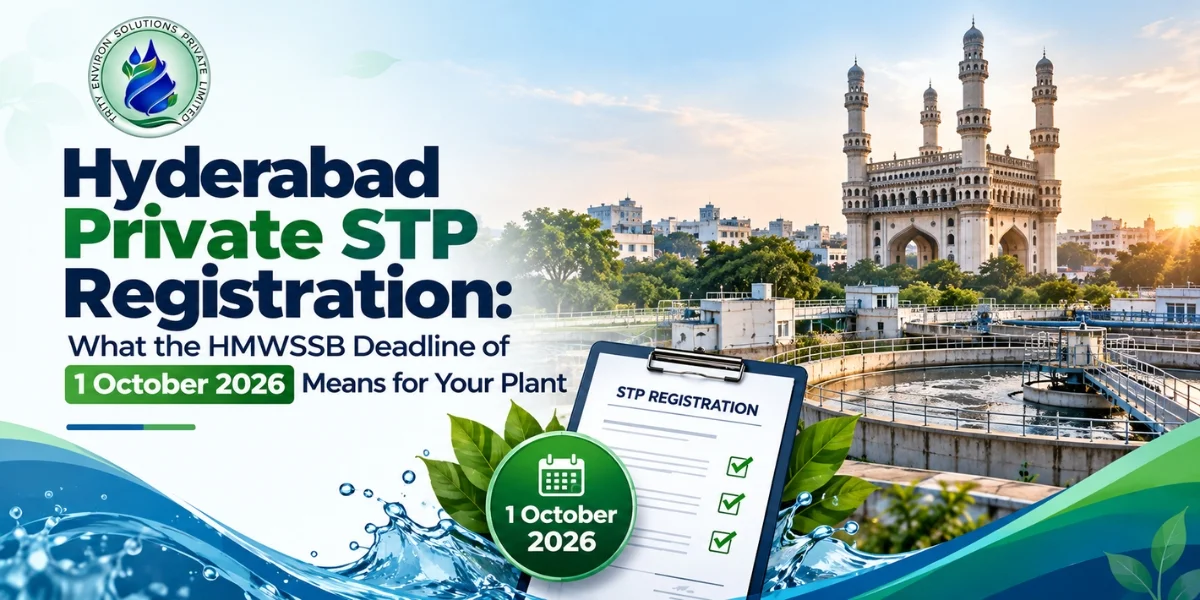
The Hyderabad Metropolitan Water Supply and Sewerage Board (HMWSSB) has asked private STP operators inside its jurisdiction to complete private STP registration in Hyderabad by 1 October 2026. The board plans to survey these plants, geo-tag them and add them to a database that records treatment capacity, daily output and quality parameters such as COD, BOD, pH and TSS. The stated aim is to move treated water into non-potable uses like gardening, construction, cleaning and industrial operations, so that fresh water is spared for drinking.
News reports describe registration as mandatory for private operators, while becoming a listed supplier of treated water is something a plant opts into. Either way, your plant's numbers will now sit in a public agency's database. If those numbers are weak, or missing, you want to find out before the board does.
This guide explains who is covered, what the form asks for, why plants stumble, and how to prepare. It is written for RWAs, facility heads, builders and plant managers.
What HMWSSB Has Asked Private STP Operators to Do
The board's exercise has two parts. The first is a survey and mapping drive: every private STP in the Core Urban Region, whether it serves an apartment community, a commercial complex or an industrial unit, is to be located, photographed and recorded. The second is a framework that lets willing plants supply treated water to nearby users who need it for non-potable purposes.
Who Is Covered and by When
The request applies to private STP operators within the water board's area: resident welfare associations, apartment owners' associations, commercial establishments, institutions and industries that run their own sewage treatment plant. The registration window closes on 1 October 2026, and the form is available on the board's website under Quick Links, in the Private STP Registration section.
If you are unsure whether your property falls inside the board's jurisdiction, check the source of your water connection. Properties with an HMWSSB consumer account number (CAN) are the ones the form is built around.
The Details the Board Will Record
Officials will note the plant's treatment capacity, the quantity of treated water produced each day, and quality readings for COD, BOD, pH and total suspended solids. Location data and photographs are collected so that each plant can be mapped. Expect the board to inspect registered plants from time to time to check that they meet the prescribed quality standards.
Registration Versus Becoming a Treated Water Supplier
These are two different steps and it helps to keep them apart. Registration puts your plant on the record. Choosing to supply treated water is voluntary: registered plants that opt in can be certified as treated water suppliers and can update their available volume on an online portal, so that nearby buyers such as construction sites, landscaping contractors and industrial users can find them.
For a large community STP producing more treated water than the property can use for flushing and gardening, this can turn a cost centre into a small income line. For a plant that barely meets its own needs, simple registration is enough for now.
Documents, Data and Common Registration Problems
Registration is a form-filling exercise on the surface, but the form asks for information that many plants cannot produce quickly. The time to discover that is not the last week of September.
Based on public reports of the portal, applicants are asked for the following:
- CAN number and the applicant or society name
- STP capacity and technical specifications
- Water quality parameters of the treated water
- Geo-location of the plant
- Photographs of the STP
- EPTRI certification, issued through the Environment Protection Training and Research Institute
Collect these in one folder before you open the portal. Lab reports should be recent and should come from a lab that can be defended if the board asks questions.
Why Plants Get Stuck
The most common blocker is missing or expired certification. Many plants were commissioned years ago, changed operators several times, and no one can find the original documents. Second comes quality data: some plants have never run a full set of tests on treated water, only occasional pH checks with a strip. Third is a mismatch between the plant's design capacity on paper and what it actually treats. A 100 KLD plant that quietly receives 160 KLD from an expanded building will not produce clean numbers, and the registration form makes that gap visible.
Plants with no operation and maintenance logs face a fourth problem. If nobody records daily flow, blower running hours or sludge removal, you have no evidence of how the plant behaves, and that weakens your position in any inspection.
Getting Your STP Ready for Reuse Grade Output
A plant that simply meets a discharge norm and a plant that can supply treated water to a construction site are not the same thing. Buyers care about clarity, odour and consistency. The board will care about the same things once registered plants start selling.
The Quality Parameters That Will Be Recorded
The four named parameters tell a fairly complete story:
- BOD shows how much biodegradable load is left after treatment. A well run biological plant should leave very little.
- COD captures oxidisable matter that BOD misses, including some chemicals from cleaning products.
- pH should sit in a neutral band. Swings usually point to dosing errors or process upset.
- TSS is a direct measure of carryover from the clarifier. High TSS is usually the first thing a buyer notices as cloudy water.
For reuse in gardening and construction, many designers target BOD below 10 mg/L and TSS below 20 mg/L. Treat these as design targets and confirm the exact requirement with the board's framework and your own consent conditions.
Dissolved Oxygen and the Biology Behind the Numbers
The biological stage does most of the work. In an aeration tank, dissolved oxygen (DO) between roughly 1.5 and 3 mg/L keeps aerobic bacteria healthy. Below that range, treatment slows and odour appears. Far above it, you waste electricity and can break up the biological flocs. If you do not own a DO meter, buy one. It is one of the cheapest ways to understand your plant.
Monitoring and Operating Discipline
Registration is not a one time event. Daily flow readings, weekly lab tests, blower and pump maintenance and scheduled sludge removal keep numbers stable. Small plants can manage this with a trained operator and a simple logbook. Larger plants benefit from flow meters and online pH sensors so that a drift is caught in hours, not weeks. Our operation and maintenance service covers exactly this routine for plants that do not have in house expertise.
Cost, Upgrade Options and Choosing an STP Partner in Hyderabad
Once the audit is done, most plants fall into one of three groups. Plants that perform well and only need paperwork. Plants that perform reasonably but need tertiary polishing for reuse. And plants that are undersized, corroded or badly designed and need a real revamp.
When a Revamp Makes More Sense Than Repairs
Repairs make sense when the tank structure is sound and the problem is equipment: a failed blower, clogged diffusers, a dead sludge pump. A revamp makes sense when the plant is hydraulically overloaded, when the process is outdated, or when the treated water simply cannot reach reuse quality. In that case an upgrade to a compact biological process such as an MBBR sewage treatment plant can increase capacity inside the same footprint, since the media carries far more biomass than suspended growth alone.
For reuse grade water, a tertiary treatment plant with filtration and disinfection is usually the missing piece. Where buyers need very low turbidity or salt content, ultrafiltration and RO stages can be added through a wastewater recycling system.
Before spending anything, work out whether the plant is the right size. Our guide on how to calculate STP capacity walks through the arithmetic with worked examples.
Questions to Ask a Supplier
Whoever you approach for an audit or an upgrade, ask these:
- Will you inspect the plant and measure actual inflow before quoting?
- Is the process design based on my real load or a standard template?
- Who supplies the media, diffusers and blowers, and what is the warranty?
- What does the annual maintenance contract cover, and how fast do you respond?
- Have you handled compliance paperwork with pollution boards and water boards before?
Prices vary widely with capacity, civil condition and target quality, so any supplier who quotes without seeing the plant is guessing. A short site visit and a one week sampling run give a far better basis for a proposal. You can also read our news update on the Hyderabad registration drive for the latest developments.
Industry Comparison / Operational Parameter Table
| Parameter / Stage |
Target Optimal Range |
Failure Impact / Risk |
Corrective Engineering Action |
| Treated water BOD |
Below 10 mg/L for typical reuse design (confirm locally) |
Odour, rejection by buyers, poor inspection result |
Check DO, MLSS and retention time; add media or extend aeration |
| Treated water TSS |
Below 20 mg/L for typical reuse design |
Cloudy water, clogged irrigation lines |
Clean clarifier, adjust sludge return, add tube settler or filter |
| pH of treated water |
6.5 to 8.5 |
Biological upset, corrosion, unusable reuse water |
Fix chemical dosing, check inflow for cleaning agents |
| DO in aeration tank |
1.5 to 3 mg/L |
Foul smell, sludge bulking, high power bills |
Service blowers and diffusers, install DO control |
Why Choose Trity Enviro
Trity Environ Solutions is an ISO 9001:2015 certified and QCI-approved sewage treatment plant manufacturer and supplier in India, delivering robust, high-efficiency systems engineered for CPCB and SPCB regulatory compliance.
Every installation is supported by pan-India Annual Maintenance Contract and Operation and Maintenance services.
Looking to upgrade or install a high-performance STP system? Call +91-9821030072 or email enquiry@trityenviro.com, or request a free engineering consultation from our technical team.