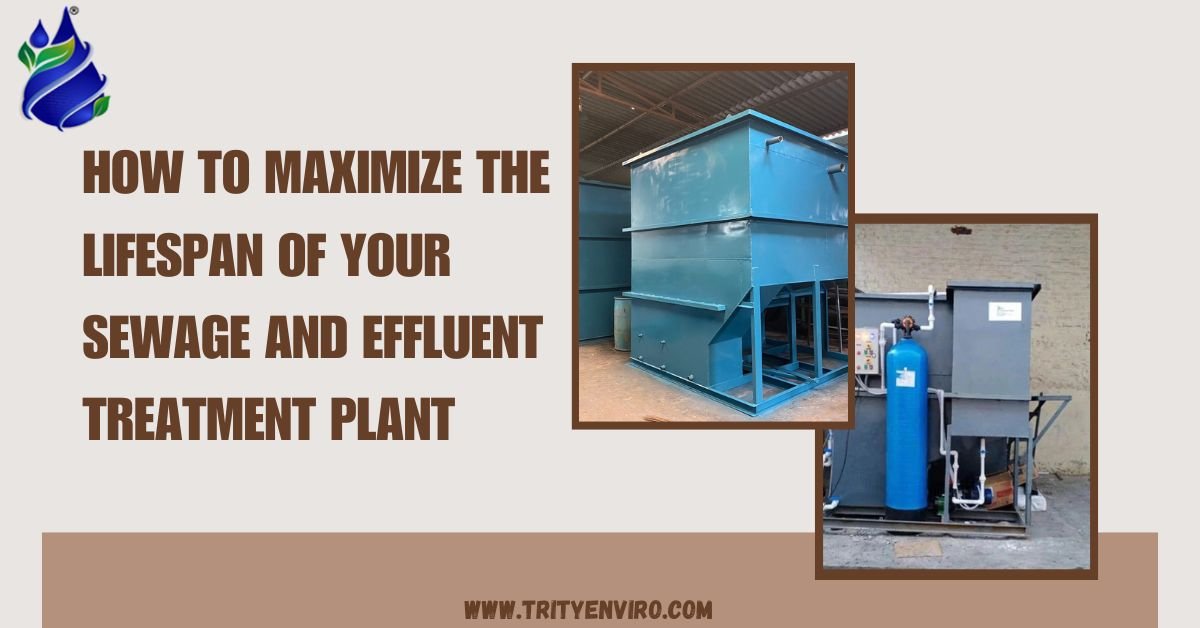
How to Maximize the Lifespan of Your Sewage and Effluent Treatment Plant
Learn how to extend the lifespan of your sewage and effluent treatment plant with regular maintenance, chemical optimization, and efficient staff training.

 ISO 9001:2015 & QCI Approved
The cheapest fuel per kilogram is not always the cheapest heat, and not every fuel is allowed. Here is how to compare your options for an NCR boiler.
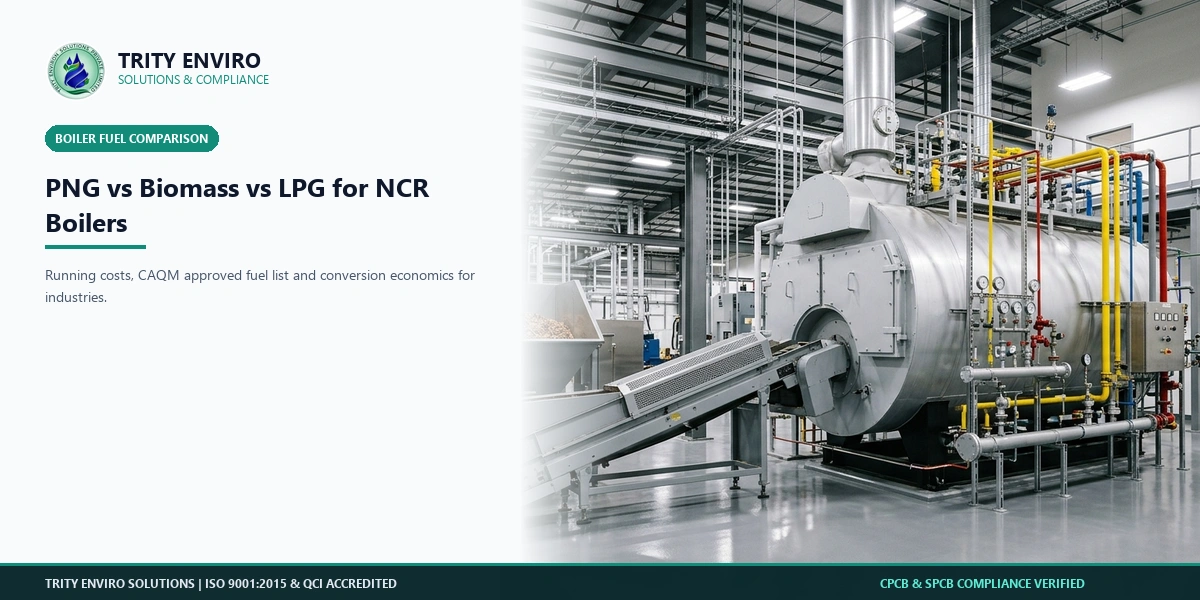
For a boiler or thermic fluid heater in Delhi-NCR, choosing fuel used to be a cost decision. Coal was cheap, available and well understood. Today the choice is a compliance decision first. The Commission for Air Quality Management (CAQM) allows industries in the region to run only on approved fuels, and enforcement has been firm. In August 2026, the Commission reviewed enforcement and noted that 1,816 violating units had received closure orders, and it also recorded that temporary permission for alternate fuels extended only up to 13 September 2026.
The revised Graded Response Action Plan (GRAP) approved on 28 September 2026 keeps the approved fuel requirement at the front of its measures, and the particulate limit of 50 mg/Nm3 that applies to covered industries from 1 October 2026 adds a second test. Fuel must be allowed, and the stack must also meet the number.
So which fuel is right? Piped natural gas (PNG) is the cleanest and the simplest to burn, but it needs a pipeline connection and a gas burner. Biomass is a renewable option and often cheaper per unit of heat, but it needs handling, storage, ash management and, in most cases, a dust collector. LPG is easy to arrange but can be expensive and needs storage and safety systems. Electricity suits some low temperature uses.
This guide compares the options for an industrial boiler in NCR on the points that matter: what is allowed, what it costs per unit of useful heat, how clean it burns, what conversion involves and what pollution control you still need. It is written for plant heads, utility managers and procurement teams. Confirm the current approved fuel list and local conditions with CAQM and your state board before you decide.
CAQM's directions list the fuels that industries in the NCR may use. Broadly, these are clean gaseous fuels such as piped natural gas and LPG, electricity and certain forms of biomass, with conditions and emission limits attached, and coal and other unapproved fuels are not permitted. The exact list and the conditions for each fuel have been revised over time, so check the current CAQM direction and any state notification rather than relying on an older summary.
Enforcement is real. Closure orders have been issued in large numbers, and the Commission has used inspections, camera systems and online data to find violators. Units that missed the transition windows face closure, environmental compensation and loss of consent.
Under the GRAP schedule, the use of only approved fuels is a Stage I measure, and stricter stages bring closures for industries that are not running on approved fuels. That means fuel violations are not only a year round risk but also a winter emergency risk. Our guide on GRAP rules for industries in Delhi-NCR explains the stages.
The 50 mg/Nm3 particulate limit, covered in our article on the Delhi-NCR PM emission standard, makes fuel choice a pollution control choice as well. Gas burns with almost no particulate. Biomass produces ash and fine dust that must be captured.
Compare fuels on cost per 1,000 kcal of useful heat, not on price per kilogram or per cubic metre. The calculation is:
Cost per 1,000 useful kcal = fuel price ÷ (calorific value in kcal per unit ÷ 1,000 × boiler efficiency)
The table below uses assumed prices for illustration only. Replace them with your current quotes.
| Fuel | Assumed price | Typical calorific value | Typical boiler efficiency | Approx. cost per 1,000 useful kcal |
|---|---|---|---|---|
| PNG | Rs 50 per SCM | about 8,500 kcal/SCM | about 88 percent | about Rs 6.7 |
| Biomass pellets or briquettes | Rs 9 per kg | about 3,800 kcal/kg | about 75 percent | about Rs 3.2 |
| LPG | Rs 90 per kg | about 11,000 kcal/kg | about 88 percent | about Rs 9.3 |
| Electricity (resistance or electrode boiler) | Rs 8 per kWh | 860 kcal/kWh | about 98 percent | about Rs 9.5 |
On these assumptions, biomass looks cheapest and PNG sits in the middle, while LPG and electricity cost the most. The picture changes with real prices, with biomass moisture and ash, with boiler efficiency and with the cost of handling and dust control. Gas prices and biomass prices also move, so run the sums every time you take a decision and include a sensitivity check.
Converting a coal or oil fired boiler to gas usually involves:
1. Confirming the gas supply: apply to the gas distributor, check pipeline availability to your site, the pressure and the delivery date.
2. Selecting a gas or dual fuel burner suited to the boiler, with a flame safeguard and a gas train.
3. Modifying the combustion chamber, controls and instrumentation as needed.
4. Installing the gas pipeline, regulating and metering station, safety valves and leak detection.
5. Obtaining approvals from the boiler inspectorate and any gas safety clearance.
6. Commissioning, tuning and training operators.
Delays often come from the gas connection and the burner delivery, not the boiler work. Industry reports from earlier transitions described long waits for gas based boilers, so start the application early. Dual fuel burners can keep production running during supply gaps if the second fuel is also approved.
A biomass fired boiler needs a fuel feeding system, a grate suited to the fuel, an ash handling system and good combustion control. Its flue gas needs particulate control. A cyclone alone is rarely enough, and a bag filter or similar device is usually required to meet 50 mg/Nm3. Read our guides on bag filter vs wet scrubber vs ESP and on how to choose an air pollution control system for your factory to plan this stage, and use continuous monitoring to prove performance.
Include in your comparison the cost of conversion or new equipment, burner or grate, fuel storage, handling, ash disposal, pollution control equipment, labour, maintenance, downtime during the changeover and the risk cost of supply interruption. Consider the efficiency difference: a modern gas boiler can run with an economiser and heat recovery, and biomass boilers benefit from good moisture control. Also consider future rules. A fuel that meets today's limit with no margin is a risk if limits tighten again.
Our products page lists air pollution control equipment and related systems, and an annual maintenance contract keeps filters, fans and instruments in good condition after commissioning. For units that also treat wastewater, we can plan effluent and emission compliance together.
Conversion does not end at commissioning. Gas fired boilers need a proper gas train with leak detection, flame failure protection, purge sequences and regular testing of safety interlocks. Train operators on start-up, purge and emergency shutdown, and keep a written procedure at the burner front. Tune combustion after every fuel change, since excess oxygen and burner settings decide both efficiency and emissions. Many plants fit oxygen trim to hold the right air to fuel ratio as load changes.
Biomass brings different risks. Storage of briquettes and pellets must be dry, covered and fire safe, with separation from ignition sources, because wet material loses heating value and dust can ignite. Ash handling and disposal need a plan. After any conversion, repeat the stack test, update your records and tell the board if your consent requires it. A conversion that is not retested leaves you guessing about compliance.
Before you sign any fuel supply or conversion order, ask your SPCB or CAQM contact in writing whether your chosen fuel and boiler type are permitted at your location, and keep the reply. Fuel rules are updated often, and a written confirmation protects you if a later notice quotes a different list.
| Parameter / Stage | Target Optimal Range | Failure Impact / Risk | Corrective Engineering Action |
|---|---|---|---|
| Fuel status | Only CAQM approved fuel, with current approvals | Closure order, environmental compensation, loss of consent | Switch fuel, keep documents, verify list with CAQM |
| Stack particulate | At or below 50 mg/Nm3 for covered industries | Notice, penalty, closure risk | Bag filter or ESP for biomass, tune combustion, test stack |
| Boiler efficiency | High and stable, with economiser and good combustion control | Higher fuel cost per unit of heat | Tune burner, add heat recovery, maintain boiler |
| Fuel supply security | Contracted supply with a backup plan | Production loss during outages | Dual fuel option, storage, second supplier |
Trity Environ Solutions is an ISO 9001:2015 certified and QCI-approved air pollution control equipment manufacturer and supplier in India, delivering robust, high-efficiency systems engineered for CPCB and SPCB regulatory compliance.
Every installation is supported by pan-India Annual Maintenance Contract and Operation and Maintenance services.
Learn how to extend the lifespan of your sewage and effluent treatment plant with regular maintenance, chemical optimization, and efficient staff training.

Explore how current STP technologies handle virus removal, their limitations, and innovations needed to protect public health and water safety.

Learn about Microbial Fuel Cells (MFC), their working principle, components, advantages, and applications in wastewater treatment and sustainable energy generation.











Discuss your requirements with our engineering team and get practical guidance for your project.

