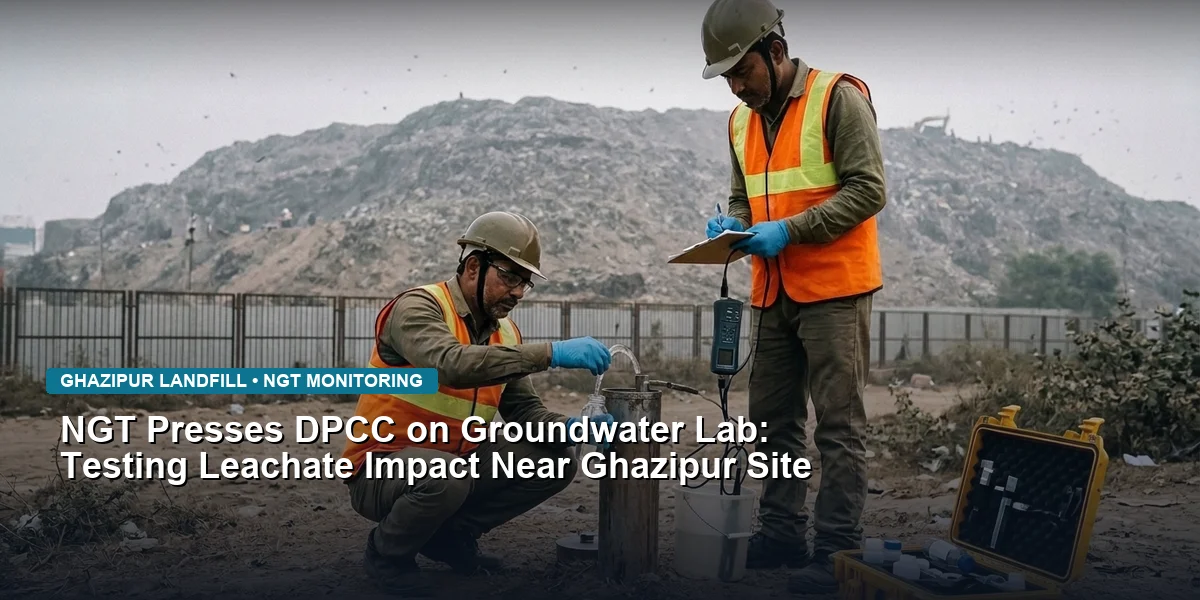
The National Green Tribunal (NGT) has asked the Delhi Pollution Control Committee (DPCC) to disclose the status of its laboratory and equipment for testing groundwater near the Ghazipur landfill. The order was passed on October 13, 2026 and became available on October 16.
The bench was blunt about expectations. It said the DPCC "is expected to have a fully equipped lab."
What the Tribunal Ordered
The case is a suo motu proceeding, which the NGT began after a newspaper report on a major fire at the Ghazipur landfill in East Delhi on April 21, 2024. The bench is headed by Chairperson Justice Prakash Shrivastava, with expert member Afroz Ahmad.
The directions
- DPCC must disclose the status of its laboratory and available equipment for groundwater testing
- The DPCC Member Secretary must appear virtually at the next hearing
- The next hearing is listed for January 19, though the report does not state the year
No separate compliance deadline was given beyond the hearing date.
The Groundwater Testing Order Behind This
The latest direction follows an earlier NGT order requiring DPCC to test groundwater around the landfill under the Solid Waste Management Rules.
- Samples were to be taken from at least 20 locations within the prescribed radius
- Testing was to extend up to a 1.5 km radius
- An analysis report was to be submitted to the tribunal
At the last hearing, DPCC's counsel told the bench the committee lacks the testing equipment and that a tender has been floated to procure it. The tribunal's latest order asks for the lab's status and puts the Member Secretary on notice to explain.
Why Groundwater Testing Near Landfills Matters
When rain percolates through waste, it produces leachate, a dark liquid with high organic load, ammonia, dissolved salts and, depending on the waste, metals. If leachate is not collected and treated, it can reach drains and the water table.
What groundwater tests usually look at
- pH, total dissolved solids and chlorides
- BOD and COD
- Ammoniacal nitrogen
- Heavy metals
- Bacteriological indicators
This list is general guidance on how landfill monitoring is commonly designed, not a statement of the parameters in this order. Without a functioning lab, a regulator cannot measure whether contamination is spreading, which is the basic reason the tribunal wants the question answered.
Why the Lab Question Is More Than Procedure
On the surface, the order asks about equipment. In practice it goes to whether a groundwater order can be carried out at all.
- The earlier direction required samples from at least 20 locations out to 1.5 km, which is a large sampling and analysis exercise
- If DPCC cannot test in its own lab, the work depends on outside laboratories or on a tender that has yet to deliver equipment
- Without results, the tribunal and the public cannot tell whether the landfill is affecting groundwater in surrounding colonies
The bench's wording, that DPCC is expected to have a fully equipped lab, signals that equipment gaps are not being accepted as a standing explanation.
How the Case Has Moved
- April 21, 2024: major fire at the landfill reported in the press; NGT takes suo motu cognisance
- March 2025: advocate commissioner appointed after inconsistencies between MCD and CPCB reports
- October 2025: tribunal asks about waste-to-energy plant use and electricity generated
- April 9, 2026: MCD directed to file a time-bound plan for clearing legacy waste, with a hearing listed for July 6
- October 13, 2026: DPCC asked to disclose its lab status; Member Secretary to appear virtually
- January 19: next hearing, year not stated in the report
The Landfill's Background
Ghazipur has been a recurring subject for the NGT. The tribunal has monitored the site since the April 2024 fire sent smoke across nearby areas.
What earlier proceedings found
- In March 2025, the NGT appointed an advocate commissioner after finding inconsistencies between MCD and CPCB reports
- The inspection flagged landfill height above permissible limits
- There were no boundary walls, so waste spilled into nearby drains
- Leachate management was poor, with contaminated drain water flowing toward the Yamuna
- In October 2025, the tribunal sought details on waste-to-energy plant use and electricity generated
- In April 2026, it directed the MCD to file a time-bound plan for clearing legacy waste and processing daily arrivals
The site by the numbers
Figures from a June 26, 2026 review by Delhi Urban Development Minister Ashish Sood, reported at the time, show the scale.
- Site area: about 70 acres, operating since 1984
- Height: about 65 metres
- Legacy waste: 67.81 lakh metric tonnes per an April 2026 drone survey, with the total now about 66.68 lakh metric tonnes including legacy and fresh waste
- Biomined between April 30 and June 25, 2026: about 3.39 lakh metric tonnes
- Phase-II processing: nearly 24 lakh metric tonnes; Phase-I biomined 13.90 lakh of the 30 lakh metric tonnes it was awarded
- Land reclaimed: about 20 acres
- Fresh waste arriving daily: 2,400 to 2,500 metric tonnes, with about 800 metric tonnes added to the heap
- Inert material goes to the NTPC Eco Park, about 23 km away
The targets set
- Remove the remaining waste by December 2027
- Complete Phase-II biomining by September 2026
- Raise daily processing to 12,000 metric tonnes by July 31, 2026, from about 7,000 at the time of review
The report does not say whether the July 31 daily target was met, so that should be checked against the latest MCD status report.
The Link Between Leachate and Water Quality
Leachate treatment is one of the weakest links at many Indian landfills. It is high in organic matter and salts, and ordinary sewage plants are not designed for it.
What good leachate management involves
- Collecting leachate through a sealed base and drainage system
- Holding and equalising flows before treatment
- Treating it in a dedicated effluent treatment plant designed for high-strength waste
- Monitoring outlet quality and groundwater around the site
- Preventing contaminated runoff from reaching nearby drains
Treatment plants for leachate need careful operation, since the feed varies with rain and waste composition. Regular servicing under a structured operation and maintenance programme keeps performance stable.
What Comes Next
- DPCC's disclosure on the lab, and whether the equipment tender has been finalised
- Whether the 20-location groundwater sampling is carried out and reported
- MCD's progress against the biomining and daily processing targets
- The January 19 hearing, where the Member Secretary is due to appear