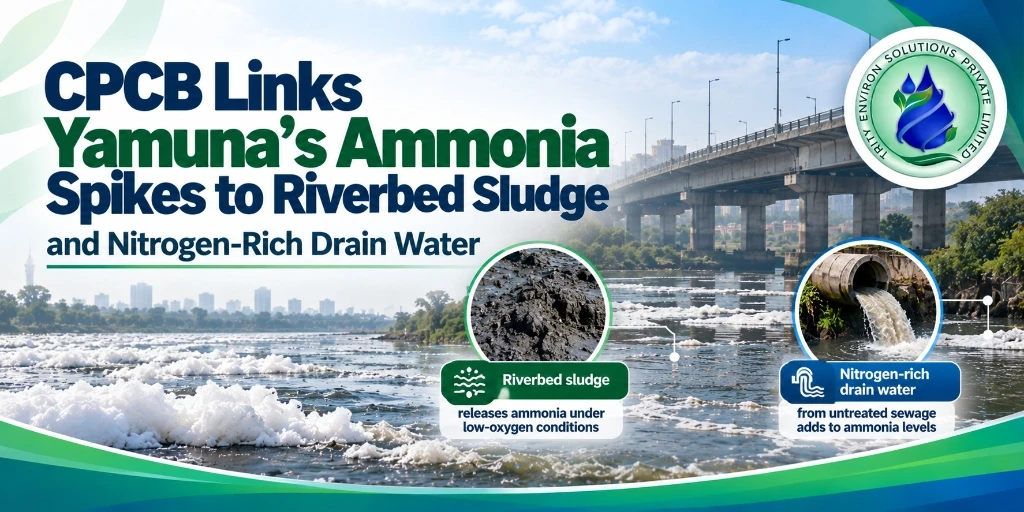
The Central Pollution Control Board (CPCB) has found that silt buildup in the Wazirabad pondage and nitrogen-heavy water from drains are behind repeated ammonia spikes in the Yamuna, according to a report summarised on October 27.
These spikes disrupt Delhi's water supply. The board warned that a one-time dredging effort will not solve the problem, and that nitrogen levels in the drains must first be brought down to acceptable limits.
What the CPCB Found
Only a short summary of the report was available, and it contains four main points.
- Silt buildup in the Wazirabad pondage contributes to ammonia spikes
- Nitrogen-heavy water from drains also contributes
- The spikes are repeated, not one-off
- One-time dredging will not fix the problem on its own
The summary gives no ammonia readings, dates of past spikes, drain names or an implementation plan. This article therefore does not state any, and later sections use earlier CPCB data, clearly labelled.
Why the Wazirabad Pondage Matters
The Delhi Jal Board draws raw Yamuna water from the Wazirabad pond for its Wazirabad and Chandrawal water treatment plants. This detail comes from a 2022 report on a CPCB study group.
According to that 2022 report, operations at both plants are disrupted when ammoniacal nitrogen exceeds 0.9 mg/L. This has repeatedly interrupted supply in the capital.
Why riverbed sludge adds ammonia
This is general background, not a finding from the October 2026 summary.
Organic matter that settles on a riverbed decomposes over time. When oxygen is low, as it is when flow is slow and the water is heavily polluted, decomposition can release ammonia back into the water. A pondage, where water slows and silt settles, is the kind of place where this can build up.
This explains why the CPCB treats sludge as a source and not only a symptom.
Why Drain Water Is the Root Cause
The report says nitrogen levels in the drains must come down first. Drains carry sewage and effluent, which contain nitrogen from human waste, detergents and industrial discharge.
If drains keep adding nitrogen, sludge builds up again after it is removed. Dredging then only resets the clock.
What Earlier CPCB Data Showed
A 2022 PTI report on a CPCB study group covered 2016 to 2020. Its findings are older but show the pattern.
The overall picture
- Ammoniacal nitrogen in the Yamuna in Delhi showed "no significant improvement" over the five years
- Monitoring covered 30 locations under the National Water Quality Monitoring Programme
- Levels rose in winter, from November to March, peaking mainly in January
The Delhi stretch
- Upstream, from Yamunotri to Himachal Pradesh, levels were stable at 0.02 to 0.15 mg/L
- At Palla, where the river enters Delhi, levels reached up to 4.80 mg/L in all years studied
- Between Nizamuddin and Okhla they climbed to 40.7 mg/L
Causes named in 2022
- Untreated or partly treated sewage from Yamunanagar, Jagadhari, Karnal, Panipat and Sonipat in Haryana
- Effluent from fertiliser, dyeing and tannery units in Panipat, Sonipat, Kundli and Karnal, including partly treated discharge from common effluent and sewage treatment plants
- Unsewered colonies on Delhi's outskirts
- Low winter river flow, which can let sludge decompose without oxygen and release ammonia
The study singled out Panipat and Sonipat as hotspots and said the rise there "clearly indicates" the effect of city drains entering the river.
These are 2016 to 2020 data. Conditions may have changed since, so they should be read as context, not as a description of October 2026.
Why One-Time Dredging Falls Short
Dredging removes the sludge that is there today. It does nothing about the nitrogen arriving tomorrow.
- If drains keep carrying nitrogen-rich water, new sludge forms and the ammonia spikes return
- Dredging disturbs settled material, which can itself release ammonia while the work is under way. This is general background, not a CPCB finding
- A permanent fix needs the inflow reduced, which is what the CPCB points to when it says drain nitrogen must come down first
The sensible reading of the CPCB's message is that dredging can be one part of a plan, but only after drain water is brought under control.
When Spikes Are Most Likely
The 2022 report found ammonia levels rise in winter, from November to March, peaking mainly in January. Low flow and cold water slow the natural breakdown of ammonia, which leaves it in the river for longer.
The report's finding is for 2016 to 2020, but the timing matters now. Winter is close, so the period of highest risk to Delhi's water supply is about to begin.
Delhi and Haryana: Shared Problem
The Yamuna crosses state boundaries. Upstream quality in Haryana shapes what Delhi receives at Palla, and Delhi's own drains add to it downstream.
DPCC data for September 2026, reported on October 9, showed faecal coliform at Asgarpur, near the Haryana border, rising from 36,000 to 38,000 MPN/100 ml, the highest in the dataset. That figure measures faecal bacteria and not ammonia, but it points the same way. The river is already carrying a heavy load when it enters Delhi.
What Lasting Control Would Take
Based on the CPCB's own conclusion that drains must be fixed first, the following steps follow. They are general measures, not a CPCB action list.
At the drain
- Intercept and treat drain flow before it reaches the river
- Check that sewage treatment plants meet nitrogen limits, not just BOD
- Stop untreated industrial effluent from entering drains
At the plant
- Run STPs and CETPs at design capacity
- Add nitrogen removal where discharge limits require it
- Keep a structured operation and maintenance programme so plants keep meeting norms
At the industrial unit
Fertiliser, dyeing and tannery units named in the 2022 report need on-site effluent treatment plant systems sized for their nitrogen load, with regular testing of outlet quality.
For buildings and colonies
Unsewered colonies can use local treatment. A well-run sewage treatment plant removes organic and nitrogen load before discharge.
What This Means for Delhi's Water Supply
Water plants cannot treat ammonia above their limit without disruption, so each spike means reduced supply until levels fall. A drain-level fix therefore protects drinking water as well as the river.
What to Watch Next
- The full CPCB report, with readings and recommendations
- Whether Delhi and Haryana agree a drain-by-drain nitrogen target
- Winter ammonia levels, which earlier data shows tend to peak from November to January
- Whether dredging at Wazirabad goes ahead alongside drain controls