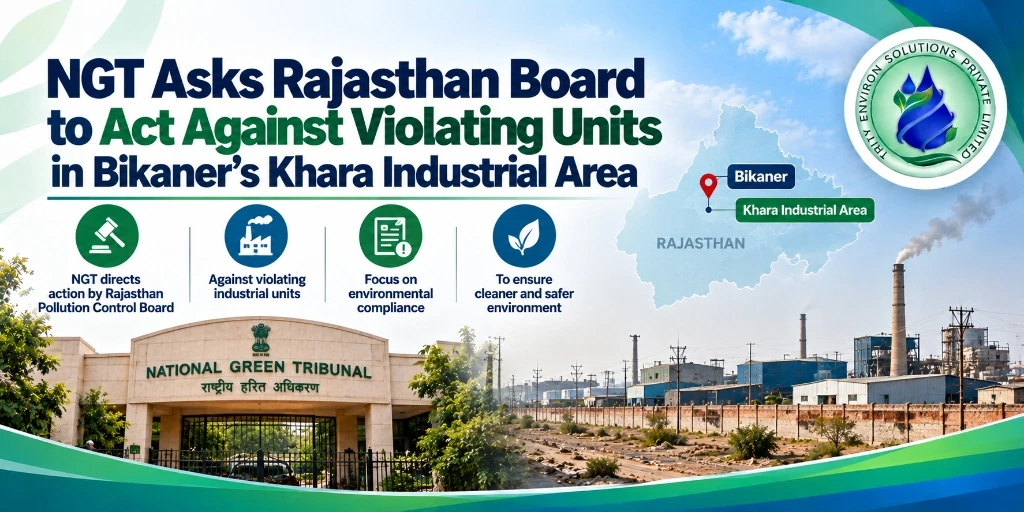
The National Green Tribunal (NGT) has directed the Rajasthan State Pollution Control Board (RSPCB) to take "necessary action against industrial units violating environmental norms" in the Khara Industrial Area in Bikaner. The order is dated October 26, 2026.
The tribunal also wants tree plantation where industries failed green-cover conditions, and a further action-taken report within three weeks. The next hearing is on December 18, 2026.
What the Order Says
The order was passed by the NGT central bench and reported in Down To Earth's daily court digest.
- RSPCB must take action against units violating environmental norms
- RSPCB must ensure adequate tree plantation and survival of the plants where industries failed green-cover conditions
- A further action-taken report is due within three weeks
- Next hearing: December 18, 2026
Closures and health figures
- RSPCB inspected units and issued closure notices to 21
- A medical survey covered 694 households and identified 121 people with respiratory-related symptoms, who were referred for detailed examination
A separate report put it differently, saying 21 units were closed. Closure notices and actual closures are not the same thing, so this article uses the Down To Earth wording. The status of each unit should be confirmed in the RSPCB's next report.
How the Case Began
The matter did not start this week.
February 2026: the NGT takes notice
On February 12, 2026, the NGT's central zone bench in Bhopal took suo motu cognisance of air pollution in Khara village, Bikaner. The trigger was a report that villagers were keeping children away from school because of "hazardous air quality".
- The bench was Justice Sheo Kumar Singh and expert member Sudhir Kumar Chaturvedi
- Notices went to the State of Rajasthan, RSPCB, the District Education Officer and the Principal Secretary (Environment)
- A joint committee of the District Magistrate and the state board was told to visit Khara and file a report within six weeks
April 2026: the joint committee reports
The committee report was filed on April 13, 2026. Its findings, as summarised by Down To Earth, were as follows.
The area - RIICO set up the Growth Centre in 1994, with general, ceramic and mineral zones, about 30 metres from Khara village - 243 industries are established: 205 operational and 38 closed - Of the 205 operational units, 151 hold valid consent to operate and 29 do not. Show-cause notices went to all 29 - Closure directions were issued to 19 industries for non-compliance between January 1, 2025 and March 31, 2026
What the committee found - Winter weather, including temperature inversion and low wind, can trap pollutants near the ground - Greenbelt plantation is limited and not proportionate to industrial activity - Damaged roads and road dust are sources of fugitive emissions - Attendance records for four Khara schools from November 2025 to January 2026 showed variations the committee attributed to holidays and festivals. It found no evidence of continuous pollution-linked absenteeism
The health survey - 694 households were surveyed and 121 people had respiratory symptoms - A medical camp was held on March 28, 2026 - A medical department report dated April 9, 2026 found no silicosis cases - The committee said the ailments "cannot, in absence of detailed exposure assessment, be conclusively attributed solely to industrial pollution"
Planned actions - RIICO tendered a cement concrete road in the mineral zone - A proposal of Rs 2,943.44 lakh for road widening, greenbelt development and parks was sent to RIICO's head office in Jaipur - The medical department was asked for higher-level examination of identified patients
What Has Changed Since April
The October 26 order builds on these findings. Two points stand out.
- The tribunal is still asking for enforcement and greenbelt compliance, which suggests the earlier measures have not fully resolved the issue
- The closure figure has moved from 19 closure directions (to March 2026) to 21 closure notices, though the two numbers cover different periods and may not be directly comparable
The sources do not say what the new report is expected to cover beyond action against violators and plantation.
Reading the Health Data Fairly
The numbers invite two opposite misreadings.
- It is not proof that industry caused the symptoms. The committee itself said that without an exposure assessment, the ailments cannot be attributed solely to industrial pollution
- It is not proof of safety either. 121 people with symptoms among 694 households is a meaningful number, and detailed examination was recommended
A proper exposure assessment, such as measuring particulate levels at homes and schools over time, would settle the question. The sources do not say one has been done.
What Industrial Units Should Take From This
Growth centres like Khara hold many small and medium units in one place, where one unit's lapses affect everyone nearby.
- Consent to operate: 29 of 205 operating units lacked valid consent in April. Operating without consent invites closure
- Dust control: road dust and fugitive emissions were named as sources, so internal roads, stockpiles and loading areas need regular wetting or paving
- Greenbelt: plantation needs to match the scale of operations, and it needs to survive
- Stack monitoring: units with stacks should keep emissions within consent limits. Calibrated SOx NOx gas analysers let operators see deviations in real time
- Wastewater: units that generate effluent need a compliant effluent treatment plant and regular testing
This is general guidance, not a direction from the tribunal.
Related NGT Orders on the Same Day
Down To Earth's digest of October 26 also covered two other matters, which are separate from Khara.
- Jaipur (Vasundhara Vihar, Sirsi): a three-member joint committee will probe alleged unauthorised commercial groundwater extraction, with a report in four weeks. The allegations are the applicant's and unverified
- Manasbal wetland, Jammu and Kashmir: an applicant has challenged CPCB and state board reports. The CPCB found that none of seven samples met Class B bathing standards
Why Enforcement Alone May Not Be Enough
Closure notices stop non-compliant units, but they do not fix the area's shared problems, such as damaged roads, thin greenbelt and winter weather that traps pollutants. The committee's own findings point to these, and RIICO's road and greenbelt proposals address them. Whether they are completed will matter as much as the closures.
What to Watch Next
- The RSPCB's action-taken report, due in about three weeks
- Whether the report lists which of the 21 units are actually closed
- Greenbelt compliance and survival figures
- The December 18, 2026 hearing