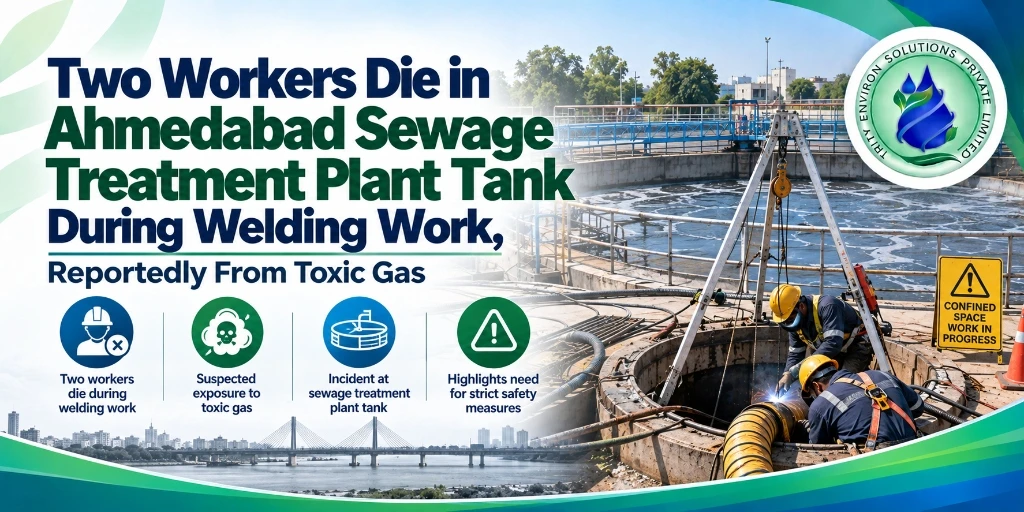
Two workers died and two were injured after falling into a tank at a sewage treatment plant (STP) run by the Ahmedabad Municipal Corporation in the Sola area, on Monday, October 26.
Preliminary information suggests a welding worker lost consciousness from a buildup of toxic gas and fell into the tank. The cause has not been confirmed, and the reports reviewed describe no formal investigation findings yet.
What Is Known
The account below is from ANI reports carried by The News Mill and Asianet Newsable on October 26.
- Where: an Ahmedabad Municipal Corporation STP in the Sola area
- What was happening: welding work at the facility
- Who: four workers of a contractor, HNB Agency Company, were involved. The reports describe a site in-charge, a welding worker, a project manager and a driver
- Outcome: two died. Two were rescued and taken to a hospital, where they are in stable condition
- Preliminary cause: a welding worker reportedly lost consciousness from toxic gas buildup and fell in
The rescue
Fire brigade personnel responded and ran a rescue operation lasting about 45 minutes, according to Divisional Fire Officer SB Jadeja. Two people were pulled out. The other two died of their injuries.
What Is Not Yet Known
The reports do not say the following, so this article does not either.
- Which gas was involved, and at what concentration
- Whether gas testing was done before the work began
- Whether the workers had breathing equipment, harnesses or a rescue plan
- Which two workers died. The reports name four employees but do not say who died, and this article does not name them
- What the contractor, the Municipal Corporation or the police have said about responsibility
The Indian Express headline you supplied refers to a police probe and a safety investigation. That article could not be accessed, and the ANI reports do not mention a probe, so this article does not state one has begun.
Why Sewage Plants Are Hazardous
This section is general background on how these plants work and is not a finding about this incident.
Sewage tanks and catch pits can accumulate gases as organic matter breaks down.
Common hazards
- Hydrogen sulphide: a toxic gas formed when sewage decomposes without oxygen. At high concentrations it can cause loss of consciousness within moments
- Methane: flammable, and it can displace oxygen
- Oxygen-deficient air: a tank with low oxygen can overcome a person without any smell or warning
- Ignition risk: welding, cutting or grinding near a tank with flammable gas can cause fire or explosion
Why one collapse becomes several
In confined-space accidents, a second or third worker often enters to help and is overcome too. This pattern is well documented. It is why rescue plans normally prohibit entry without breathing apparatus.
In this case, four people fell in or were affected, according to the reports. Whether others entered to help is not stated.
What Safe Work on an STP Normally Requires
These are standard good-practice measures. They are not a description of what happened at Sola.
Before work starts
- A written permit for the job, naming the hazards
- Gas testing for oxygen, hydrogen sulphide and flammable gas, before entry and during the work
- Isolating and, where needed, draining and ventilating the tank
- Separate permits for hot work such as welding
During work
- Continuous gas monitoring with alarms
- Forced ventilation of the space
- A trained attendant outside the tank, with a means of calling for help
- Harnesses and retrieval lines so that a person can be pulled out without someone else entering
Emergency planning
- Rescue staff trained and equipped with breathing apparatus
- A rule that no one enters to rescue without equipment
- A drill that the whole team has practised
Questions an Investigation Should Answer
When the inquiry reports, these are the points that would explain what happened. They are questions, not findings.
- Was the tank isolated and tested before welding began, and who signed off?
- Was the work scheduled during normal operation, or with the plant shut down and the tank emptied?
- Did the contractor's workers have training in confined-space entry?
- Was a rescue team and breathing equipment on site before the work started?
- Did the contract between the Municipal Corporation and the contractor assign responsibility for safe entry?
The answers will show whether this was a gap in procedure, equipment or supervision, and which rules apply.
Contractors, Operators and Accountability
Many municipal STPs are run by contractors. When the plant owner, the operator and a repair contractor are different parties, safety duties can fall between them.
- Contracts should state who checks the space and who authorises entry
- Contractor staff need training and equipment, not just instructions
- The plant operator should hold records of gas tests and permits
A structured operation and maintenance programme includes safe-entry procedures, trained operators and regular checks of tanks, pumps and gas hazards. That discipline protects workers as well as plant performance.
Lessons for Other Plants
Whatever the inquiry finds, other municipal and private plants can use this week to check their own practice.
- Review whether every entry into a tank or pit needs a written permit
- Check that gas detectors are present, calibrated and used
- Confirm that contractors' workers have received confined-space training
- Put the emergency contact numbers and rescue plan where workers can see them
- Run a short drill so that the first response is not improvised
Housing societies, hospitals and factories that run their own plants face the same hazards on a smaller scale, and the same basic precautions apply.
Why Such Deaths Keep Happening
Reports of workers dying in sewer lines, septic tanks and treatment plants recur in India. The causes named in such cases are usually the same: no gas test, no breathing equipment and no rescue plan. This article does not claim any of these happened at Sola, because the reports do not say.
What to Watch Next
- The findings of any investigation, including the gas involved and the safety steps in place
- Whether the Municipal Corporation reviews safety rules for contractors at its STPs
- Whether action is taken against any party found responsible
- Any compensation announced for the families of the workers
Closing Note
Two people did not return home from work on Monday. The most useful response is not speculation but a clear, published account of what failed, and checks that make it unlikely to be repeated at other plants.