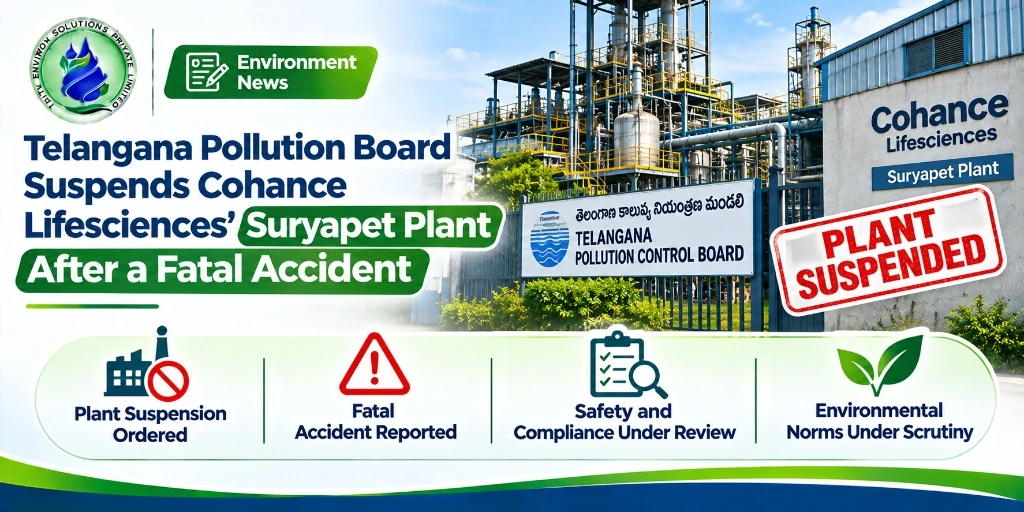
The Telangana State Pollution Control Board (TGPCB) has ordered Cohance Lifesciences Limited to suspend all manufacturing at its Suryapet site with immediate effect, after an industrial accident in which an employee died.
The company disclosed the order to stock exchanges on November 6. It says it received the order on November 5.
This is not a pollution-violation story. The order, as described in the company's filing, concerns alleged gaps in safety measures required under the plant's consent conditions.
What Is Known
The facts below come from the company's regulatory filing, as reported by Multibagg, Investywise and Whalesbook on November 6. Reuters also carried the headline that the site was shut after a worker died.
The accident
- An industrial accident took place during the manufacturing process at the site
- One employee on duty was exposed to hazardous conditions
- He was given emergency medical aid and moved to a specialised hospital in Hyderabad, where he later died of his injuries
The order
- TGPCB ordered immediate suspension of all manufacturing at the Suryapet site
- The company received the order on November 5, 2026
- It disclosed the order on November 6 under Regulation 30 of the SEBI Listing Obligations and Disclosure Requirements Regulations, 2015
- After inspecting the site, TGPCB identified alleged non-compliances with safety measures required under consent conditions. The filing describes this as a lack of strict implementation of accident-prevention safety measures
- The company does not describe these as final legal findings
The company's response
- It has started corrective and preventive measures
- It expects to submit representations and compliances to the board, seeking cancellation of the closure directions and permission to resume
- It says the financial and operational impact cannot yet be quantified with reasonable certainty
- It said it would provide the employee the best possible care during treatment
One outlet's summary said the company "expects to appeal the order soon". The filing's wording, as described by two other outlets, is that it will submit representations and compliances. The article follows the filing's wording.
What Is Not Known
- The accident date. None of the reports give it
- The substance, process or equipment involved. Not disclosed
- Whether more than one person was hurt. The reports describe one employee
- The closure period. The filing lists the order as "immediate" with no fixed duration
- Any fine, prosecution or remediation order. None is disclosed
- Revenue or capacity affected. No figures are given
No cause should be assumed. Until the board or the company publishes more, the cause of the accident remains unstated.
Why a Pollution Board Closes a Plant After an Accident
This section is general background and not a finding about this case.
State pollution control boards grant consent to establish and consent to operate to industrial units. These consents come with conditions. They commonly cover emissions, effluent, hazardous waste handling and, for some categories, safety and accident-prevention measures.
When a serious incident occurs, a board can inspect and, if it finds conditions not being followed, issue directions that include suspension of operations. This is a regulatory step. It is separate from any police investigation or inspection by the factories department.
Consent conditions and safety
The filing says the alleged non-compliances relate to safety measures "required under consent conditions". That is the link between a board and a safety lapse. It does not mean there was any pollution event.
What This Means for the Company
- The Suryapet plant is described as a pharmaceutical contract manufacturing facility. Prolonged downtime could affect supply schedules and output, according to Whalesbook
- Investors are watching the restart timeline and possible regulatory scrutiny
- The company has not set a restart date
The reports give no market data, so this article does not discuss share price movement.
Process Safety in Chemical and Pharma Plants
These are general good-practice points and not claims about what happened at Suryapet.
Where accidents tend to arise
- Reactors and vessels that handle reactive or flammable materials
- Transfers of solvents and chemicals
- Maintenance and cleaning work in confined or vented spaces
- Changes to a process without a safety review
What a safety management system usually includes
- Hazard and operability studies for each process
- Written procedures, work permits and training
- Gas detection and ventilation where hazardous vapours can build up
- Emergency response drills and clear escape routes
- Incident reporting and investigation, including near misses
The link with effluent and waste
Chemical units also produce wastewater that needs treatment before discharge. Plants making pharmaceutical intermediates often need an effluent treatment plant designed for their effluent, and some states require zero liquid discharge systems for certain categories. Regulators inspect these alongside safety conditions, so a closure for one reason can bring scrutiny on others. The reports on Cohance do not mention effluent.
Lessons for Other Plants
- Review whether every consent condition, including safety measures, is actually followed on the shop floor
- Check that safety systems are tested and records are up to date
- Keep a structured operation and maintenance schedule for plant, pollution-control and safety equipment
- Brief contractors and new workers on hazards before they begin work
How a Closure Typically Ends
Companies in this situation usually do the following. This describes the usual process and not a prediction for Cohance.
- Submit corrective actions and compliances to the board
- Ask for a re-inspection
- Wait for the board to review and revoke or modify the order
The company has said it intends to follow this path. The timing is the board's to decide.
Regulatory Layers After an Industrial Accident
This is general background on how several bodies can be involved. The reports on Cohance describe only the pollution board's order.
- State pollution control board: acts under the consent conditions and the environmental laws, which is what the filing describes
- Factories inspectorate or labour department: typically examines workplace safety and may investigate the accident under factory safety law
- Police: may register a case if there is a death
- Company internal review: most plants carry out their own root-cause investigation
Each follows its own process and timeline. A board order does not by itself decide responsibility for an accident, and the reports do not say whether any other body has acted.
What a restart usually needs
When a board suspends operations, a company usually has to show that the specific gaps have been fixed. That may include evidence of repaired or added safety systems, revised procedures, retraining and an independent audit. The board then decides whether to lift the order. The time this takes varies and the filing sets no date.
What to Watch Next
- Whether TGPCB publishes its inspection findings
- Whether the company files updates with the stock exchanges, as it said it would
- When, and under what conditions, the order is revoked or modified
- Whether the regulator takes further action, including against others, which the reports do not mention
Our thoughts are with the family of the worker who died. The first priority after any such accident is to learn what failed and to fix it.