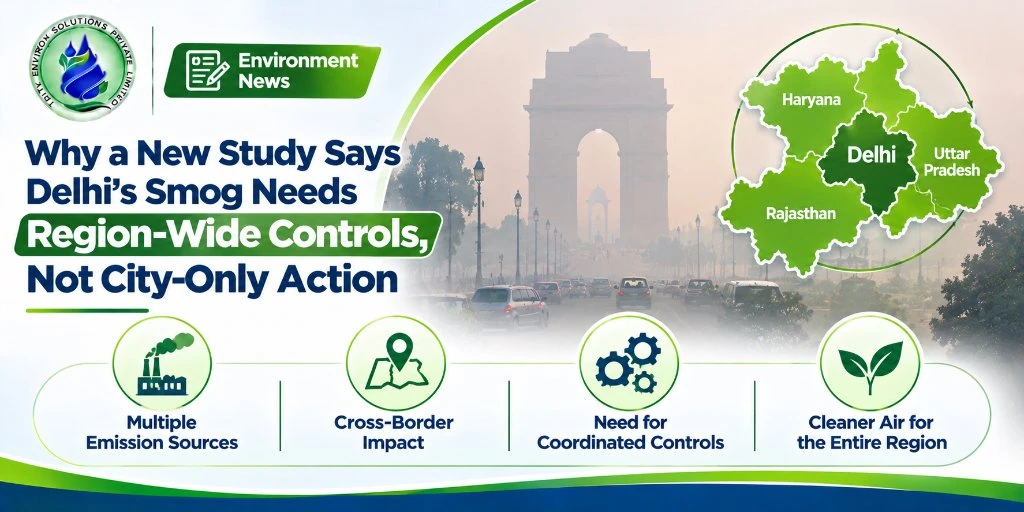
A new study from the National Institute of Advanced Studies (NIAS) argues that controlling pollution across whole airsheds, not city by city, could cut PM2.5 sharply. For the airshed that includes Delhi, the model shows a fall of about 60% if human-made emissions there were removed.
The finding comes as Delhi's air has moved from "satisfactory" to "very poor" within days. It is a modelling result and not a policy plan, and the details matter.
What the Study Is
The paper is titled "Airshedem-Based Mitigation as a Pathway to Cleaner Air in India", by Ummed Singh Saharan and Gufran Beig of NIAS. Urban Acres reported on it on November 4.
How it was built
- Climate data from 2000 to 2023
- Satellite-derived pollution estimates
- Emission inventories
- Machine-learning methods
The authors divide India into 16 air-quality management regions, which they call "airshedems". An airshed is the area within which air and pollutants move and mix, whatever the state and city boundaries on the map.
The Headline Result
The 60% scenario
The researchers simulated switching off human-made emissions only in the Delhi region, labelled AS-2 in the study.
- PM2.5 in AS-2 could fall by about 60%
- Neighbouring regions could see declines of 5% to 17%
- The national average could fall about 10%, from 33 to 30 micrograms per cubic metre
The background that would remain
Even with all local human emissions removed, AS-2 kept a PM2.5 level of 21 micrograms per cubic metre. About 5 of those came from pollution transported from neighbouring countries. This shows that some pollution is natural or comes from outside the region.
A difference in numbers
Beig gave separate figures in a statement: about 70% locally, 40% across the Indo-Gangetic Plain and 10% nationally. The report notes it does not explain why this differs from the 60% figure. This article therefore reports both and does not choose between them.
Which Areas Are in the Delhi Airshed
AS-2 includes the following.
- Delhi, Haryana, Punjab and Chandigarh
- Parts of Uttarakhand, Himachal Pradesh, Jammu and Kashmir, Uttar Pradesh, Rajasthan and Madhya Pradesh
The point is that the airshed crosses many state lines. A measure taken in Delhi alone acts on only part of the area that feeds the city's air.
Two Airsheds Carry Half the Load
The study finds that two of the 16 airsheds cover 23% of India's land but account for 50% of national PM2.5 and nitrogen oxide source loads. The second is AS-7, linked mainly to coal and mineral mining, thermal power and automobiles.
That concentration is the core of the argument. Action in a few regions can change national exposure more than the same effort spread thinly.
What the Study Says Should Be Done
The proposal
- Coordinated, region-wide emission control instead of city-only action
- Sector-specific measures for each key source
The sources it names
- Residential activity
- Transport
- Industry
- Agriculture
- Crop burning
- Residential biofuel use
What is not in the report
The article does not specify concrete measures, a lead authority, funding, costs or timelines. It also says the framework has not been shown to have been adopted by any government agency. Readers should treat the 60% figure as a measure of potential, not a forecast of what will happen.
How the Study Compares With What Delhi Sees Now
Delhi's air has moved quickly in the last week.
- AQI 78 on October 30 after record rain
- 324 on November 2, when Stage II of the Graded Response Action Plan (GRAP) was invoked
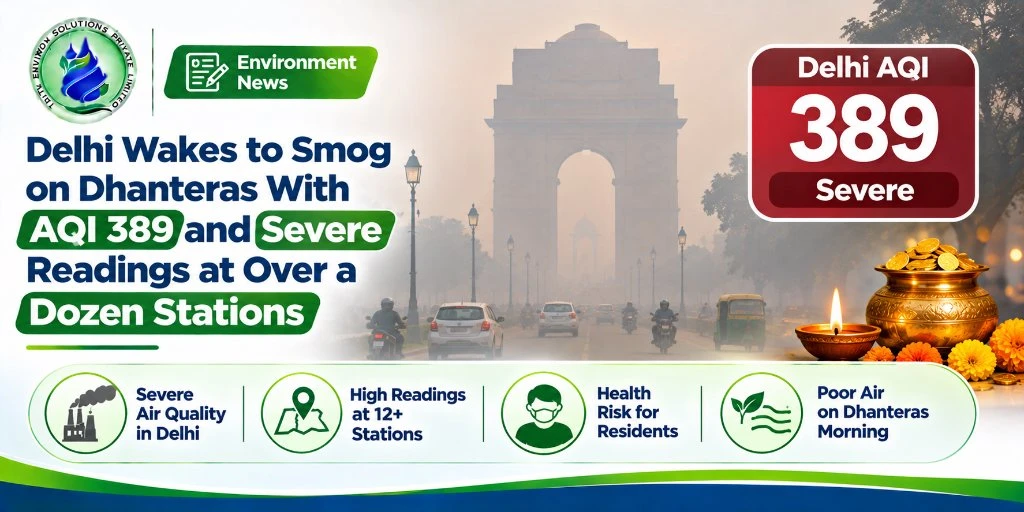
- 389 on the morning of November 6, according to CPCB data
Stubble burning is one source feeding Delhi from the wider region. Punjab's pollution control board recorded 2,347 farm fires as of November 4, with Tarn Taran highest at 558, followed by Ferozepur (316) and Amritsar (207), as reported by Business Standard. Those fires are in the same airshed the study describes.
Where the study and GRAP differ
GRAP responds to a daily reading, using measures such as road sweeping, vehicle restrictions and construction curbs once the AQI crosses a threshold. The airshed idea is to reduce the underlying emissions all year across the region, so that fewer days reach those thresholds. The two approaches are not alternatives. The study argues the second is needed for lasting change.
What the Study Cannot Tell Us
- A scenario that removes all human-made emissions is not achievable, and the real effect of any partial policy would be smaller
- A model depends on the quality of its emission inventories and its assumptions
- The report does not say how the findings were reviewed
- The study was reported through a single news outlet, and the paper itself was not available for this article
What Industry and Local Bodies Can Take From It
These are general points and not recommendations from the study.
- Industry: emissions leave the stack and enter a shared airshed. Meeting limits at the source, and measuring them, is the contribution each unit makes. Calibrated SOx NOx gas analysers help a plant check its own stack emissions
- Local bodies: road dust, waste burning and construction dust are local sources that add up across a region
- Neighbouring districts: pollution does not stop at a boundary, so enforcement in one district affects another's air
The Commission for Air Quality Management, which covers Delhi-NCR, publishes its directions on its website. The NCR is one part of the airshed the study describes.
Why This Matters for Policy
Air-quality commissions and pollution boards act within defined areas. If pollution moves freely across them, enforcement in one area may be undone by lax enforcement in the next. A shared airshed framework would give neighbouring states a common target and a way to see how their actions affect each other.
The study does not claim this will happen. It sets out why it could help.
What to Watch Next
- Whether the paper's methods and data are published for scrutiny
- Whether any government body or commission responds to the airshed proposal
- Whether the 60% and 70% figures are reconciled
- How Delhi's air behaves through Diwali week, which is likely to be a test of regional controls
Each winter shows the same pattern: smoke from across the region meets stagnant air over the city. A region-wide approach is a direct response to that pattern.