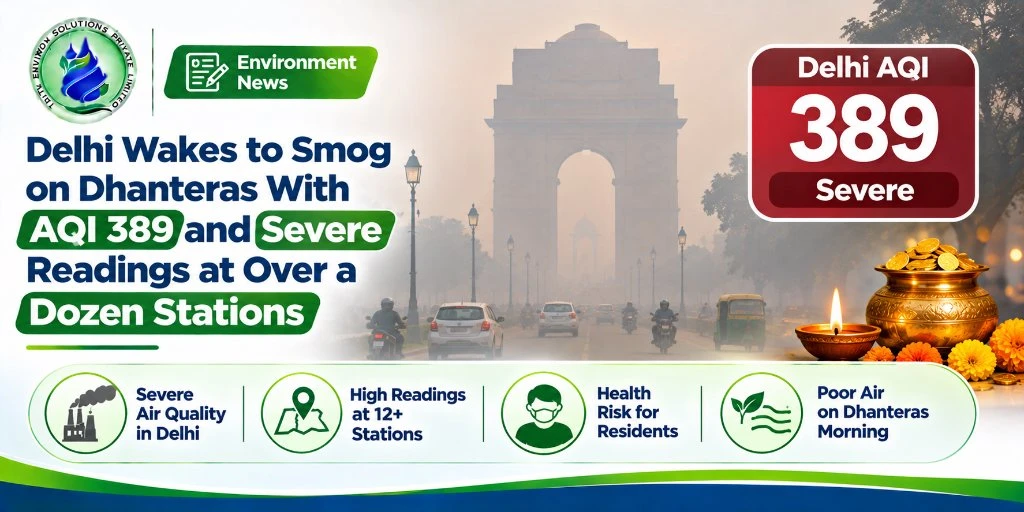
Delhi woke to thick smog on Friday, November 6, Dhanteras. The city's Air Quality Index (AQI) was 389 at 8 am, in the "very poor" category, according to Central Pollution Control Board (CPCB) data.
The reading was up from the previous day, and forecasters expect it to worsen around Diwali. Stage II of the Graded Response Action Plan (GRAP) remains in force.
The Readings
City-wide
- Friday, November 6, 8 am: 389, "very poor"
- Thursday, November 5: 367 (Business Standard and Open) or 369 (Business Today). The outlets differ slightly
- Tuesday, November 3 and Wednesday, November 4: 331 and 373, as reported by Business Standard in earlier coverage
Severe-category stations
Outlets list slightly different stations, as follows. The CPCB scale puts 401 to 500 in "severe".
- Business Today (about 28 stations severe): IIT Delhi 473, Jahangirpuri 460, R K Puram 446, Sirifort 431, ITO 424, Patparganj 423, Dwarka Sector 8 418, Burari Crossing 411
- ANI and Business Standard: IIT Delhi and Rohini 474 each, Punjabi Bagh 465, RK Puram 443, ITO 422, Firoz Shah Road 420, India Gate 403
Business Today notes that its labels for some stations are inconsistent and advises checking CPCB for exact categories.
Very poor stations
Aya Nagar and Chandni Chowk were in the 390s, IGI Airport Terminal 3 was at 385, and Anand Vihar and Akshardham at 359. Business Today also gave 352 for Badarpur.
The differences between outlets come from different station sets and snapshots. The city-wide figure, 389, is the same in all four reports.
GRAP and Response
- Delhi is under GRAP Stage II, which corresponds to a city-wide AQI of 301 to 400, according to Open
- Truck-mounted water sprinklers were deployed near India Gate to control road dust
- A CREA expert called for stricter GRAP implementation, according to Business Today. The report does not say which GRAP stage the city is in
Stage II was invoked across the National Capital Region on November 2. The Commission for Air Quality Management publishes the notices on its website. GRAP stages are triggered by forecasts and readings, so a move to Stage III depends on the commission's decision, which none of the reports predict.
What Is Driving the Pollution
Stubble burning
Punjab's pollution control board recorded 2,347 farm fire incidents as of November 4, according to Business Standard. Tarn Taran had the most (558), followed by Ferozepur (316) and Amritsar (207). Business Today said farm fires had risen over the past two days.
Delhi's Environment Minister Manjinder Singh Sirsa claimed, citing Punjab government figures, that 77% of stubble had been burnt, as reported by Open. That is his claim, and the article does not verify it.
Other sources named
- Firecracker emissions
- Vehicular pollution
- Road dust
- Weakening winds and poor dispersal
The reports do not give a source-by-source share for November 6.
The weather
The India Meteorological Department reported a morning temperature of 17.8°C and mostly clear skies. It forecast shallow fog for the next four days, with fog or mist likely in the early mornings of November 10 and 11.
The Forecast Through Diwali
Business Today reported the following.
- The Air Quality Early Warning System expects air quality to move from "very poor" to "severe" from November 6 to 8
- Skymet's Mahesh Palawat said northwesterly winds should hold until November 7, with light easterly winds from Diwali night possibly dispersing pollutants on November 8
- Conditions could worsen from November 9 as those winds weaken and pollutants accumulate
- The capital is likely to see severe air quality on Diwali, as firecracker pollution coincides with peak stubble-burning season and unfavourable weather
CREA's Manoj Kumar said the AQI could rise from "very poor" to severe if the weather stays unchanged, with some hotspots exceeding 450. He called the day after Diwali particularly concerning.
These are forecasts and can change. Wind direction in particular decides whether smoke accumulates or disperses.
The Run-up in Context
- October 21: GRAP Stage I invoked at AQI 244
- October 30: AQI 78 after record rain
- November 2: 324, GRAP Stage II
- November 6: 389
The rain of October 30 gave a brief break, and forecasters at the time said it would not last. It lasted about two days.
What Residents Can Do
These are general suggestions and not official advice.
- Limit outdoor activity, especially in the morning, and especially for children, older people and those with heart or lung disease
- Keep windows closed during peak hours and use air purifiers where possible
- Wear a well-fitting N95-type mask outdoors on severe days
- Avoid adding to the load. Skip firecrackers and avoid burning waste, leaves or firewood
- Check the live AQI near where you live rather than relying on the city-wide figure
What Industry and Facility Managers Should Do
- Run diesel generator sets only as standby power
- Keep stack emissions within consent limits. Calibrated SOx NOx gas analysers let operators spot deviations as they happen
- Keep dust controls in place at construction sites and yards. CAQM's fact sheet, reported by Outlook, said construction restrictions across the NCR run from November 5 to 20
- Keep monitoring records ready, since boards are tightening enforcement
What the Reports Do Not Say
Industrial emissions are sometimes assumed to be a main driver of days like this. None of the four reports reviewed attributes Friday's reading to industry specifically, so this article does not either. Industry is one source among several, and the figures the reports give are for stubble burning, vehicles, firecrackers and dust.
Reading the AQI Categories
The CPCB scale used in the reports runs as follows.
- 0 to 50: good
- 51 to 100: satisfactory
- 101 to 200: moderate
- 201 to 300: poor
- 301 to 400: very poor
- 401 to 500: severe
At 389, the city-wide reading is near the top of "very poor". About 28 stations in the severe range means a large part of the city is already above 400.
Why station readings differ from the city figure
The city-wide AQI is an average across stations. Stations near heavy traffic, construction or open burning often read much higher than those in greener or less built-up areas. In the reports, IIT Delhi and Rohini read 474 while Anand Vihar read 359. A resident of a severe-category area faces worse exposure than the headline number suggests.
What to Watch Next
- Daily CPCB bulletins for November 7 and 8
- Whether the AQI crosses 400 on a daily average, and any CAQM decision on a higher GRAP stage
- Farm-fire counts from Punjab and Haryana
- Readings on and after Diwali, the period forecasters have singled out
The air will depend on the wind in the next few days. What the city can do is cut the emissions that it controls.