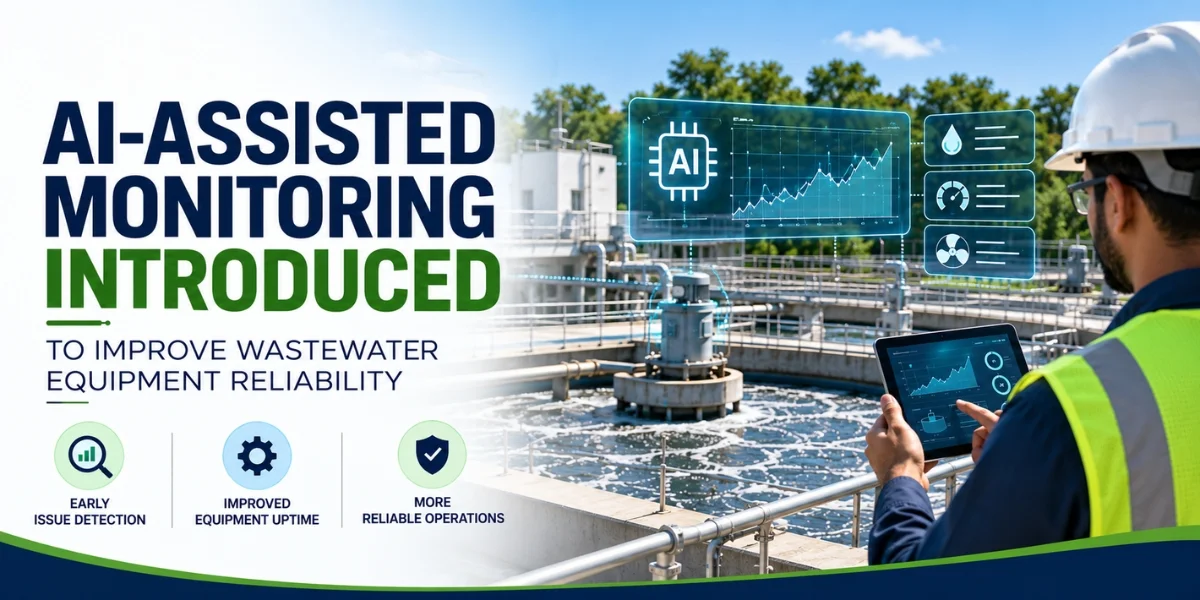
Wastewater utilities and industrial plants are increasingly turning to AI-assisted monitoring to catch equipment problems before they cause a failure, rather than relying on scheduled inspections or waiting for a breakdown. Through 2026, this shift has moved from pilot projects toward wider adoption, driven by ageing infrastructure, rising energy costs and persistent staffing shortages in plant operations.
Why Equipment Reliability Has Become a Priority
Aerators, pumps, blowers and other core wastewater treatment equipment operate continuously in harsh, corrosive conditions, making them prone to gearbox failures, motor burnout and fouling. Traditional maintenance has relied on manual rounds and calendar-based servicing, an approach that tends to miss gradual degradation, such as bearing wear or diffuser clogging, until it becomes an operational crisis. For a facility where aeration failure can mean a compliance breach within hours, that gap matters.
How AI-Assisted Monitoring Works
AI-based predictive maintenance systems typically combine IoT sensors, programmable logic controllers (PLCs) and edge computing units that track vibration, temperature, energy draw and other operational parameters in real time. Machine learning models trained on this data are used to flag developing equipment issues before they cause downtime, rather than after a failure has already occurred.
Some implementations go further, building a digital twin of the facility that allows operators to simulate how equipment will respond to different operating conditions before making changes on the live plant. This is distinct from, but complementary to, the kind of continuous water-quality monitoring used to track effluent parameters like BOD and COD.
Reported Benefits Across the Industry
Industry reporting through 2026 points to a consistent set of benefits associated with predictive maintenance adoption, though actual results vary by facility and implementation:
- Reduction in unplanned equipment failures, commonly cited in the range of 30 to 40 percent.
- Energy and chemical cost savings from AI-driven aeration and dosing control, reported in the range of 20 to 35 percent in some implementations.
- Extended asset lifespan, as gradual degradation is addressed before it forces a full component replacement.
- Reduced reliance on manual, on-site inspection rounds, which can help address staffing shortages in plant operations.
These figures come from vendor and industry reporting rather than independent audits, and actual performance will depend on data quality, sensor coverage and how well a system is calibrated to a specific plant's equipment and operating conditions.
What This Means for Plant Operators
For plant operators and EHS teams, the practical starting point is usually sensor coverage and data quality rather than the AI model itself. Facilities with incomplete historical maintenance records or limited sensor networks often find it harder to get reliable predictions in the early stages of adoption, which is why phased rollouts, starting with a plant's most critical or failure-prone equipment, tend to be more common than a full-facility rollout from day one.
For a more detailed look at how AI and IoT are being applied specifically to Indian STPs and ETPs, including real-time parameter monitoring and automated compliance reporting, see our earlier coverage on AI in wastewater treatment.
Key Highlights
- AI-assisted predictive maintenance is moving from pilot use to broader adoption across wastewater plants in 2026.
- Systems typically combine IoT sensors, PLCs and machine learning to flag equipment issues before failure.
- Industry reporting cites 30-40 percent reductions in unplanned equipment failures in some implementations.
- Energy and chemical cost savings of 20-35 percent have been reported alongside predictive aeration and dosing control.
- Sensor coverage and data quality, not the AI model alone, are typically the limiting factor in early adoption.
Sources & Further Reading
This article draws on industry reporting from Oxmaint, Industrial Repair Store, and iFactory, published between January and August 2026.