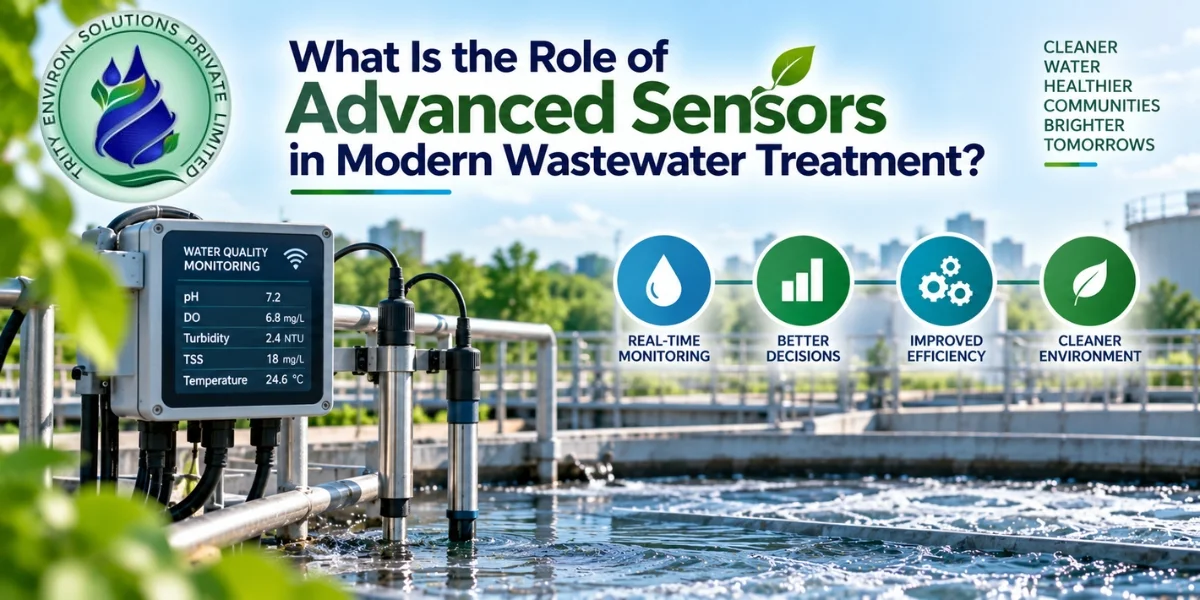
What Is the Role of Advanced Sensors in Modern Wastewater Treatment?
How IoT sensors and AI are transforming wastewater treatment in 2026, real case studies, predictive maintenance, and what modern sensors can detect.

 ISO 9001:2015 & QCI Approved
Waste segregation is no longer just good practice, it is now the law under India's new SWM Rules 2026. This guide covers what actually counts as wet or dry waste, how the new four-bin, color-coded system works, and what it means for households and businesses alike.
Waste is one of the defining environmental challenges of this decade, and how it gets managed starts with a single decision made at the source: whether it gets segregated correctly before it ever reaches a bin. India generates over 62 million tonnes of solid waste every year, yet only a fraction of it is properly collected and treated, largely because wet waste and dry waste still end up mixed together in the same bag more often than not. Understanding what actually separates the two, and following India's newly updated segregation rules, is the single most effective step any household, society, or business can take toward reducing landfill burden and improving recycling outcomes.
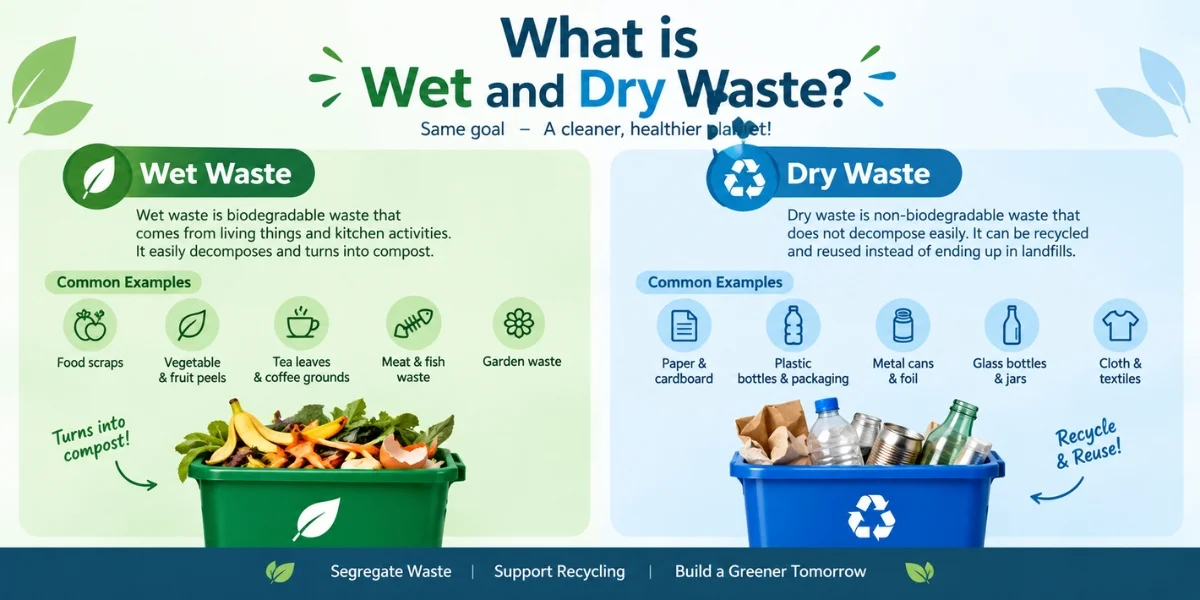
Wet waste, also called organic or biodegradable waste, is anything that decomposes naturally and can be composted or converted into biogas. It typically includes food scraps, vegetable and fruit peels, leftover cooked food, tea leaves and coffee grounds, garden trimmings, and flowers, including flowers from daily puja. Wet waste is usually the largest single category by weight in an average Indian household, driven mainly by kitchen activity. Once collected separately and kept free of plastic or other contamination, wet waste can be processed through composting or bio-methanation and converted into nutrient-rich compost, organic fertilizer, or biogas.
Dry waste refers to non-biodegradable material that does not decompose naturally, though a large share of it is recyclable. Common examples include paper, cardboard, plastic bottles and packaging, glass jars and bottles, metal cans, old clothes and footwear, thermocol, and e-waste. Dry waste is further split into recyclables, such as clean plastic, paper, glass, and metal, and non-recyclables, such as certain multi-layer plastics or broken glass that cannot realistically be processed. A detail that often confuses people is that used tissue paper and paper towels are classified as dry waste in India, not wet waste, since they are processed through recycling channels rather than composting.
| Aspect | Wet Waste | Dry Waste |
|---|---|---|
| Nature | Biodegradable | Non-biodegradable |
| Also known as | Organic or kitchen waste | Recyclable or dry garbage |
| Examples | Food scraps, peels, tea leaves, garden trimmings, flowers | Plastic, paper, glass, metal, e-waste |
| Disposal method | Composting or bio-methanation | Sent to Material Recovery Facilities (MRFs) for sorting and recycling |
| Bin colour under SWM Rules 2026 | Green | Blue |
| End result | Compost, organic fertilizer, or biogas | Recycled into new products |
The Ministry of Environment, Forest and Climate Change notified the Solid Waste Management (SWM) Rules, 2026 on 27-28 January 2026, and they came into full effect from 1 April 2026, superseding the earlier SWM Rules of 2016. The most significant change is that basic two-bin, wet-and-dry segregation is no longer sufficient on its own. The rules now mandate four-stream segregation at source, expanding the categories to wet waste, dry waste, sanitary waste, and special care waste, each tied to its own colour-coded bin.
This does not replace the basic wet-dry distinction covered above, it builds on it. Wet and dry remain the two largest categories by volume in most homes, so getting that split right is still the foundation. What changes is that sanitary and hazardous items, which were often loosely mixed into the dry waste stream before, now need their own dedicated handling.
A few other changes under the new rules are worth knowing. The framework applies the Polluter Pays principle, allowing State Pollution Control Boards to levy environmental compensation for non-compliance, false reporting, or improper handling. Landfills are now restricted to non-recyclable, non-energy-recoverable waste, with higher fees charged for unsegregated waste compared to properly segregated waste. A centralised online portal run by CPCB now tracks waste from generation through collection, processing, and disposal.
The SWM Rules 2026 introduce a clear definition of Bulk Waste Generators (BWGs), entities with a floor area of 20,000 square metres or more, water consumption of 40,000 litres per day or more, or solid waste generation of 100 kilograms per day or more. This covers government offices, PSUs, commercial establishments, malls, and residential societies. Since BWGs collectively account for close to 30% of India's total solid waste generation, the rules place direct legal responsibility on them under an Extended Bulk Waste Generator Responsibility (EBWGR) framework, requiring wet waste to be processed on-site wherever feasible, or an EBWGR certificate to be obtained where on-site processing is not practical.
For facilities already managing wastewater compliance through an STP or ETP, solid waste segregation is a natural extension of the same environmental compliance mindset, since both wet waste composting sites and industrial solid waste handling areas generate their own wash-down water and leachate that needs proper treatment before discharge, rather than being allowed to run off untreated.
Segregating wet and dry waste at the source delivers benefits well beyond simple compliance. It directly reduces landfill burden, since properly segregated dry waste can actually be recycled instead of being buried alongside organic matter it contaminates. It supports public health, since mixed waste, particularly decomposing wet waste sitting alongside dry material, attracts pests and accelerates bacterial growth in ways that segregated waste does not. It makes recycling economically viable, since contaminated recyclables are frequently rejected by processing facilities, while clean, segregated dry waste retains real value for scrap dealers and recyclers. And under the new rules, correct segregation is simply now a direct legal requirement tied to municipal compliance targets, not an optional civic gesture.
Dry waste collected separately moves to a Material Recovery Facility (MRF), now formally recognised under the SWM Rules 2026 as the country's official sorting hub, where it is separated into plastics, metals, paper, and glass before being sold on for recycling into new products. Wet waste, once kept free of plastic contamination, is processed through composting or bio-methanation at municipal facilities or through home composting, converting it into nutrient-rich compost, fertilizer, or biogas rather than adding to landfill volume. Sanitary waste is collected separately and disposed of through designated channels, while special care waste is handed over to authorised agencies equipped to handle hazardous material safely.
Setting up correct segregation does not require complicated infrastructure, just consistent daily habits.
Trity Environ Solutions works across the full spectrum of environmental compliance for residential, commercial, and industrial clients, and proper waste segregation is a natural complement to the wastewater treatment infrastructure we design and install. Whether it is a sewage treatment plant handling a society's daily sewage load or an effluent treatment plant managing an industrial unit's process wastewater, our engineering team helps clients build a genuinely complete environmental compliance approach, not just a single isolated system. Every installation is backed by pan-India Annual Maintenance Contract and operation and maintenance support. We are ISO 9001:2015 certified, QCI approved, and deliver CPCB-compliant engineering across every project we take on.
Wet waste is biodegradable organic matter, such as food scraps and garden waste, that decomposes naturally and can be composted. Dry waste is non-biodegradable material, such as plastic, paper, and metal, much of which can be recycled instead of composted.
The SWM Rules 2026 mandate segregation into wet waste (green bin), dry waste (blue bin), sanitary waste (red bin), and special care or hazardous waste (black bin), replacing the earlier system that focused mainly on wet and dry categories alone.
Used tissue paper is classified as dry waste in India, since it is processed and recycled rather than composted, even though it may feel counterintuitive given that it is often damp.
Entities with a floor area of 20,000 square metres or more, water consumption of 40,000 litres per day or more, or solid waste generation of 100 kilograms per day or more qualify as Bulk Waste Generators, including offices, malls, institutions, and residential societies, and they carry direct legal responsibility for on-site waste processing under the new rules.
Under the SWM Rules 2026, unsegregated waste attracts higher landfill fees than properly segregated waste, and non-compliance can result in environmental compensation levied by State Pollution Control Boards under the Polluter Pays principle.
Looking to build a complete environmental compliance approach for your society, facility, or industrial unit?
Call +91-9821030072 or email enquiry@trityenviro.com, or get in touch with our engineering team to discuss your wastewater and environmental compliance requirements.
How IoT sensors and AI are transforming wastewater treatment in 2026, real case studies, predictive maintenance, and what modern sensors can detect.
How to calculate the real economic payback period for an ETP or STP investment, with two worked examples showing why it varies so widely.

Explore pharmaceutical degradation in ETPs. Learn how persistent drugs, treatment tech, and microbial activity impact wastewater treatment efficiency.

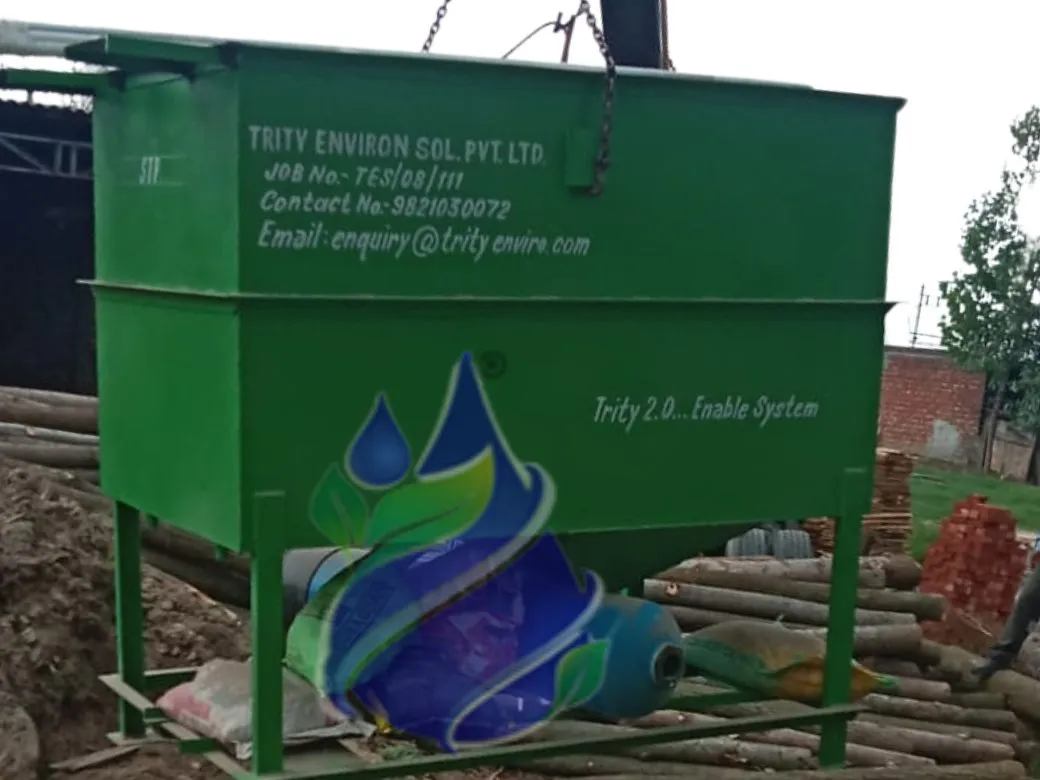


Discuss your requirements with our engineering team and get practical guidance for your project.