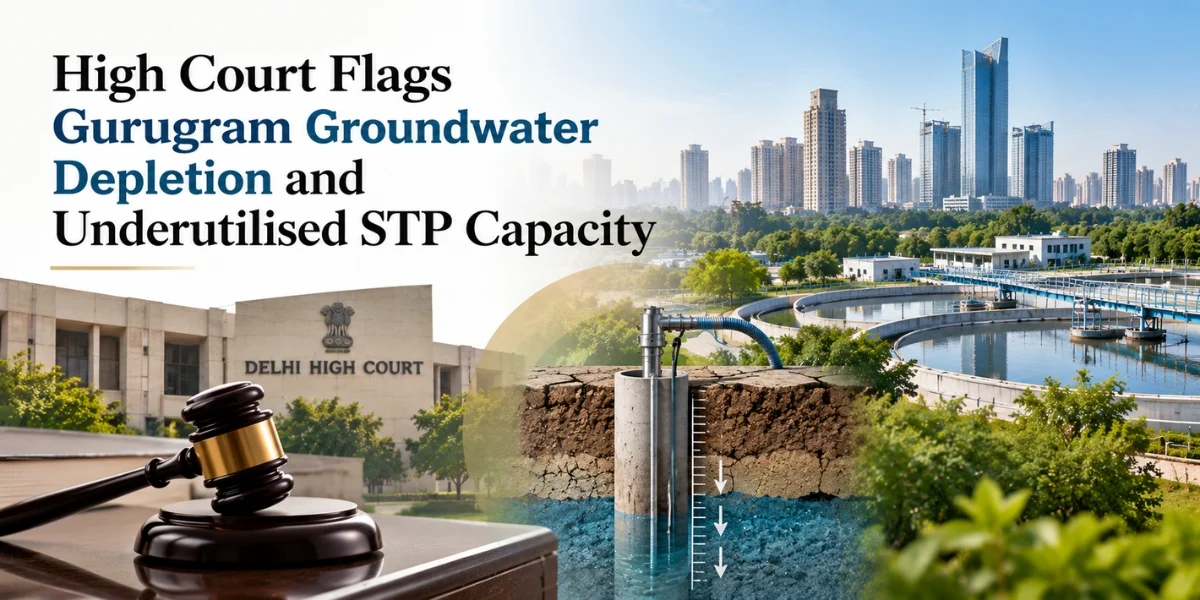
There's a genuinely strange thing happening in Gurugram: the city is running out of groundwater and sitting on sewage-treatment capacity it isn't fully using, at the same time. The Punjab and Haryana High Court put this contradiction on the record on September 26, 2026, in a case over groundwater preservation in Gurugram's municipal limits, and the court's framing is worth taking seriously, because it reframes what looks like two separate problems as one connected failure.
What the High Court Actually Said
A bench of Chief Justice Ashwani Kumar Mishra and Justice Rohit Kapoor, hearing Sunil Singh v Ministry of Environment & Forests and Others, observed that Gurugram has been facing a persistent water crisis due to the non-availability of potable water, driven by decades of indiscriminate borewell use that has continuously depleted groundwater levels. The court also noted that the city's natural water bodies have substantially diminished, while the channels that once sustained them remain largely blocked, and that Gurugram's severe monsoon waterlogging isn't being used to replenish the very groundwater table that's in decline.
The bench had already called for an affidavit from the Central Ground Water Authority on August 19, 2026, which has now been filed, and has summoned the officers-in-charge of the Haryana Shehri Vikas Pradhikaran and the Gurugram Metropolitan Development Authority (GMDA) for the next hearing, listed for October 1, 2026.
Just How Depleted Are We Talking?
The numbers here are stark enough to explain why a High Court is now directly involved. The Central Ground Water Authority first declared Gurugram a "dark zone," meaning extraction exceeds recharge, back in 2008. In the years since, the water table has dropped by 82 percent, and in some areas the average depth to groundwater now exceeds 38 metres, falling at a rate of roughly 1.5 metres every year. More than 90 villages across Sohna, Pataudi, Farukhnagar and Gurugram blocks now sit in the Central Ground Water Authority's "red zone," where the rate of groundwater extraction exceeds natural recharge by over 300 percent.
Here's Where It Gets Genuinely Frustrating: The Underused Capacity
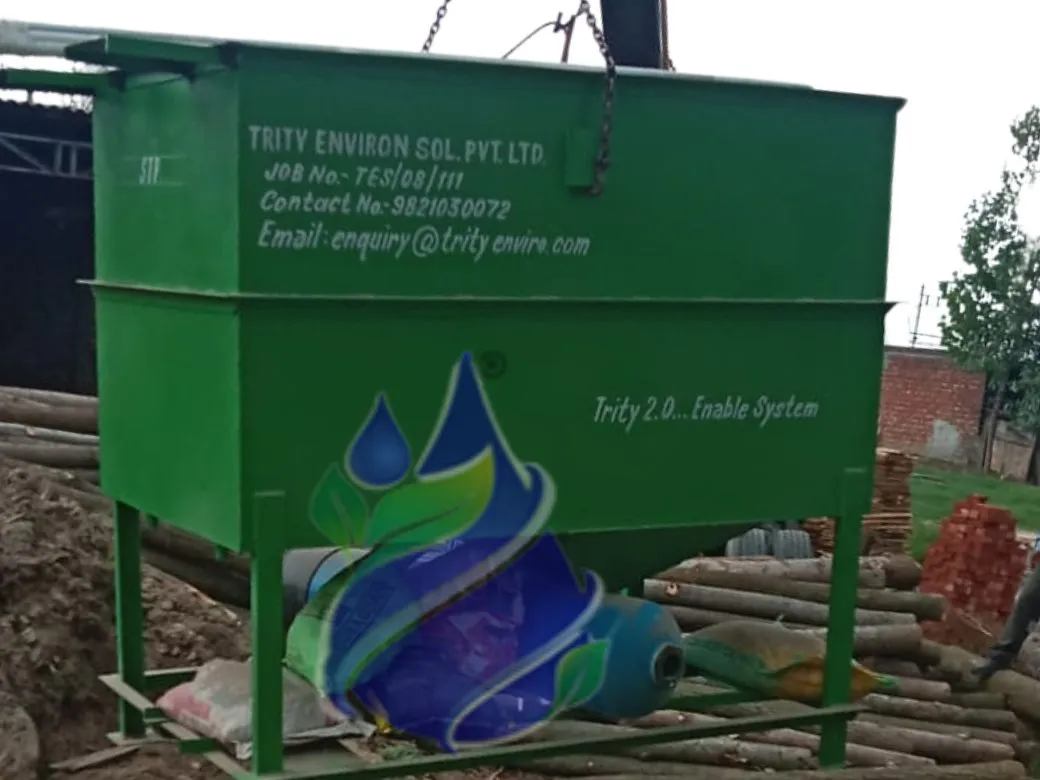
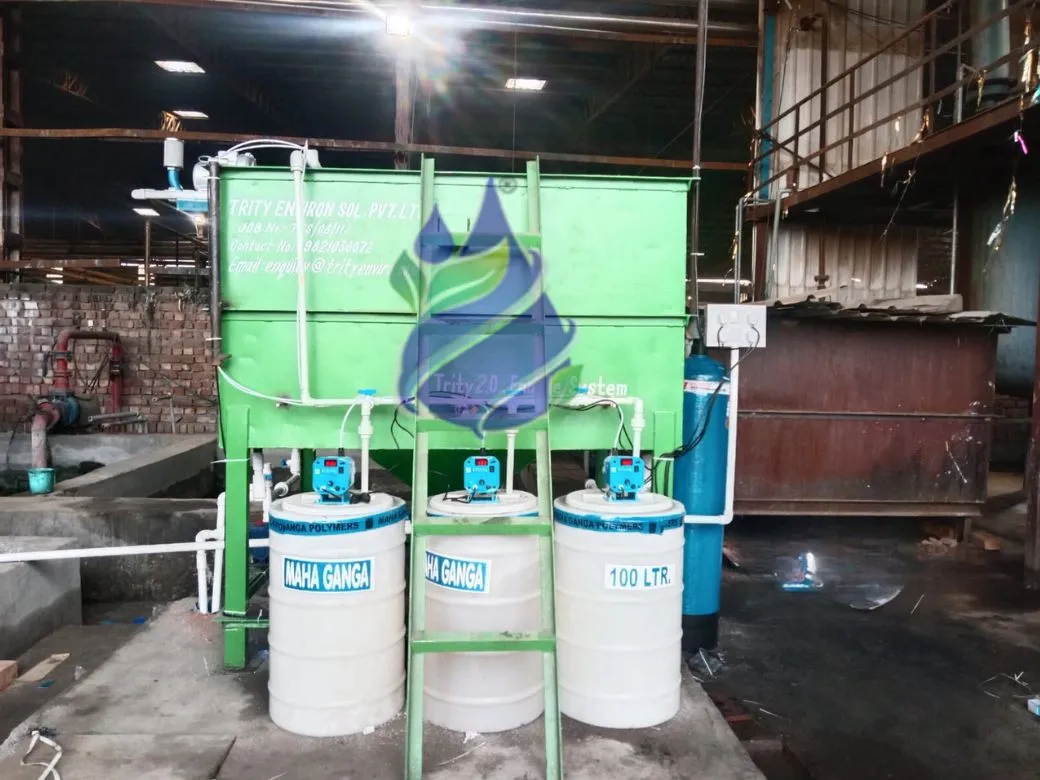
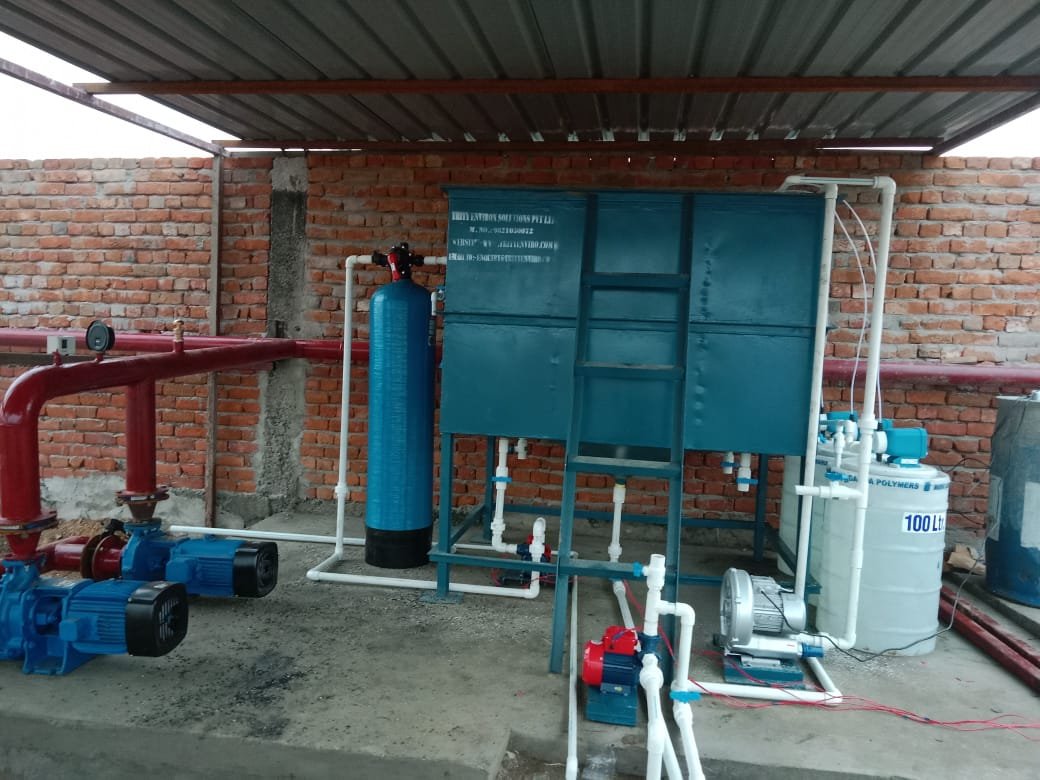
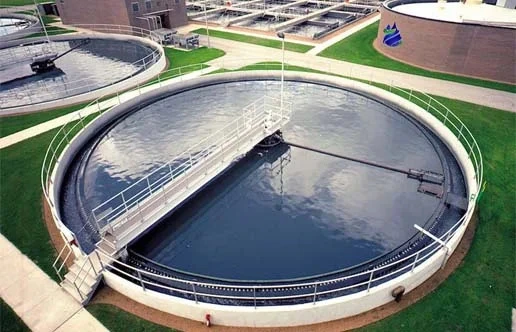
A detailed analysis published two days before the court's latest order laid out the structural pattern underneath all this: a system in which construction activity, private groundwater extraction, lost water bodies, blocked drainage channels, underused sewage-treatment capacity and inadequate storm-water management have all developed together, largely uncoordinated, over several decades. That phrase, underused sewage-treatment capacity, is really the crux of it. Gurugram has invested in STPs capable of producing treated water that could, in principle, substitute for a meaningful share of non-potable demand, construction, horticulture, groundwater recharge through managed aquifer recharge schemes, industrial process water, yet a significant share of that treatment capacity isn't being matched with distribution infrastructure or mandated reuse, so treated water goes to waste while borewells keep drilling deeper.
It's a genuinely odd kind of inefficiency: the city isn't short on treated water supply relative to at least some of its non-potable demand, it's short on the plumbing, policy and enforcement needed to actually connect that supply to the demand that's currently being met by draining the aquifer instead. A functioning wastewater treatment system only delivers on its environmental promise if the treated output is actually routed somewhere useful rather than discharged and forgotten.
Why the Court Is Treating This as One Problem, Not Two
This is really the most useful part of the High Court's framing, and it's worth sitting with. Monsoon waterlogging usually gets treated as a short-term emergency, something to be pumped out and forgotten once the rain stops, while groundwater depletion gets treated as a slow-moving, separate environmental concern to be managed on a different timeline entirely. The court's order implicitly rejects that split: the same water that floods Gurugram's streets every monsoon is water that isn't recharging the aquifer it desperately needs to recharge, and the same treatment infrastructure sitting underused is capacity that could be relieving pressure on that aquifer right now, not in some future phase of planning.
Whether the October 1 hearing produces coordinated directions across GMDA, HSVP and groundwater authorities, rather than another round of isolated departmental responses, is really what determines whether this moment becomes a turning point or just another well-documented crisis.
Key Highlights
- The Punjab and Haryana High Court, hearing Sunil Singh v Ministry of Environment & Forests, flagged Gurugram's water crisis and groundwater depletion on September 26, 2026.
- Gurugram has been a declared groundwater "dark zone" since 2008; the water table has since dropped 82%, with depths exceeding 38 metres in many areas.
- More than 90 villages across four blocks in the district fall in the Central Ground Water Authority's "red zone," where extraction exceeds recharge by over 300%.
- Analysts and the court both point to underused sewage-treatment capacity as part of the same structural problem as groundwater depletion and monsoon waterlogging.
- The GMDA and Haryana Shehri Vikas Pradhikaran have been summoned, with the next hearing scheduled for October 1, 2026.
Sources & Further Reading
This article draws on reporting from Bar and Bench and LiveLaw on the High Court proceedings, and Urban Acres' structural analysis of Gurugram's water system, all published around September 25-26, 2026.