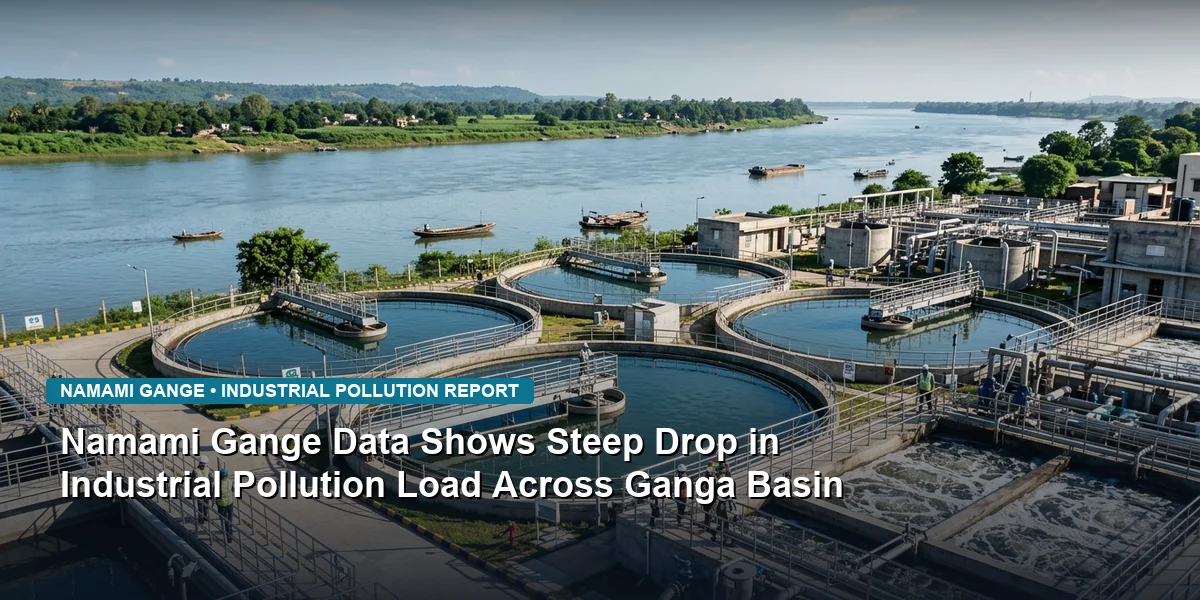
Fresh data released by the Ministry of Jal Shakti under the Namami Gange programme shows a significant, sustained decline in industrial pollution entering the Ganga and Yamuna river systems, driven largely by closer monitoring of Common Effluent Treatment Plants (CETPs) and annual compliance inspections of Grossly Polluting Industries (GPIs).
The release frames the shift as a move away from one-off enforcement drives toward continuous compliance, with sector-specific charters, geo-tagged inspection evidence, and regulatory follow-up built into the system rather than treated as exceptions.
What the Annual GPI Inspection Drive Covers
The inspection mechanism, which began in 2017 with Central Pollution Control Board (CPCB) support, aims to cover 100% of Grossly Polluting Industries across the Ganga basin every year. For the 2026 cycle, 40 technical institutes have been nominated to carry out third-party assessments.
Each inspection checks several things at once:
- Compliance with the Consent to Operate conditions issued by the relevant State Pollution Control Board
- Effluent Treatment Plant (ETP) inlet and outlet samples for parameters including pH, BOD, COD, TSS and TDS
- Whether the unit's Online Continuous Emission Monitoring System (OCEMS) is actually connected and reporting
- Evidence of bypass discharge, where effluent skips treatment entirely
- Groundwater conditions near the industrial site
Violations are documented with geo-tagged photographic evidence, and non-compliant units can face a Show Cause Notice or closure action from their State Pollution Control Board.
Scale of the 2025 Inspection Cycle
- 3,703 Grossly Polluting Industries were assessed nationwide
- 1,296 of these sit in the Ganga basin and 2,407 in the Yamuna basin
- The inspections spanned 113 districts across six states and one Union Territory
- Potential discharge points span 46 tributaries and sub-tributaries of the two river systems
The Pollution Load Numbers
The headline figures in the release point to a real, measurable reduction in organic pollution load over the life of the programme.
Compliance rates (all assessed GPIs):
- Rose from 39% in 2017 to 70% in 2025
Compliance rates (Ganga basin specifically):
- Rose from 39% in 2017 to 86% in 2025
Operational GPIs:
- Increased from 888 in 2017 to 3,154 in 2025, reflecting both industrial growth and better tracking of previously unregistered units
BOD (Biochemical Oxygen Demand) load:
- All assessed GPIs: down from 26 tonnes per day (TPD) to 12.02 TPD
- Ganga basin GPIs specifically: down from 26 TPD to 7.16 TPD, a reduction of roughly 72.5%
Effluent discharge volume (Ganga basin):
- Down from 349 million litres per day (MLD) to 274.88 MLD, a reduction of about 21%
Targeted Action on the Highest-Load Industries
A separate priority track focused on 246 of the most polluting GPIs identified in 2022. Of these:
- 222 units took part in 17 structured workshops and submitted formal action plans
- 24 units either shut down or converted to dry (zero-discharge) operations
- 173, 141 and 126 units met their short-term, medium-term and long-term targets respectively
- Combined pollution load from this group fell from 18.68 TPD to 6.381 TPD, a drop of nearly 65%, within the 2022-23 period
- 156 units have since exited the priority list entirely, leaving 66 still under close watch
CETPs: The Shared Infrastructure Behind Cluster Compliance
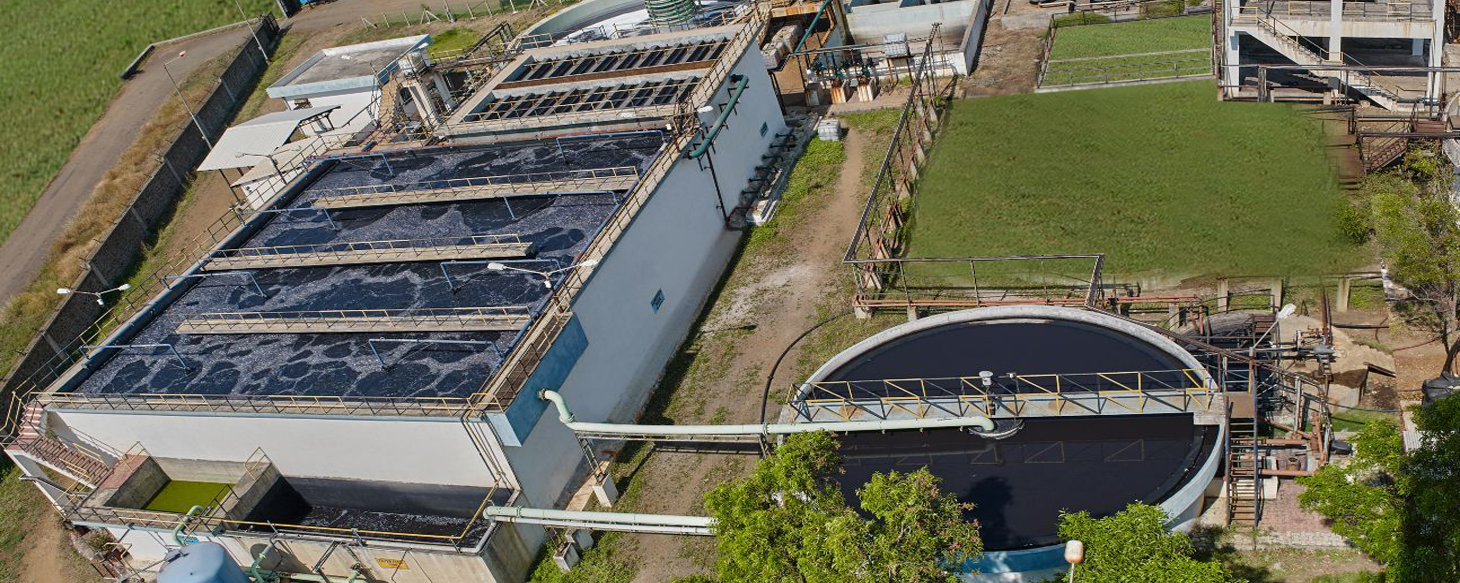
Common Effluent Treatment Plants treat wastewater collectively for industrial clusters, which makes their performance a bottleneck for compliance across dozens of smaller units at once. The 2025 assessment covered 41 CETPs across the Ganga and Yamuna main-stem states, of which 40 were operational.
- Total operational capacity: 514.53 MLD
- Actual utilisation: 286.31 MLD, meaning a meaningful share of built capacity is still underused
- CETPs meeting prescribed treatment standards: 27 of the 41 assessed
The measures recommended for CETPs include better day-to-day operation and maintenance, treatment upgrades where needed, biological treatment stages, improved functioning of Primary Effluent Treatment Plants (PETPs), and stricter outlet monitoring. Textile clusters are specifically advised to move toward chemical management systems, non-toxic dyes and low-salt processes, while tannery clusters are pointed toward cleaner production methods and mechanical desalting rather than chemical-heavy alternatives.
Sector Charters Target the Biggest Polluters
Five sectors, Pulp & Paper, Sugar, Distillery, Textile and Tannery, together accounted for roughly 70% of Ganga basin GPIs and an outsized 88% of total pollution load in earlier assessments. Each now operates under its own compliance charter, alongside a broader Water Recycling and Pollution Prevention Charter that sets numeric targets for water reduction and recycling, developed with third-party technical input.
The resource-efficiency gains reported in these sectors are notable:
- Sugar sector (2017-2025): Freshwater use per tonne of cane fell from 155 litres to 58 litres; wastewater generation fell from 190 to 136 litres per tonne; BOD output fell from 0.0065 to 0.0029 kg per tonne
- Pulp & Paper: 60 recycled-fibre mills now operate on Zero Liquid Discharge, saving an estimated 928.89 MLD of groundwater and conserving roughly 1,649.80 MW of energy annually
Across all sectors covered, the programme estimates around 719 million litres of groundwater saved per day, about 1,277.6 MW of energy saved annually, and roughly 1,162.6 tonnes of CO2-equivalent emissions avoided.
What This Means for Industrial Operators
For industries operating within CETP clusters or discharging into the Ganga-Yamuna basin, the direction of regulatory travel is unambiguous: inspection coverage is expanding, OCEMS connectivity is being verified rather than assumed, and the gap between built treatment capacity and actual utilisation at CETPs (514.53 MLD built versus 286.31 MLD used) is exactly the kind of shortfall regulators are now positioned to catch.
Industries relying on shared CETP infrastructure benefit from ensuring their own pre-treatment meets the inlet standards those plants are designed around, since a CETP operating below its rated capacity or failing outlet parameters puts every connected unit at compliance risk, not just the plant operator. Reliable in-house effluent treatment plant systems and zero liquid discharge (ZLD) solutions reduce that dependency and give operators direct control over their compliance position rather than inheriting a shared facility's shortfalls.