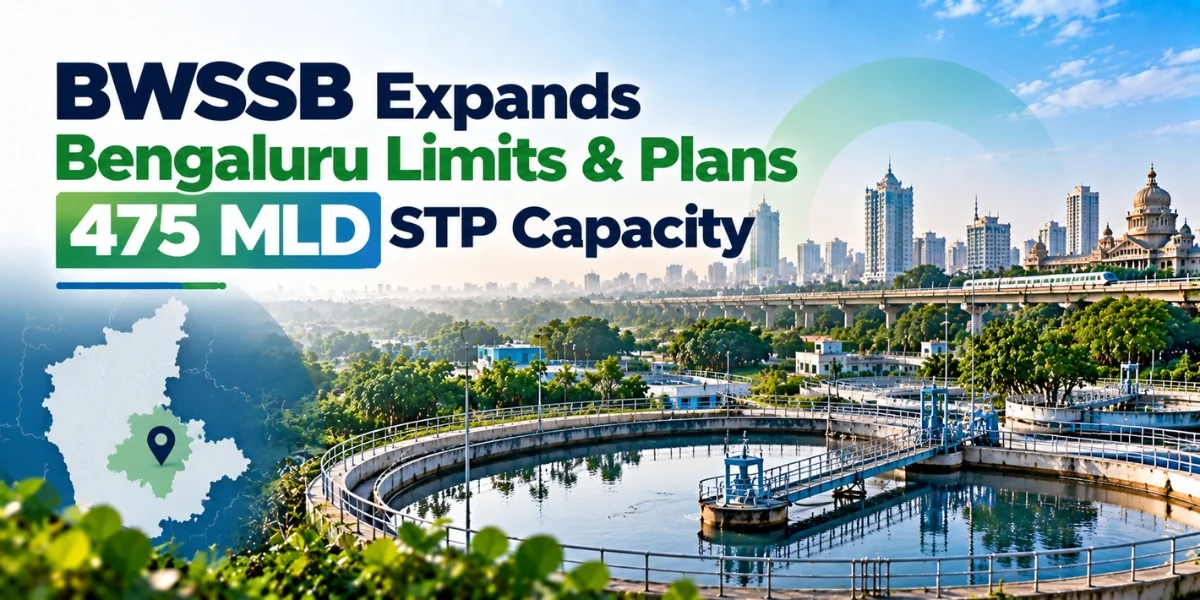
Bengaluru just got a lot bigger, at least on paper for its water utility. In a notification issued on September 24, 2026, the Karnataka government expanded the Bangalore Water Supply and Sewerage Board's (BWSSB) jurisdiction to cover the entire Bengaluru Urban district, roughly 2,100 sq km, bringing fast-growing peripheral belts like Sarjapur, Bommasandra, Hebbagodi and Attibele under the utility's remit for the first time. The move lands just as BWSSB is separately working through a fresh plan to add 475 MLD of new sewage treatment capacity across the city.
A Long Overdue Catch-Up
"For the last 25 years, we have been trying to catch up after urban growth," a state minister said while announcing the expansion, describing it as a shift away from the old pattern of building infrastructure only after an area has already urbanised. All areas and villages under Bengaluru North, East, South, Yelahanka and Anekal taluks now fall under BWSSB limits, though officials note that more than 90 percent of these newly added areas currently depend entirely on groundwater, with no piped water or underground drainage in place. BWSSB has been directed to prepare a master plan for both drinking water and sewerage in these areas.
The Treatment Gap BWSSB Is Racing to Close
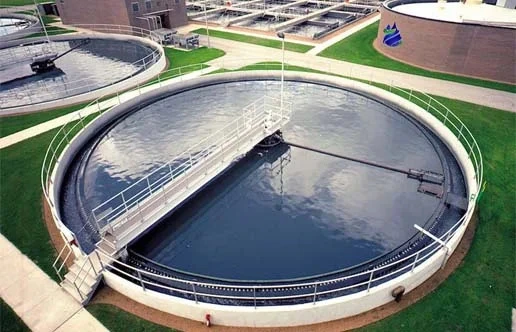
The jurisdiction expansion arrives alongside a separate, already-in-motion push to add treatment capacity. According to a report reviewed a week before this expansion, BWSSB plans nine new sewage treatment plants with a combined capacity of 475 MLD, at an estimated cost of Rs 2,071.21 crore, targeting a reported treatment gap of 1,215.5 MLD. The new and upgraded plants are expected to use advanced treatment systems designed to meaningfully cut nitrogen and phosphorus levels, not just organic load, spread across three packages covering areas from Madiwala and Bellandur to Kadugodi and Byramangala.
That gap figure is worth sitting with for a second: Bengaluru's own sewer system already stretches over 12,000 km and serves more than 11.5 lakh sanitary connections, yet the city still can't fully treat what it generates. This is a familiar story across urban India; as the Central Pollution Control Board's national inventory has long shown, installed treatment capacity in most Indian cities lags well behind actual sewage generation, and Bengaluru's newly expanded footprint means that gap is about to get a lot of new ground to cover.
Why the Jurisdiction Map Matters as Much as the Pipes
It's easy to focus on MLD figures and forget that none of that capacity means much if an area isn't even mapped into the utility's planning zone in the first place. That's really what makes this week's notification interesting: it's less a construction announcement and more a planning-authority reset, the kind of decision that determines where the next decade of sewer lines, pumping stations and sewage treatment plants actually get built. Get the jurisdiction map wrong, and even a well-funded STP programme ends up chasing yesterday's city rather than tomorrow's.
For BWSSB, the practical challenge now is sequencing: extend piped water and drainage to areas that have never had it, while simultaneously building out the treatment capacity that a growing, newly-mapped population will need. Officials from BWSSB, the Bengaluru Metropolitan Region Development Authority and the Minor Irrigation department have been asked to prepare a joint plan for the areas outside core city limits, so this is very much a "watch this space" story rather than a finished one.
Key Highlights
- Karnataka expanded BWSSB's jurisdiction on September 24, 2026, to cover the entire ~2,100 sq km Bengaluru Urban district.
- More than 90% of the newly added peripheral areas currently rely entirely on groundwater, with no piped water or drainage network.
- Separately, BWSSB has proposed nine new STPs adding 475 MLD of capacity, at a cost of around Rs 2,071 crore.
- The city's reported sewage treatment gap stands at roughly 1,215.5 MLD, larger than the new plants' combined capacity.
- BWSSB, BMRDA and the Minor Irrigation department have been asked to prepare a joint master plan for water and sewerage in the expanded area.
Sources & Further Reading
This article draws on reporting from the Deccan Herald and Asianet Newsable on the BWSSB jurisdiction expansion, and Urban Acres' report on BWSSB's proposed 475 MLD STP expansion, both published in September 2026.