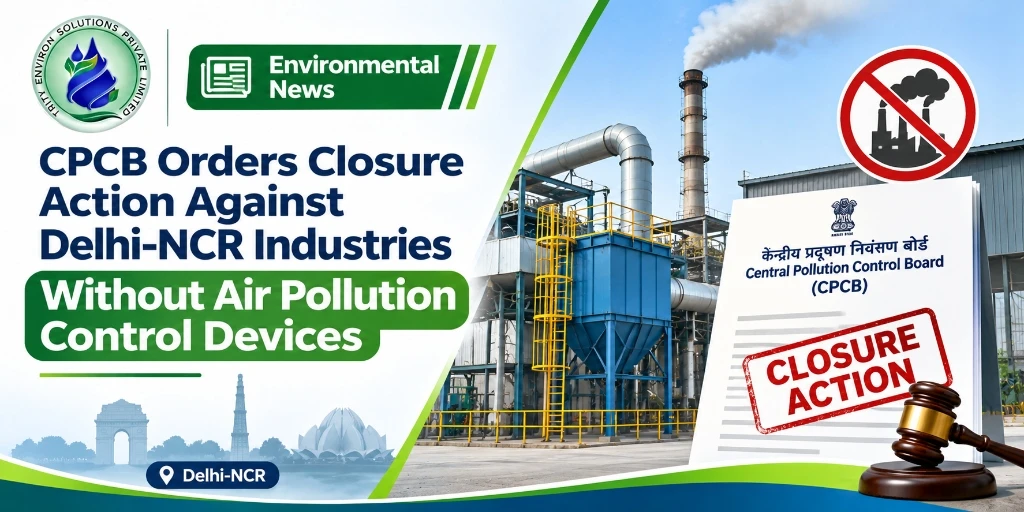
The Central Pollution Control Board (CPCB) has directed pollution control boards in Delhi-NCR to issue closure show-cause notices to industries that have neither placed orders for air pollution control devices (APCDs) nor obtained adequacy or exemption certificates.
The direction, issued on Friday, October 30 under Section 18(1)(b) of the Air (Prevention and Control of Pollution) Act, 1981, was reported by IANS on October 31. It ties enforcement to the revised particulate matter limit of 50 mg/Nm3, which took effect on October 1, 2026.
What the Direction Requires
The direction is addressed to the Delhi Pollution Control Committee (DPCC) and the State Pollution Control Boards of Haryana, Uttar Pradesh and Rajasthan.
The enforcement steps
- Show-cause notices: boards must immediately issue closure show-cause notices to covered units that have no APCD work order and no adequacy report or exemption certificate
- Closure orders: if a unit does not give satisfactory evidence within five days, a closure order follows
- Staying closed: closed units remain shut until they place work orders and the board accepts a compliance timeline
- Reporting: boards must send CPCB a unit-wise list of non-compliant industries and weekly action-taken reports, covering consent-to-operate revocations and electricity disconnections through distribution companies or District Magistrates
- Acknowledgement: boards must confirm receipt of the direction promptly
The reports reviewed do not say how many units are affected.
Why CPCB is acting now
CPCB says industrial stack emissions contribute significantly to particulate matter in the National Capital Region, and that controlling emissions at the source is critical in winter. It points units to its APCD monitoring portal at apcd.cpcb.gov.in.
The Standard Behind the Direction
The direction rests on the air quality commission's industrial emission rules.
- February 20, 2026: CAQM issued Direction No. 98, covering 17 categories of highly polluting industries identified by CPCB, Red Category (medium and large) air-polluting industries, food-processing and textile units with boilers or thermic fluid heaters, and metal industries with furnaces in Delhi-NCR
- July 30, 2026: an amendment extended the revised standard to all industries under Clause 21(i), from October 1, 2026
- Revised limit: 50 mg/Nm3 for particulate matter
Readers can find CAQM directions on the commission's website.
Earlier deadlines
CPCB's March 23, 2026 directions set two earlier dates.
- March 31: registration on the CPCB portal
- April 30: submission of work orders for installing or retrofitting APCDs
What Is New Compared With Earlier Orders
The March directions already provided for closure, revocation of consent to operate, electricity disconnection and sealing. The reports do not say whether the five-day window and weekly reporting are new, so this article does not claim they are.
What is clear is the sequence: immediate show-cause notice, five days to respond, then closure, with the board reporting to CPCB every week.
Where Industry Compliance Stood Before the Order
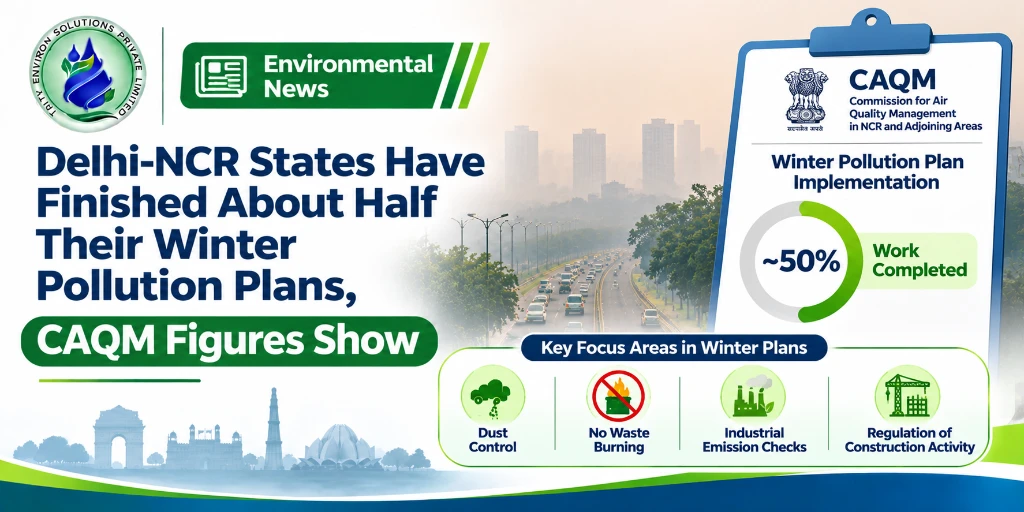
CAQM's fact sheet reported by Outlook on November 3 gives an overview of where the NCR's industrial units stood.
- Online emission monitoring (OCEMS): 2,296 of 2,345 units (about 98%) were connected to CPCB servers
- APCDs: of 2,296 identified industries, 845 (about 37%) had submitted adequacy certificates and 409 had received exemptions
- Still to act: 1,042 units (about 45%) still needed to install devices
These are the commission's figures as reported. The percentages come from the outlet, and the count of units covered by the new CPCB direction was not published. The 1,042 figure suggests the number is large, but no source ties the two together, so no link is claimed here.
What Units Should Do Now
These are general compliance steps and not instructions from CPCB.
Check where you stand
- Find out whether your unit falls under Direction No. 98 and the 50 mg/Nm3 standard
- Check the CPCB portal for your registration, work-order status and any adequacy or exemption record
- Keep copies of work orders, adequacy reports and exemption certificates ready for the board
Close the gap
- If you have no work order, place it now and record the date
- Choose the device for the pollutant and flue gas conditions, for example bag filters, electrostatic precipitators, scrubbers or cyclones
- Ask suppliers for the commissioning schedule, since the board will want a timeline
Show the numbers
- Keep stack emissions measured and recorded
- Calibrate analysers regularly. Our SOx NOx gas analyser page describes stack gas monitoring equipment used for this purpose
- Keep the data accessible in case the board asks for it within the five-day window
Why Closure Hurts More Than Compliance
For an industrial unit, closure means halting production, losing orders and risking electricity disconnection. An APCD is a one-time capital cost, plus running and maintenance cost. Weighing the two is simple for most units, and that is the logic of the direction.
Wastewater is another compliance area that boards inspect alongside air. Units with process effluent should review their effluent treatment plant performance at the same time, since boards often inspect air and water compliance together. That is general practice and not a statement from the direction.
The Wider Air Quality Context
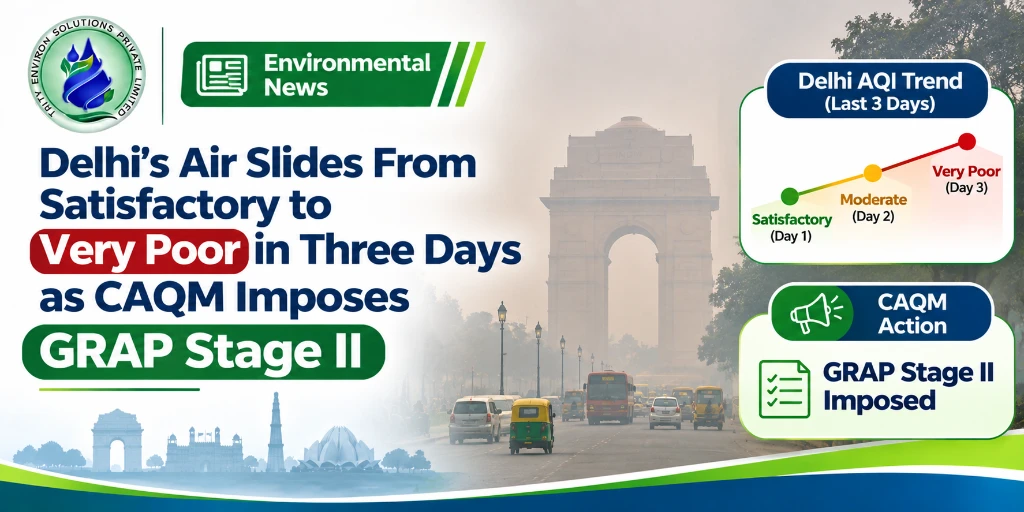
The direction came as Delhi's air was worsening. Stage II of GRAP was invoked on November 2 after the AQI reached 324, and the Delhi AQI stood at 373 on November 4, per Business Standard. Industry is one of several sources. The Decision Support System share cited in the Pioneer on November 3 put industries in Delhi and peripheral areas at 4.2% and transport at 19.2%. Source shares vary day to day.
Why Five Days Matters
A five-day window is short for an industrial unit. In that time a unit must find its records, confirm whether it has a work order, and, if not, place one and show it to the board. Units that have only verbal commitments from suppliers may struggle to produce proof.
Documents boards are likely to ask for
This is a general list based on the direction's wording, not an official checklist.
- A dated purchase or work order for the control device
- A copy of the adequacy assessment report, if one was obtained
- An exemption certificate, if the unit qualifies
- The unit's consent to operate and registration on the CPCB portal
What a unit should not assume
A unit should not assume that a work order placed after the notice will be accepted as evidence of earlier compliance. The direction asks for a compliance timeline the board accepts before a closed unit can reopen, and the board decides what is acceptable.
What to Watch Next
- The number of show-cause notices and closure orders each board reports
- Whether CPCB publishes the unit-wise non-compliance list
- Whether more units are connected, certified or exempted over the next weeks
- Whether CAQM links industrial action to its GRAP stages
Industry in Delhi-NCR has had since February to prepare. The new direction removes any remaining room for delay.