
A Guide to Launching Your Commercial RO Water Plant Business
Complete guide to starting a commercial RO water plant business in India: licenses, investment by capacity, real profit margins, and common mistakes.

 ISO 9001:2015 & QCI Approved
Sewage never arrives at a steady rate. It surges at breakfast, collapses at midnight and spikes in the rain. An equalisation tank is the cheapest way to stop that swing from reaching your biological treatment stage.
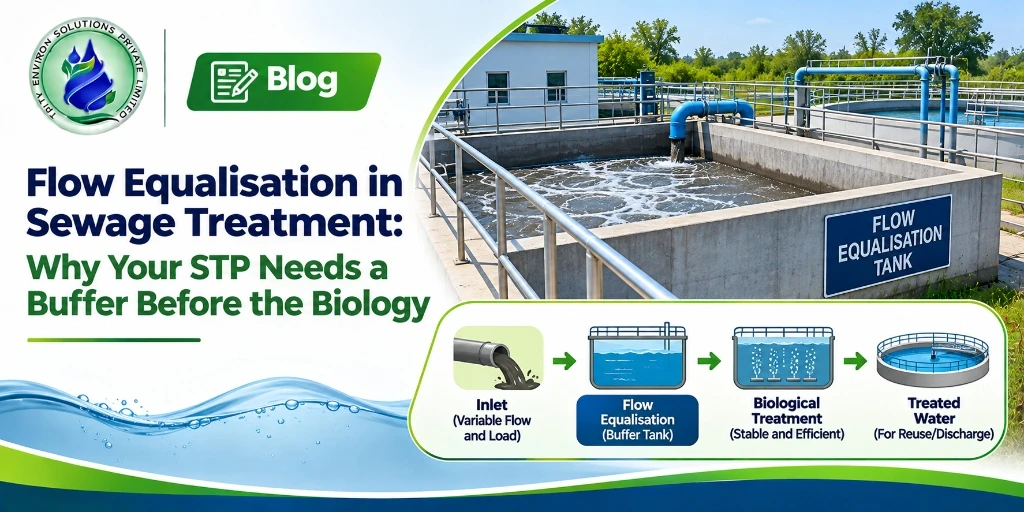
Flow equalisation is the practice of collecting incoming sewage in a buffer tank and releasing it to the treatment process at a steady, controlled rate. The tank absorbs the daily surges, so the biological stage sees a calm and predictable feed.
Sewage does not arrive in a straight line. Flow peaks in the morning and again in the evening, drops sharply overnight and swings with rain. Peak flow can reach two to three times the average, and peak-to-average ratios between 1.5 and 3.5 are commonly used in design.
A plant fed that raw swing has two poor options. It can build every unit large enough for the peak, which wastes capital, or it can accept shock loads when the peak arrives, which hurts effluent quality. Equalisation is the third and cheaper option.
Human routine drives the curve. Different facilities show different peaks:
Water that is not sewage can still reach the plant. Cracked pipes let groundwater in, and illegal roof and sump connections push stormwater into the sanitary line. A single sump pump can add over 7,000 gallons in 24 hours.
These flows arrive in bursts after rain, which is exactly when the plant is least able to cope. Our guide on the causes of sewage explains infiltration and inflow in detail.
Industrial and institutional sites discharge in batches: tank cleaning, wash cycles, boiler blowdown or process changeovers. A short slug of strong or acidic wastewater can overwhelm a biological stage that was designed for an even, average load.
The tank lets downstream units be sized near the average flow instead of the peak:
Flow variation usually comes with concentration variation. Equalisation blends strong and weak sewage together:
Bacteria need a regular diet. At night a plant without equalisation starves its biomass, and at peak hour it overfeeds it:
A constant flow makes everything else easier to control:
Volume depends on how much the flow varies and how steady you want the outflow to be:
As an illustration, a 300 KLD STP has an average flow of 12.5 m³/hr. At 6 hours of retention the working volume is 75 m³, and adding about 15% gives roughly 86 m³ in total. The final figure should always come from a flow survey of your site.
There are two basic layouts:
Most small and mid-size STPs and almost all industrial ETPs use in-line tanks, because load stabilisation matters as much as flow control.
An unmixed tank becomes a settling basin and then a septic tank:
Equalisation only works if the controls support it:
Every biological process gains from a steady feed, and some depend on it:
Published case studies show how much steadier flow helps. In one paint-manufacturing effluent plant, influent BOD swung between roughly 150 and 650 mg/L. A 90 m³ equalisation tank with a six-hour retention time and two paddle mixers was added, and the vendor reported about a 30% improvement in overall treatment efficiency.
The lesson applies equally to sewage: the biology does not need a bigger tank, it needs a more predictable feed.
| Facility | Flow Pattern | Equalisation Priority |
|---|---|---|
| Housing society | Morning and evening peaks | Moderate volume, in-line, covered |
| Hotel or resort | Check-out and meal peaks | Larger volume, strong mixing |
| Hospital | Shift-based, higher load | In-line, screened, odour controlled |
| Railway station or mall | Schedule or footfall driven | Larger volume, robust level control |
| Industrial unit | Batch and strong discharges | In-line, pH and load blending |
Trity Environ Solutions is an experienced sewage treatment plant manufacturer in Ghaziabad, serving Delhi NCR and clients across India. Our engineers size every equalisation tank from a flow survey and peak factor, then match it to an SBR, MBBR or packaged configuration, so the biological stage never meets a surge it was not built for.
As a trusted STP manufacturer and supplier, Trity Enviro backs each plant with an Annual Maintenance Contract covering mixers, pumps and level instruments. We are ISO 9001:2015 certified, QCI approved, and deliver CPCB-compliant engineering nationwide.
Speak directly with our senior environmental engineers for technical guidance, sizing calculations, or a tailored project proposal.
Call +91-9821030072 or email enquiry@trityenviro.com
Complete guide to starting a commercial RO water plant business in India: licenses, investment by capacity, real profit margins, and common mistakes.
The core concept of Zero Liquid Discharge explained step by step: pretreatment, concentration, evaporation, crystallization, and what gets recovered.
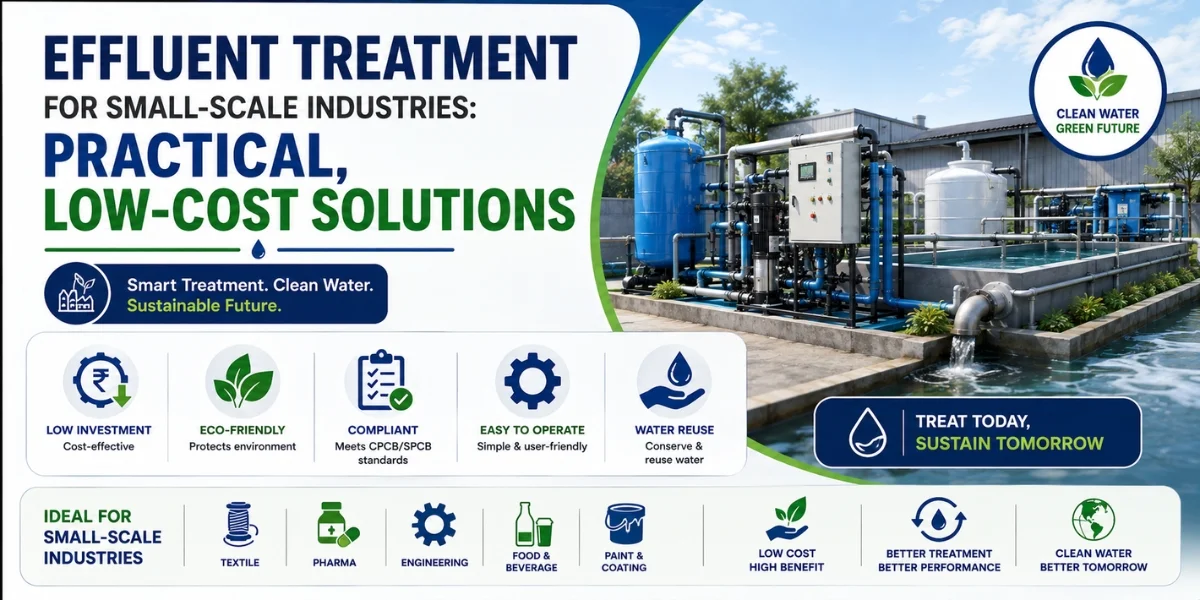
Practical, budget-friendly effluent treatment for small-scale industries: compact ETP systems, CETP options, and government subsidy schemes.











Discuss your requirements with our engineering team and get practical guidance for your project.

