Table of Contents: Engineering Guide & Process Index
1. The Microbiological Mandate: Pathogen Elimination in Urban Wastewater Reuse
1.1 Physico-Chemical Profile and Technical Operating Dynamics
Rapid urbanization, declining groundwater tables, and severe municipal water rationing across Indian metropolises (including Bengaluru, Chennai, Hyderabad, Delhi-NCR, and Mumbai) have made treated sewage reclamation mandatory. Under Central Pollution Control Board (CPCB) urban reuse guidelines and National Building Code (NBC) 2016 directives, commercial business parks, residential high-rises, and industrial factories must recycle 100% of treated sewage for toilet flushing, central air conditioning cooling tower makeup, and landscape greenbelt irrigation.
However, secondary biological wastewater contains high densities of pathogenic microorganisms, including enteric bacteria (Escherichia coli, Salmonella, Shigella, Vibrio cholerae), enteric viruses (Rotavirus, Norovirus, Hepatitis A), and protozoan cysts (Giardia lamblia, Cryptosporidium parvum). Direct human exposure through aerosolized cooling tower drift or bathroom flushing presents severe public health risks. Disinfection serves as the critical final barrier, inactivating pathogens and preventing waterborne disease transmission.
1.2 Biological and Kinetic Parameters for System Stability
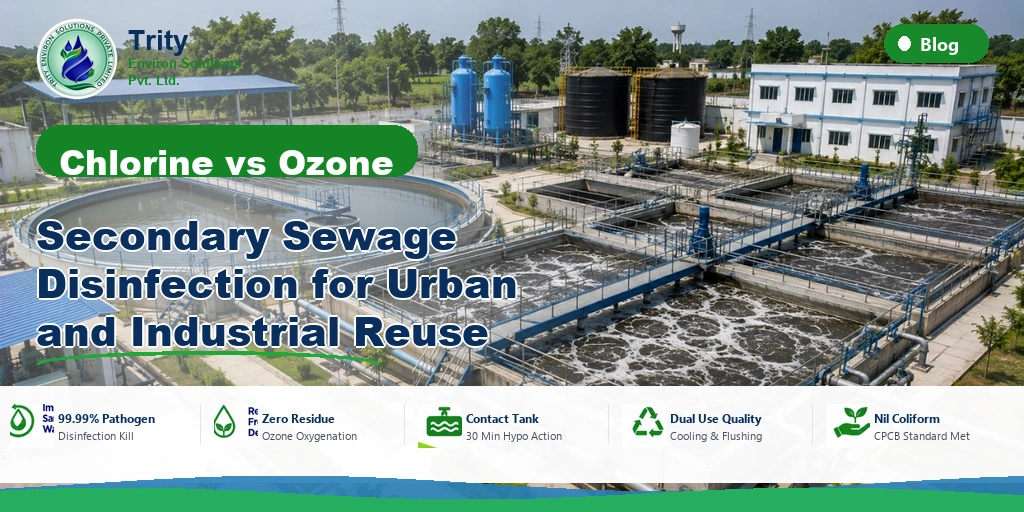
Process engineers must evaluate the comparative advantages, sizing requirements, chemical hazards, and lifecycle economics between two dominant disinfection technologies: Chemical Chlorination (using Sodium Hypochlorite or Chlorine Dioxide) versus Advanced Ozonation (O3).
2. Disinfection Chemistry: Hypochlorite Free Chlorine vs Molecular Ozone
2.1 Stoichiometric Reaction Mechanisms and Reaction Chemistry
The chemical mechanisms of pathogen inactivation differ fundamentally between chlorination and ozonation:
2.2 Chemical Dosage Calculations and Optimization Benchmarks
| Engineering Metric |
Sodium Hypochlorite Chlorination (NaOCl) |
Ozone Disinfection (O3) |
| Oxidizing Mechanism |
Hypochlorous acid (HOCl) diffusion across cell wall |
Direct molecular lysis + Hydroxyl radical (.OH) oxidation |
| Oxidation-Reduction Potential (ORP) |
+1.36 Volts (Moderate oxidizing power) |
+2.07 Volts (Second most powerful oxidant known) |
| Inactivation of Protozoan Cysts (Cryptosporidium) |
Extremely Poor (Cysts are resistant to standard chlorine) |
Superior (> 3-log inactivation of Cryptosporidium oocysts) |
| Disinfection By-Products (DBPs) |
Forms carcinogenic Trihalomethanes (THMs) & Chloramines |
Zero THMs; decomposes into harmless elemental oxygen (O2) |
| Color and Micro-Pollutant Destruction |
Low to moderate color bleaching; poor on pharmaceuticals |
Destroys refractory dyes, endocrine disruptors, and odors |
| Residual Protection in Distribution Piping |
Long-lasting residual (1.0 to 2.0 ppm free chlorine) |
Zero residual (Decays within 10 to 20 minutes) |
3. CPCB Disinfection Standards: Ct Concept and Inactivation Kinetics
3.1 Stoichiometric Reaction Mechanisms and Reaction Chemistry
Disinfection efficacy is governed by the Chick-Watson law and the standardized Ct Concept, defined as the product of disinfectant concentration (C in mg/L) and effective hydraulic contact time (t in minutes) required to achieve targeted pathogen reduction:
Standard Ct Equation: Inactivation Log = k * (C * t)
CPCB Treated Wastewater Standards for Urban Reuse:
- Fecal Coliforms: < 100 MPN / 100 mL (Urban non-potable reuse) | < 10 MPN / 100 mL (Sensitive zones)
- Turbidity: < 2.0 NTU
- Residual Chlorine Target: Minimum 1.0 mg/L at delivery tap (flushing line) to prevent re-growth.
Comparative Ct Values for 99.9% (3-Log) Pathogen Inactivation at 20 deg C:
- E. Coli Bacteria: Chlorine Ct = 0.5 to 2.0 mg*min/L | Ozone Ct = 0.02 mg*min/L (100x faster!)
- Rotavirus / Poliovirus: Chlorine Ct = 15 to 30 mg*min/L | Ozone Ct = 0.5 to 1.2 mg*min/L
- Giardia lamblia Cysts: Chlorine Ct = 80 to 150 mg*min/L | Ozone Ct = 1.0 to 2.0 mg*min/L
- Cryptosporidium parvum: Chlorine Ct > 7,200 mg*min/L (Unfeasible) | Ozone Ct = 5.0 to 10.0 mg*min/L
3.2 Chemical Dosage Calculations and Optimization Benchmarks
As demonstrated by kinetic benchmarks, while chlorine is effective against simple coliform bacteria, achieving virus and protozoan parasite destruction requires impractical chlorine doses and contact times, whereas ozone achieves rapid total microbial sterilization within minutes.
4. Sizing Calculations: 500 KLD STP Chlorination vs Ozonation Engineering
4.1 Mathematical Formulations and Governing Mass Balance
To establish exact equipment ratings, consider the design of a disinfection system for a 500 KLD commercial IT campus STP:
Worked Engineering Design: 500 KLD STP Disinfection Train
Inflow Parameters:
- Daily Hydraulic Flow (Q) = 500 m3/day (25.0 m3/hr average over 20 hours)
- Target: Fecal Coliforms < 10 MPN/100 mL, complete odor destruction.
OPTION A: Sodium Hypochlorite Chemical Chlorination System:
Design Chlorine Dosage = 6.0 mg/L (ppm) as available Cl2 (allowing 4.5 ppm chlorine demand + 1.5 ppm residual).
Daily Neat Chlorine Required = [500 m3/day * 6.0 g/m3] / 1000 = 3.00 kg Cl2/day.
Using Commercial Liquid Sodium Hypochlorite (10% available Cl2 strength, Sp. Gravity 1.18 kg/L):
Volume of 10% Hypo Required = 3.0 kg / 0.10 = 30.0 kg/day (25.4 Liters/day neat liquid).
Chemical Preparation Tank: 200-Liter HDPE tank (holds 7-day chemical supply diluted to 2.5% strength).
Dosing Pump Selection: Electronic diaphragm dosing pump rated 0 to 5.0 LPH at 4.0 bar pressure (0
4.2 Step-by-Step Numerical Sizing Protocol and Worked Example
.1 kW motor).
Chlorine Contact Tank (CCT) Sizing (Mandatory 30-Minute Hydraulic Retention Time):
CCT Volume Required = 25.0 m3/hr * (30 min / 60 min) = 12.5 m3 (Round to 15.0 m3 gross volume).
Civil Dimensions: 5.0 m Length * 1.5 m Width * 2.0 m Depth with serpentine over-and-under baffle walls.
OPTION B: Corona Discharge Ozone Generation System:
Design Ozone Dosage = 4.0 mg/L (ppm) as pure O3 (sufficient for disinfection + 30% color destruction).
Required Ozone Production Rate = 25.0 m3/hr * 4.0 g/m3 = 100.0 grams of O3 per hour (g/hr).
Ozone Generator Selection: Medium-frequency corona discharge ozone generator rated 120 g/hr at 10% wt concentration,
fed by an integrated Pressure Swing Adsorption (PSA) pure oxygen concentrator (93% O2 purity).
Total Electrical Power Consumption = 1.8 kW continuous (including oxygen generator and chiller).
Ozone Contact Chamber (OCT) Sizing (Retention Time = 10 to 12 Minutes):
OCT Volume Required = 25.0 m3/hr * (12 min / 60 min) = 5.0 m3 (Saves 60% civil footprint vs CCT!).
Diffuser System: Fine pore sintered ceramic or titanium micro-bubble diffusers installed at 4.0 m water depth.
5. Disinfection By-Products (DBPs) and Indoor Air Health Hazards in Flushing Re-Use
5.1 Stoichiometric Reaction Mechanisms and Reaction Chemistry
When choosing a disinfection technology for commercial buildings, the chemical nature of Disinfection By-Products (DBPs) represents a critical indoor environmental health and safety issue:
- Trihalomethanes (THMs) and Chloroform Outgassing: Chlorine reacts aggressively with residual humic acids and organic matter in treated sewage, forming toxic, volatile trihalomethanes (chloroform, bromoform, chlorodibromomethane). In corporate offices, malls, and residential apartments where treated water feeds toilet flushing cisterns, every flush atomizes water into the restroom air. Indoor air testing reveals chloroform concentrations exceeding OSHA thresholds, creating persistent eye irritation and respiratory complaints.
- 5.2 Chemical Dosage Calculations and Optimization Benchmarks
>Toxic Chloramines and Nitrogen Trichloride: Ammonia present in secondary sewage reacts with chlorine to form monochloramine, dichloramine, and nitrogen trichloride. In indoor environments and cooling towers, chloramines generate an intense, suffocating 'swimming pool' chemical odor that corrodes HVAC ducts and copper piping.
- The Ozone Advantage for Indoor Flushing: Ozone reacts by direct cleavage of aromatic rings and decomposes within 15 minutes into pure dissolved oxygen (DO > 8.0 mg/L). Ozone leaves zero chemical residues, zero trihalomethanes, and zero chloramines. Flushing cisterns receive sparkling, crystal-clear, highly oxygenated water that completely suppresses anaerobic bathroom odor.
6. Standard Operating Procedure (SOP) for Operating Chlorination and Ozone Plants
6.1 Daily Start-Up, Inspection, and Operational Shift Protocol
Ensuring continuous disinfection compliance requires plant technicians to follow a standardized operational routine:
- Daily Chlorination SOP:
- Test commercial sodium hypochlorite stock concentration weekly using sodium thiosulfate iodometric titration. Commercial bleach degrades naturally in warm storage, losing 15% to 25% of active chlorine per month.
- Calibrate the electronic dosing pump using a graduated 100 mL drawdown cylinder for 60 seconds.
- Measure free residual chlorine at the effluent discharge weir hourly using an N,N-diethyl-p-phenylenediamine (DPD-1) colorimeter. Maintain free chlorine strictly between 1.0 and 2.0 mg/L.
- Daily Ozonat
6.2 Preventive Maintenance, Instrument Calibration, and Safety Check
ion SOP:
- Inspect the PSA oxygen concentrator feed gas dew point monitor: feed gas dew point must remain strictly below -60 degrees Celsius. Moisture entering the corona discharge reactor forms corrosive nitric acid that destroys ceramic dielectric tubes.
- Monitor cooling water flow through the ozone generator heat exchanger. Ozone generation produces heat; gas temperature must remain below 30 degrees Celsius to prevent thermal decomposition of ozone molecules.
- Verify ozone destructor operation on the contact tank off-gas exhaust pipe. Ambient catalytic carbon destructors convert residual airborne ozone back into oxygen, maintaining workplace air strictly below 0.1 ppm O3.
7. Field Troubleshooting Matrix: Resolving Wastewater Disinfection Failures
7.1 Stoichiometric Reaction Mechanisms and Reaction Chemistry
When coliform counts spike or disinfection equipment fails, plant engineers can isolate root causes using this diagnostic matrix:
7.2 Chemical Dosage Calculations and Optimization Benchmarks
| Observed Failure Symptom |
Probable Root Cause |
Diagnostic Field Test |
Engineering Corrective Action |
| Treated water fecal coliforms spike > 1,000 MPN/100 mL despite continuous chlorine dosing. |
Secondary clarifier solids carryover (TSS > 30 mg/L) shielding bacteria inside organic particles. |
Measure treated water turbidity (> 5.0 NTU). Check chlorine demand titration. |
Backwash tertiary sand filter. Chlorine cannot penetrate solid flocs; improve upstream filtration to achieve turbidity < 2.0 NTU. |
| Chlorine dosing pump runs but zero free chlorine detected in contact tank; high combined chlorine. |
Incomplete nitrification in biological stage; high ammonia-nitrogen reacting to form chloramines. |
Measure effluent ammonia (NH4-N > 15 mg/L). Test total vs free chlorine using DPD reagents. |
Increase biological aeration DO to restore nitrification. Ammonia consumes 7.6 mg Cl2 per mg NH4-N (breakpoint chlorination demand). |
| Ozone generator trips on high discharge temperature; output drops by 70%. |
Cooling water chiller failure or scaling inside the dielectric tube water jacket. |
Check cooling water inlet temperature (> 25 deg C) and water flow switch. |
Service chiller refrigeration circuit. Descale dielectric water jacket with mild sulfamic acid. Maintain cooling water < 18 deg C. |
| Ambient ozone sensor alarms in STP plant room; pungent electrical ozone odor. |
Off-gas ozone destructor catalyst exhausted or leak in PTFE delivery tubing. |
Use portable handheld ozone sniffer to pinpoint leak along flange gaskets and destructor exhaust. |
Emergency shutdown of generator. Replace manganese dioxide / copper oxide catalyst in off-gas destructor. Tighten SS316 compression fittings. |
8. Lifecycle Capital and Operational Cost (CAPEX vs OPEX) Analysis
8.1 Core Technology Comparison and Mechanistic Distinctions
Evaluating chlorination versus ozonation across a 10-year Total Cost of Ownership (TCO) reveals distinct economic and operational profiles:
- Capital Expenditure (CAPEX) Comparison: Sodium hypochlorite dosing systems carry low equipment capital costs (Rs. 1.2 to 2.5 Lakhs for dosing skids), but require large, expensive reinforced concrete (RCC) contact tanks (15 to 25 m3 capacity) to achieve 30 minutes of retention time. Conversely, an ozone generator carries a higher initial equipment cost (Rs. 6.5 to 10.0 Lakhs for a 120 g/hr skid), but requires a compact contact chamber (only 5 m3), saving Rs. 3.5 Lakhs in civil construction and conserving valuable basement floor space.
- Operational Consumables (OPEX) Comparison: Operating a sodium hypochlorite system requires purchasing commercial chemical bleach continuously. For a 500 KLD plant dosing 25 Liters of 10% bleach daily (costing Rs. 22/Liter), annual chemical expenditure is Rs. 2.0 Lakhs, plus the labor and hazard of handling caustic drums. An ozone generator produces disinfectant on-site from ambient air, consuming 1.8 kW of electricity. Operating 20 hours daily at Rs. 8.50/kWh consumes Rs. 1.11 Lakhs annually in power, delivering 45% lower annual operational running cost.
- The Dual-Barrier Hybrid Architecture: For premium commercial IT parks, modern design deploys a hybrid approach: inline ozonation (3 ppm) destroys color, pharmaceuticals, and Cryptosporidium while providing sparkling clarity, followed by a trace chlorine dose (0.8 ppm) into the final distribution pump header to maintain residual biostatic protection throughout miles of domestic flushing and cooling tower pipes.
8.2 Operational Efficiency, Footprint, and Capital Trade-offs
By tailoring disinfection chemistry to specific water reuse applications, facilities achieve total microbiological safety, eliminate hazardous disinfection by-products, and ensure enduring compliance with CPCB urban water recycling standards.
9. Dechlorination Engineering and Chemical Neutralization Protocols
9.1 Daily Start-Up, Inspection, and Operational Shift Protocol
While maintaining a chlorine residual is mandatory for municipal distribution networks and plumbing pipelines to prevent bacterial regrowth, discharging chlorinated effluent into aquatic ecosystems or feeding it into sensitive downstream treatment units presents critical hazards. Under Central Pollution Control Board (CPCB) standards for surface water discharge, residual chlorine must not exceed 0.5 mg/L, as even 0.1 mg/L of free chlorine is acutely toxic to aquatic fish and macro-invertebrates.
Furthermore, when treated wastewater is reclaimed through tertiary reverse osmosis (RO) membranes for cooling tower makeup or boiler.
- Chemical Dechlorination with Sodium Metabisulfite (SMBS):.
- Catalytic Granular Activated Carbon (GAC) Dechlorination:.
Upgrade Your Wastewater Disinfection and Reuse Systems
9.2 Preventive Maintenance, Instrument Calibration, and Safety Check
Eliminate coliform bacteria, destroy odors and color, and comply with CPCB reuse standards with Trity Environ Solutions advanced chlorination and ozonation engineering.
Get Expert Consultation
Call: +91 98188 14787
Related Technical Guides & Engineering Solutions
Explore our detailed engineering manuals and turnkey industrial plant solutions:
- Commercial Sewage Treatment Plant (Stp) Solutions: Industrial engineering, manufacturing, and turnkey compliance support.
- Commercial Ro Plant Systems: Industrial engineering, manufacturing, and turnkey compliance support.
- Industrial Water Softener Systems: Industrial engineering, manufacturing, and turnkey compliance support.
- Environmental Engineering Consultation With Trity Enviro: Industrial engineering, manufacturing, and turnkey compliance support.
- Decentralized STP for Highway Dhabas, Resorts and Toll Plazas: Design, Grease Traps and CPCB Norms
- MGF and ACF Filter Sizing Guide for Tertiary Wastewater Treatment Systems: Design, Media and Backwash Math
- MLSS and F/M Ratio Management in Activated Sludge STPs: Engineering Operating Manual
- STP Commissioning Checklist: Seeding, Acclimatization and 7-Day Performance Testing Guide
For turnkey plant sizing, technical audits, or statutory pollution control board compliance, contact our senior process specialists for on-site environmental engineering consultation.