Table of Contents: Engineering Guide & Process Index
1. The Heavy Pollution Profile of Leather Tanning Industrial Effluents
1.1 Physico-Chemical Profile and Technical Operating Dynamics
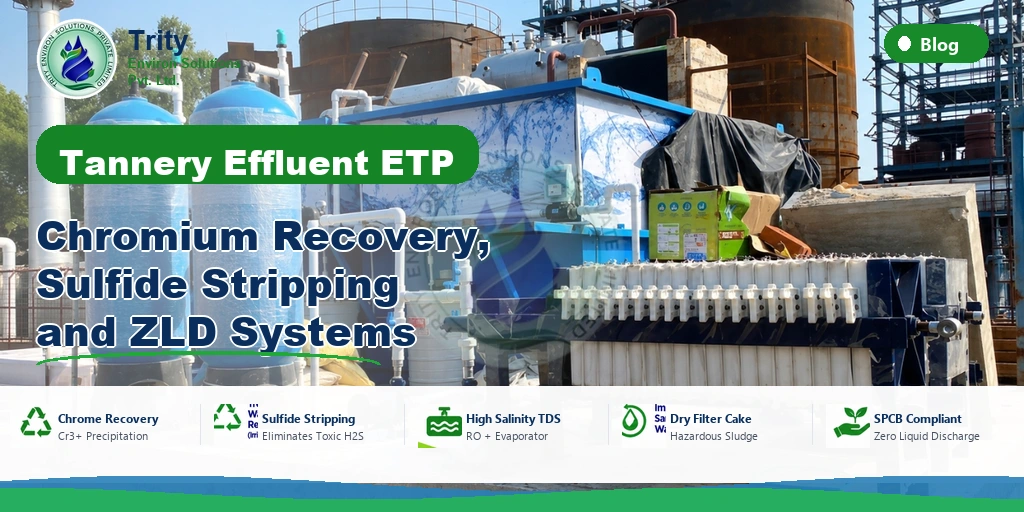
Leather tanning represents one of India's oldest and most economically vital export industries, concentrated across historic industrial clusters in Tamil Nadu (Ranipet, Ambur, Vaniyambadi), Uttar Pradesh (Kanpur, Unnao), and West Bengal (Kolkata Leather Complex). However, converting raw animal hides and skins into finished leather consumes between 30 and 45 cubic meters of fresh water per metric ton of raw hide, releasing some of the most toxic, complex industrial effluents encountered in environmental engineering.
1.2 Biological and Kinetic Parameters for System Stability
Categorized under the Central Pollution Control Board (CPCB) Red Category 17-sector list, tanneries generate segregated waste streams with extreme chemical toxicity:
- Beamhouse Soak and Liming Liquors: Hides are dehaired using calcium hydroxide (hydrated lime) and sodium sulfide (Na2S). The resulting liming effluent exhibits extreme alkaline pH (11.5 to 12.8), high chemical sulfides (S2- ranging from 800 to 2,500 mg/L), and massive Total Suspended Solids (TSS up to 8,000 mg/L) composed of degraded hair keratin, collagen proteins, and animal fats. If acidified accidentally, sulfides convert into lethal hydrogen sulfide (H2S) gas.
- Chrome Tanning Spent Liquors: The chrome tanning stage utilizes basic chromium sulfate [Cr(OH)(SO4)] to cross-link collagen fibers. Up to 30% to 40% of applied chromium fails to fix into the leather hide, discharging into spent tanning baths with trivalent chromium (Cr3+) concentrations between 2,500 and 6,000 mg/L. Chromium is a designated hazardous heavy metal that bioaccumulates in aquatic life and causes severe toxic hepatitis and nephropathy.
- Pickling and Deliming Waste: Utilizes ammonium sulfate, sodium chloride, and sulfuric acid to condition pelts. This stream is loaded with extreme Total Dissolved Solids (TDS up to 60,000 to 80,000 mg/L, dominated by chloride and sulfate salts) and high ammonia-nitrogen (NH4-N between 300 and 800 mg/L).
2. CPCB & SPCB Environmental Standards for the Tanning Industry
2.1 Statutory CPCB and SPCB Discharge Quality Standards
Tanneries face stringent environmental discharge standards under the Environment (Protection) Rules, 1986 and State Pollution Control Board guidelines:
2.2 Continuous Online Monitoring (OCEMS) and Compliance Audits
| Pollutant Parameter |
Raw Composite Tannery Effluent |
Inland Surface Water Norm |
CETP Member Discharge Norm |
| pH Value |
3.2 to 12.5 (Severe fluctuations) |
6.5 to 9.0 |
6.5 to 9.0 |
| Total Chromium (Cr) |
150 to 800 mg/L (Spent bath > 3,500) |
< 2.0 mg/L |
< 2.0 mg/L (At factory gate) |
| Hexavalent Chromium (Cr6+) |
Trace to 25 mg/L |
< 0.1 mg/L |
< 0.1 mg/L |
| Chemical Sulfides (as S2-) |
250 to 1,200 mg/L |
< 2.0 mg/L |
< 5.0 mg/L |
| Biochemical Oxygen Demand (BOD5) |
2,000 to 4,500 mg/L |
< 100 mg/L |
< 350 mg/L |
| Chemical Oxygen Demand (COD) |
5,000 to 12,000 mg/L |
< 250 mg/L |
< 1,000 mg/L |
| Total Dissolved Solids (TDS) |
18,000 to 55,000 mg/L |
< 2,100 mg/L (ZLD mandatory) |
Segregated saline line |
3. Segregated Process Architecture: The Three-Stream Treatment Strategy
3.1 Physico-Chemical Profile and Technical Operating Dynamics
Modern tannery environmental engineering strictly prohibits blending raw wastewater streams at the source. Mixing acidic spent chrome baths with alkaline liming liquors instantly generates lethal hydrogen sulfide gas while diluting chromium into massive sludge volumes. Successful tannery ETPs enforce strict stream segregation:
Segregated Three-Stream Architecture:
Stream 1: Spent Chrome Tanning Liquor (Dedicated Collection):
Pre-Screening yields Reaction Tank yields Magnesium Oxide (MgO) Precipitation at pH 8.8 yields Sludge Thickening yields Filter Press Dewa
3.2 Biological and Kinetic Parameters for System Stability
tering yields Acid Re-Dissolution with H2SO4 at pH 2.2 yields Recovered Basic Chromium Sulfate reused 100% in tanning drums!
Stream 2: Beamhouse Liming and Dehairing Liquor:
Rotary Fine Wedge-Wire Screen (0.5 mm) yields Catalytic Sulfide Oxidation Tower (Dosing Manganese Sulfate catalyst + intense aeration) yields Chemical sulfide oxidized completely to harmless sulfate (SO4^2-).
Stream 3: Composite General Effluent and Post-Tanning Washings:
Equalization Basin yields Primary Physico-Chemical Clarifier yields Biological Extended Aeration / MBBR Basin yields Secondary Tube Settler yields Tertiary Ultrafiltration yields High-Recovery Reverse Osmosis yields Multi-Effect Evaporator (ZLD).
4. Sizing Calculations: Chromium Recovery Unit and Catalytic Sulfide Tower
4.1 Mathematical Formulations and Governing Mass Balance
To demonstrate the mathematical engineering design, consider a 10 TPD raw hide tannery generating 15 m3/day of spent chrome liquor and 40 m3/day of liming liquor:
Worked Engineering Design: Tannery Recovery Systems
PART 1: Chrome Recovery and Recycling Plant (CRRP) Sizing:
- Daily Chrome Liquor Volume = 15.0 m3/day (Batch treatment: two 7.5 m3 batches per day)
- Inlet Total Chromium = 3,500 mg/L (3.5 kg/m3) yields Total Cr = 52.5 kg Cr daily.
Step 1: Precipitation Reaction Tank Sizing:
Batch Volume = 7.5 m3. Selected Tank Dimensions: 2.2 m Diameter * 2.5 m Height (FRP-lined MS).
Motorized Agitator: 1.5 kW motor with reduction gearbox driving dual turbine impellers at 60 RPM.
Precipitant Selection: Light magnesium oxide (MgO) slurry (10% solution).
MgO is preferred over caustic soda or lime because MgO self-buffers at pH 8.5 to 8.8, eliminating localized
over-alkalization and producing dense, crystalline, fast-settling basic chromium hydroxide flocs.
MgO Consumption: Approximately 0.65 kg MgO per kg Chromium = 52.5 * 0.65 = 34.1 kg MgO/day.
Step 2: Acid Re-Dissolution Chamber Sizing:
Dewatered C
4.2 Step-by-Step Numerical Sizing Protocol and Worked Example
r(OH)3 filter cake is transferred to an acid-resistant glass-lined or PVDF vessel.
Commercial sulfuric acid (98% H2SO4) is dosed slowly under continuous agitation until pH drops to 2.2.
Cr(OH)3 + H2SO4 <, -> Cr(OH)(SO4) + 2 H2O (Basic Chromium Sulfate solution, 33% basicity).
Total Chromium Recovery Efficiency: 98.5% recovery, saving Rs. 12,000 daily in fresh tanning chemicals!
PART 2: Catalytic Sulfide Oxidation Tower Sizing:
- Liming Stream Flow = 40.0 m3/day (Average 5.0 m3/hr over 8 hours)
- Inlet Sulfide (S2-) = 1,200 mg/L (1.2 kg/m3) yields Total Daily Sulfide = 48.0 kg S2-.
Oxidation Reaction: 2 S^(2-) + 2 O2 + H2O , [MnSO4 catalyst], > S2O3^(2-) + 2 OH^- , , > SO4^(2-)
Stoichiometric Oxygen Requirement = 2.0 kg O2 per kg Sulfide = 48.0 * 2.0 = 96.0 kg O2/day.
At 10% Oxygen Transfer Efficiency (coarse bubble): Air Mass Required = 960 kg Air = 800 Nm3 of air daily.
Air Flow Rate over 8 hours = 100 Nm3/hr (59 CFM) at 0.5 bar.
Catalyst Dosing: Manganese Sulfate (MnSO4 * H2O) dosed at 50 ppm (50 g/m3) = 2.0 kg catalyst daily.
Oxidation Tower Dimensions: 2.0 m Diameter * 5.0 m Height FRP vessel (15.7 m3 volume, 3.1 hr HRT),
equipped with bottom SS316 perforated air sparging grids and emergency alkaline exhaust wet scrubber.
5. Zero Liquid Discharge (ZLD) Engineering: Managing Extreme Salinity and TDS
5.1 Engineering Principles and System Configuration
Achieving Zero Liquid Discharge in tanneries is recognized as the most formidable membrane separation challenge due to extreme sodium chloride and sodium sulfate concentrations (TDS up to 45,000 mg/L):
- Pre-RO Ultrafiltration and Multi-Barrier Softening: Secondary biologically treated general tannery effluent contains residual tannins, synthetic retanning syntans, and vegetable dyes. Effluent undergoes chemical softening with hydrated lime and soda ash in a lamella clarifier to precipitate calcium down to < 20 mg/L, followed by pressurized hollow-fiber ultrafiltration (PVDF, 0.02 micron) to ensure SDI < 1.5.
- High-Pressure Reverse Osmosis (HPRO): The softened, ultrafiltered water feeds a three-stage reverse osmosis train:
- Stage 1 & Stage 2 (BW
5.2 Operational Best Practices and Quality Control Benchmarks
RO operating at 40 to 65 bar): Recovers 70% of water as high-purity permeate (TDS < 200 mg/L), which is recycled directly back to the tannery beamhouse drums.
- Stage 3 (High-Pressure Disc Tube RO operating at 90 to 120 bar): Concentrates the primary RO reject brine from 35,000 mg/L up to 90,000 mg/L TDS, recovering an additional 12% to 15% clean water.
- Multi-Effect Evaporation (MEE) and Crystallization: The concentrated 90,000 ppm brine is pumped to a 4-effect falling film titanium evaporator coupled with an Agitated Thin Film Dryer (ATFD). Pure condensed steam condensate is returned to factory boilers, while the ATFD discharges dry, crystallized sodium chloride and sodium sulfate salt cake for hazardous TSDF disposal or authorized industrial reuse.
6. Standard Operating Procedure (SOP) for Daily Plant Operation and Safety Protocols
6.1 Daily Start-Up, Inspection, and Operational Shift Protocol
Operating a tannery ETP involves hazardous chemicals (sulfides, chromium, acids, and lime) requiring strict safety protocols:
- Step 1: Atmospheric Gas Monitoring and Safety Protocol: Ensure stationary ambient hydrogen sulfide (H2S) electrochemical gas detectors installed above the liming sump and dehairing channels are calibrated and operational. If atmospheric H2S exceeds 10 ppm, the system triggers audio sirens and ramps extraction blowers. Operators must carry personal gas monitors and self-contained breathing apparatus (SCBA) when inspecting below-ground sumps.
- Step 2: Spent Chrome Batch Precipitation Routine: Pump spent chrome liquor into the CRRP reaction tank through a 0.5 mm basket strainer. Start the agitator and dose 10% magnesium oxide slurry slowly over 45 minutes until tank pH stabilizes at exactly 8.5 to 8.8. Continue mixing for 60 minutes. Stop the mixer and allow chromium hydroxide flocs to settle for 2 hours.
- Step 3: Filter Press Cake Filtration and Acid Leaching:6.2 Preventive Maintenance, Instrument Calibration, and Safety Check
g> Pump settled chromium sludge into the recessed chamber filter press at 7.0 bar pressure. Compress until clear filtrate drips cease. Release the green chromium cake into the acid-dissolution tank. Slowly add 98% commercial sulfuric acid under continuous cooling agitation until the cake dissolves completely into an emerald-green liquid at pH 2.2. Measure Baume gravity and pump to tanning liquor storage.
- Step 4: Catalytic Sulfide Stripping Verification: Check the liming oxidation tower hourly. Verify manganese sulfate catalyst dosing pump stroke. Measure dissolved sulfide at the tower outlet using lead acetate test paper: the paper must remain pure white (zero brown staining indicates residual sulfide < 1.0 mg/L) before the stream is allowed to blend with general effluent.
- Step 5: Biological MBBR Dissolved Oxygen Check: Maintain dissolved oxygen in the biological aeration basin strictly between 2.0 and 2.5 mg/L. Measure mixed liquor suspended solids (MLSS) weekly, maintaining 3,500 to 4,500 mg/L.
7. Field Troubleshooting Matrix: Resolving Tannery Wastewater Upsets
7.1 Diagnostic Root-Cause Analysis for Common Process Upsets
When tannery treatment units experience chemical or biological deviations, plant engineers can isolate root causes using this diagnostic protocol:
7.2 Corrective Remediation Action Matrix and Operator Workflows
| Observed Operational Failure |
Probable Root Cause |
Diagnostic Field Inspection |
Engineering Corrective Action |
| Deadly rotten-egg gas (H2S) alarms trip across equalization basin; community panic. |
Acidic pickle bath or spent chrome liquor accidentally dumped into un-oxidized liming sewer line. |
Check equalization tank pH (< 6.5). Atmospheric H2S monitor reads > 25 ppm. |
Evacuate area immediately. Automatically dump 20% caustic soda (NaOH) into basin to force pH > 10.0, converting gaseous H2S back into non-volatile HS- ions. Inspect tributary line isolation valves. |
| Biological aeration tank turns pale green; bacteria die; COD reduction drops from 85% to 15%. |
Chromium recovery plant bypassed; toxic trivalent chromium broke through into biological basins. |
Test aeration mixed liquor for total chromium (Cr > 10 mg/L is lethal to nitrifiers and heterotrophs). |
Isolate CRRP effluent line. Dose ferrous sulfate (100 ppm) and lime (pH 9.0) in primary clarifier to precipitate Cr. Re-inoculate biological basin with fresh cow dung and activated sludge seed. |
| Chrome recovery filter press produces loose, sloppy green slime that blinds filter cloths. |
Caustic soda (NaOH) was used instead of magnesium oxide (MgO), causing localized pH spikes > 11. |
Measure precipitation tank pH (> 10.0). Gelatinous flocs trap water and resist pressure filtration. |
Switch back strictly to light calcined magnesium oxide powder. Maintain slow-speed agitation for 60 minutes to develop dense crystalline flocs. |
| RO membranes at ZLD plant foul irreversibly with brown scale within 5 days of operation. |
Residual vegetable tannins and synthetic retanning syntans escaping biological treatment. |
Perform SDI test. Measure feed Total Organic Carbon (TOC > 25 mg/L). Autopsy fouled lead element. |
Install Fenton advanced chemical oxidation (H2O2 + FeSO4 at pH 3.5) ahead of biological treatment to cleave recalcitrant tannin aromatic rings. |
8. Lifecycle Capital and Operational Cost (CAPEX vs OPEX) Analysis
8.1 Core Technology Comparison and Mechanistic Distinctions
Investing in a high-efficiency segregated tannery ETP and Chrome Recovery plant delivers exceptional financial and regulatory returns:
- Chemical Cost Recovery via Chrome Recycling: Basic chromium sulfate accounts for a major share of raw material costs in leather manufacturing. Recovering 52.5 kg of pure chromium daily in a 10.
- ZLD Evaporator Steam Cost Reduction: Pre-concentrating.
- Total Immunity from Judicial Closure Orders:.
By enforcing stream segregation, catalytic sulfide.
Transform Your Tannery Wastewater into a Closed-Loop Resource
8.2 Operational Efficiency, Footprint, and Capital Trade-offs
Recover 98% of basic chromium, eliminate toxic sulfide odors, and achieve cost-effective Zero Liquid Discharge with Trity Environ Solutions advanced tannery engineering.
Get Expert Consultation
Call: +91 98188 14787
Related Technical Guides & Engineering Solutions
Explore our detailed engineering manuals and turnkey industrial plant solutions:
- High-Recovery Commercial Ro Plant Installations: Industrial engineering, manufacturing, and turnkey compliance support.
- Industrial Zero Liquid Discharge (Zld) Plant Architecture: Industrial engineering, manufacturing, and turnkey compliance support.
- Demineralized (Dm) Water Plant Systems: Industrial engineering, manufacturing, and turnkey compliance support.
- Effluent Treatment Plant (Etp) Water Recycling: Industrial engineering, manufacturing, and turnkey compliance support.
- Expert Membrane Engineering Audit And Consultation: Industrial engineering, manufacturing, and turnkey compliance support.
- Chemical Precipitation in Industrial ETP: Coagulant and Flocculant Dosing Optimization Guide
- RO Reject Brine Concentration: High Recovery RO vs EDR for Zero Liquid Discharge (ZLD) Guide
- CETP Member Industry Inlet Norms, Conveyance and Billing Models Engineering Guide
- Lamella Tube Settler vs Conventional Clarifier Sizing Guide: Hazen Theory, Design and 70% Land Savings
For turnkey plant sizing, technical audits, or statutory pollution control board compliance, contact our senior process specialists for on-site environmental engineering consultation.

 ISO 9001:2015 & QCI Approved