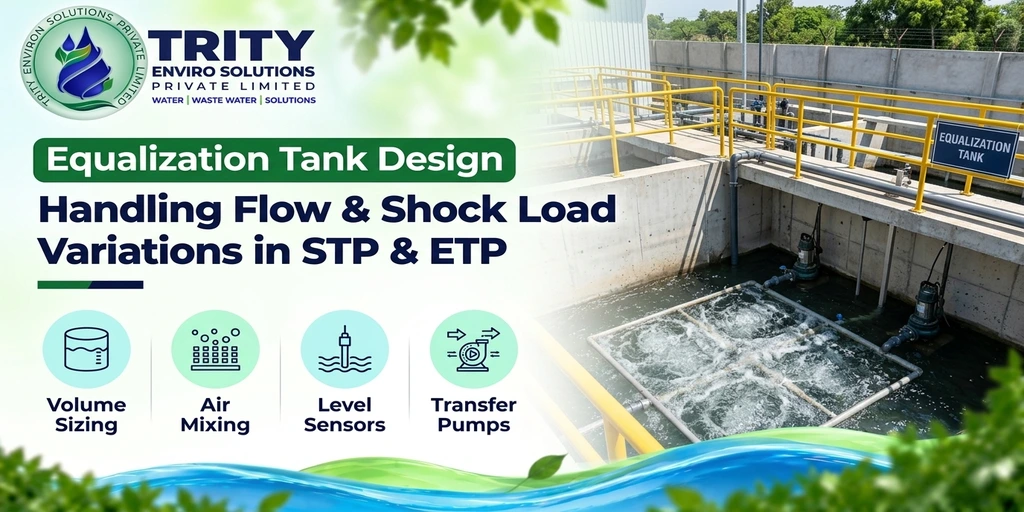
Equalization Tank Design for STP and ETP: How to Handle Flow and Load Variations
Design an equalization tank for your STP or ETP: size volume from flow variation, plan mixing and aeration, pH control and layout, with a worked example.

 ISO 9001:2015 & QCI Approved
Commission new sewage treatment plants without biological failure. Master pre-commissioning mechanical audits, cow dung seeding math, stepped F/M ramp-ups, and CPCB testing.
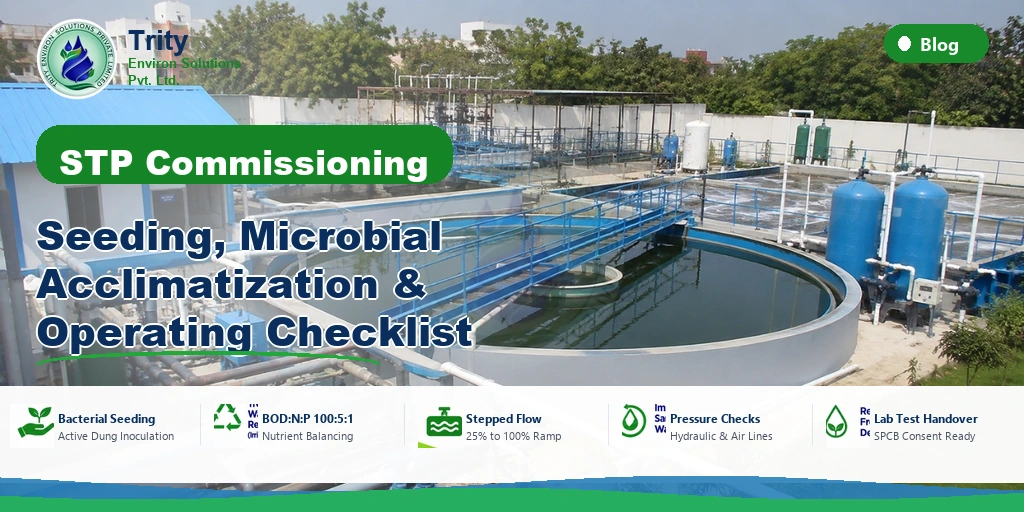
Commissioning a new sewage treatment plant (STP) in commercial complexes, residential high-rises, or industrial townships represents a critical operational transition from civil construction to biological equilibrium. Rushing to introduce raw sewage into dry, unverified concrete basins without conducting rigorous pre-commissioning mechanical audits is the primary cause of early equipment burnouts, submerged piping ruptures, and catastrophic biological failure.
Before any biological inoculum or wastewater enters the plant, commissioning engineers must execute a structured 5-phase mechanical readiness verification:
Biological wastewater systems rely on billions of specialized heterotrophic and autotrophic nitrifying bacteria to oxidize organic carbon and convert toxic ammonia into harmless nitrogen. Because municipal raw sewage contains only low, dispersed concentrations of native bacteria, starting an STP purely from raw inflow takes 6 to 10 weeks of unstable operation. To achieve rapid startup, commissioning teams introduce concentrated biological inoculum:
| Inoculum Source | Microbial Viability & Species | Target Dosing Ratio | Time to Establish Active Sludge |
|---|---|---|---|
| Active Liquid Return Sludge (RAS) | Fully acclimated, active aerobic heterotrophs & nitrifiers | 10% to 15% of aeration basin working volume | 7 to 10 Days (Gold Standard Method) |
| Dewatered Active Sludge Cake (Filter Press) | Semi-dormant biomass (18% to 22% solids) from healthy STP | 3.0 to 5.0 kg wet cake per m3 of aeration volume | 10 to 14 Days (Requires re-hydration) |
| Fresh Bovine (Cow Dung) Slurry | High cellulolytic & enteric bacteria; rich nutrient matrix | 2.0 to 3.0 kg fresh dung per m3 of aeration volume | 18 to 25 Days (Traditional Indian method) |
| Commercial Freeze-Dried Bacterial Consortia | Lyophilized Bacillus & Pseudomonas spore strains | 10 to 20 grams per m3 of aeration volume | 14 to 20 Days (Supplementary booster) |
When utilizing fresh cow dung slurry (the most widely available low-cost seeding method across Indian job sites), technicians must screen the slurry through a 2 mm wire mesh before pouring it into the aeration basin. Unscreened dung contains long straw, hay, and pebbles that permanently foul air diffusers and jam return sludge pumps.
Introducing full raw sewage inflow into a newly seeded aeration tank is a fatal mistake that causes instantaneous organic shock loading, driving dissolved oxygen down to 0.0 mg/L, killing off delicate nitrifiers, and generating an offensive septic stench. Microbial populations must be systematically cultivated using a stepped hydraulic and organic ramp-up schedule:
To establish exact chemical and biological requirements, consider the commissioning design for a 200 KLD commercial IT business park STP:
Once the plant reaches 100% hydraulic and organic capacity, the project engineering contract mandates an uninterrupted 7-Day Performance Guarantee Test Run (PGTR) to prove compliance with Central Pollution Control Board (CPCB) urban reuse standards:
| Monitored Quality Parameter | Raw Influent Sewage | CPCB Urban Reuse Standard | Mandatory Test Method |
|---|---|---|---|
| pH Value | 6.5 to 8.5 | 6.5 to 8.5 | Electrometric Glass Electrode (IS 3025 Part 11) |
| Biochemical Oxygen Demand (BOD5 at 20 deg C) | 250 to 350 mg/L | < 10 mg/L | 5-Day Incubation at 20 deg C (IS 3025 Part 44) |
| Chemical Oxygen Demand (COD) | 500 to 750 mg/L | < 50 mg/L | Closed Reflux Titrimetric / Colorimetric (IS 3025 Part 58) |
| Total Suspended Solids (TSS) | 200 to 350 mg/L | < 10 mg/L | Gravimetric Drying at 105 deg C (IS 3025 Part 15) |
| Ammoniacal Nitrogen (NH4-N) | 35 to 55 mg/L | < 5.0 mg/L | Nesslerization Spectrophotometric (IS 3025 Part 34) |
| Turbidity (NTU) | 150 to 300 NTU | < 2.0 NTU | Nephelometric Ratio Method (IS 3025 Part 10) |
| Fecal Coliforms | 10^6 to 10^8 MPN/100 mL | < 100 MPN / 100 mL (Desirable: Nil) | Multiple Tube Fermentation / MPN (IS 1622) |
Samples must be collected as 24-hour flow-weighted composites, preserved at 4 degrees Celsius in insulated coolers, and analyzed by a certified NABL-accredited and SPCB-recognized laboratory. All seven daily test reports must strictly meet the guarantee limits before issuing the final Plant Handover Certificate.
The site commissioning team must execute this rigorous daily routine throughout the 30-day commissioning window:
When unexpected failures occur during startup,.
| Observed Commissioning Failure | Probable Root Cause | Diagnostic Field Inspection | Engineering Corrective Action |
|---|---|---|---|
| Aeration basin foams violently with billowing white soapy froths escaping over walls. | Young sludge with low MLSS (< 800 mg/L) exposed to high surfactant cleaning chemicals. | Measure MLSS concentration. Foam is light, non-greasy, and collapses upon water spraying. | Do not waste sludge! Increase Return Activated Sludge (RAS) rate. Spray treated water on foam. Dose food-grade silicone anti-foam temporarily. |
| Aeration basin turns dark grey/black; dissolved oxygen drops to 0.0 mg/L; foul septic stench. | Severe organic overloading (feeding full raw sewage flow too early) or blower diffuser choking. | Measure DO (0.0 mg/L). Check blower delivery pressure (high backpressure indicates choked diffusers). | Halt raw sewage feeding immediately. Run blowers 24/7. Dose 100 kg fresh cow dung slurry or 5 m3 active RAS seed to restore biomass. |
| Secondary clarifier overflows with light, fluffy flocs; SVI spikes > 250 mL/g (Sludge Bulking). | Nutrient deficiency (starvation of nitrogen or phosphorus during startup ramp-up). | Microscopic examination shows long filamentous bacteria extending from flocs into water. | Immediately dose agricultural urea and diammonium phosphate (DAP) to re-establish BOD:N:P = 100:5:1. Dose 2 ppm sodium hypochlorite into RAS line. |
| Treated water exhibits zero coliform reduction despite continuous chemical chlorine dosing. | Incomplete biological nitrification leaving high ammonia (NH4-N > 20 mg/L) that consumes free chlorine. | Test treated water for ammonia and combined chlorine. Free chlorine reads 0.0 mg/L. | Increase aeration DO to > 2.5 mg/L to enable complete autotrophic nitrification. Ammonia must be < 5.0 mg/L for chlorine to be effective. |
The successful conclusion of the commissioning.
By enforcing this structured pre-commissioning audit,.
Eliminate startup foaming, accelerate bacterial acclimatization, and guarantee 100% CPCB compliance with Trity Environ Solutions expert wastewater commissioning and testing services.
Get Expert Consultation Call: +91 98188 14787Explore our detailed engineering manuals and turnkey industrial plant solutions:
For turnkey plant sizing, technical audits, or statutory pollution control board compliance, contact our senior process specialists for on-site environmental engineering consultation.
Design an equalization tank for your STP or ETP: size volume from flow variation, plan mixing and aeration, pH control and layout, with a worked example.
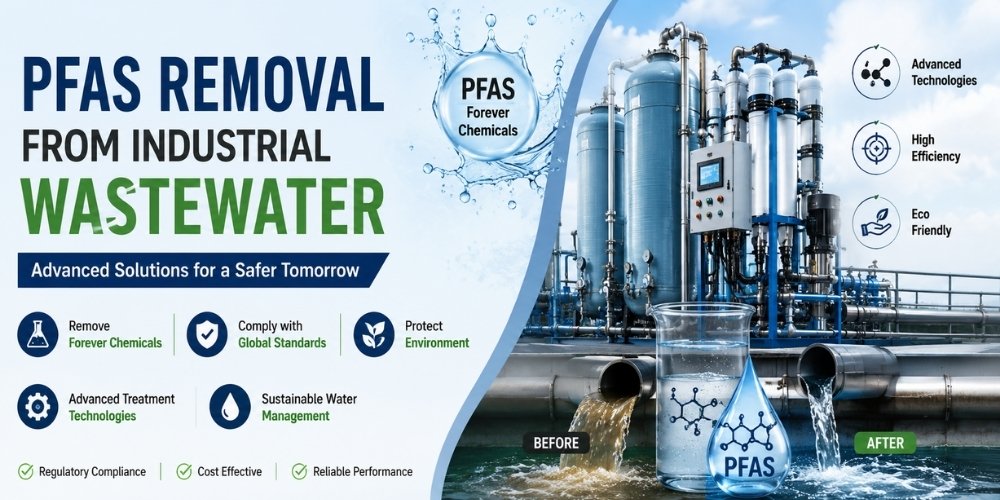
Complete guide to PFAS removal from industrial wastewater. Compare GAC, RO, ion exchange and AOP technologies, costs, and India's 2026 regulations.
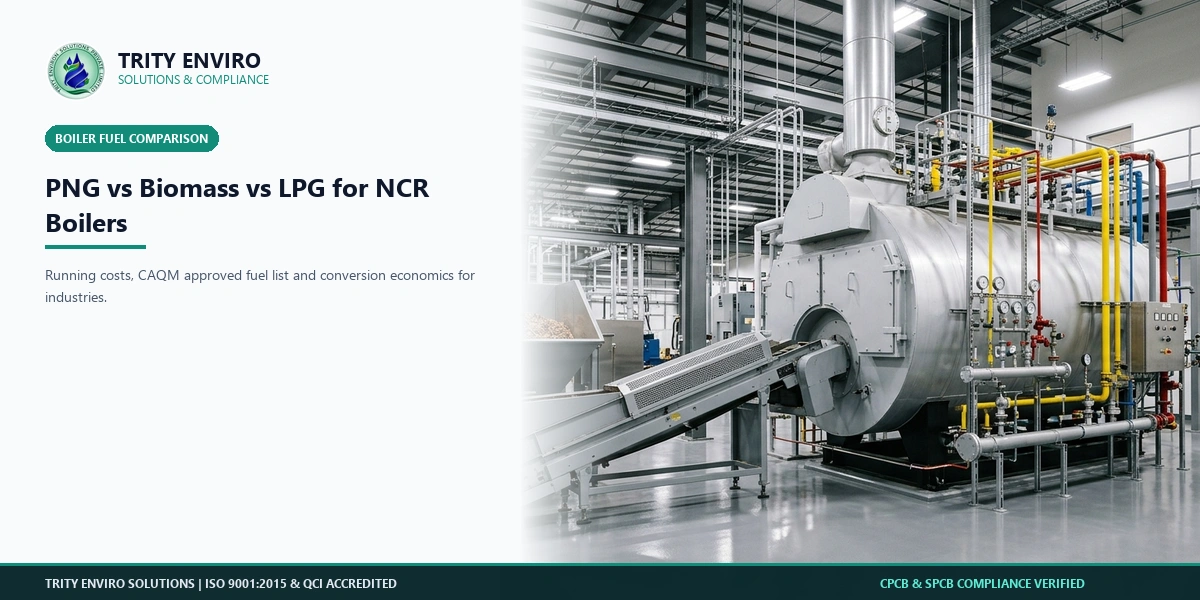
Compare PNG, biomass and LPG for NCR boilers: CAQM approved fuel rules, heat cost per 1,000 kcal, emissions, conversion steps and pollution control needs.











Discuss your requirements with our engineering team and get practical guidance for your project.

