Table of Contents: Engineering Guide & Process Index
1. Sanitation Challenges of Isolated Commercial Establishments on National Highways
1.1 Engineering Principles and System Configuration
India's expansive national highway network (NHAI) has catalyzed rapid commercial development, spanning thousands of high-footfall highway dhabas, multi-cuisine food courts, luxury drive-in resorts, and automated toll plaza administrative complexes. Because these commercial establishments are situated in remote rural or semi-urban corridors far beyond municipal underground sewerage grids, they cannot discharge wastewater into public sewer mains.
Historically, property owners relied on primitive unlined septic tanks and soak pits. However, highway hospitality establishments present unique and extreme wastewater characteristics that cause standard septic systems to fail catastrophically within months of operation:
- Extreme Hydraulic Peaking and Flash Surges: Footfall surges violently during weekend travel spikes, festival holidays, and bus stopover intervals. A highway dhaba might generate 80% of its total daily sewage volume within two brief 2-hour rush windows (13:00 to 15:00 and 20:00 to 22:00), overwhelming standard gravity settlement tanks.
- Extreme Oil, Fat and Grease (FOG) Concentrations: Commercial kitchen washings from deep fryers, tandoor grease, clarified butter (ghee), and mustard oil generate raw Fat, Oil, and Grease (FOG) concentrations between 150 and 600 mg/L (compared to domestic sewage which rarely exceeds 30 mg/L). FOG solidifies in cold underground pipes, coats biological media, and seals off soak pit subsoil perviousness.
- Variable Organic Shock Loads: High-strength blackwater from heavily utilized public restrooms (ammonia-nitrogen > 65 mg/L, fecal coliforms > 10^7 MPN/100 mL) mixes with greywater loaded with harsh caustic floor sanitizers, causing microbial mortality in poorly buffered treatment tanks.
1.2 Operational Best Practices and Quality Control Benchmarks
Recent enforcement directives from the National Green Tribunal (NGT) and Central Pollution Control Board (CPCB) mandate that all commercial establishments generating more than 5,000 to 10,000 Liters of wastewater per day install on-site mechanized sewage treatment plants (STP) with zero overflow into roadside storm drains.
2. CPCB Standards for Commercial and Hospitality Establishments
2.1 Statutory CPCB and SPCB Discharge Quality Standards
Treated sewage discharge from decentralized commercial establishments must satisfy strict environmental quality thresholds under CPCB notification standards:
2.2 Continuous Online Monitoring (OCEMS) and Compliance Audits
| Quality Parameter |
Raw Highway Dhaba Sewage |
Treated Effluent Norm |
Mandatory Reuse Destination |
| pH Value |
5.5 to 8.5 (Grease acidity) |
6.5 to 8.5 |
Landscape greenbelt & toilet flushing |
| Biochemical Oxygen Demand (BOD5) |
350 to 800 mg/L (High kitchen load) |
< 10 mg/L (Urban) / < 20 mg/L |
100% on-site water recycling |
| Chemical Oxygen Demand (COD) |
750 to 1,800 mg/L |
< 50 mg/L |
Prevents anaerobic odor in gardens |
| Total Suspended Solids (TSS) |
300 to 900 mg/L |
< 10 mg/L |
Eliminates sprinkler nozzle clogging |
| Oil and Grease (FOG) |
150 to 600 mg/L |
< 5.0 mg/L (or Nil) |
Prevents soil sealing and foul odors |
| Fecal Coliforms |
10^6 to 10^8 MPN/100 mL |
< 100 MPN/100 mL (Disinfected) |
Eliminates human health hazard |
3. Process Selection: Packaged MBBR vs SBR for Decentralized Highway Applications
3.1 Core Technology Comparison and Mechanistic Distinctions
Selecting the biological treatment technology for a remote highway dhaba or resort requires balancing treatment efficacy, footfall volatility tolerance, structural footprint, and ease of non-expert operation:
- Moving Bed Biofilm Reactor (MBBR): The gold-standard technology for decentralized highway installations. MBBR systems utilize suspended virgin HDPE bio-media (K1/K3 carriers) circulating continuously in the aeration tank. Bacteria grow as a fixed, protected biofilm inside the carrier flutes. When footfall drops to zero during nocturnal hours, the attached biofilm enters endogenous starvation without dying or washing out. When morning tourist buses arrive, the massive biomass inventory instantly metabolizes the surge without process lag.
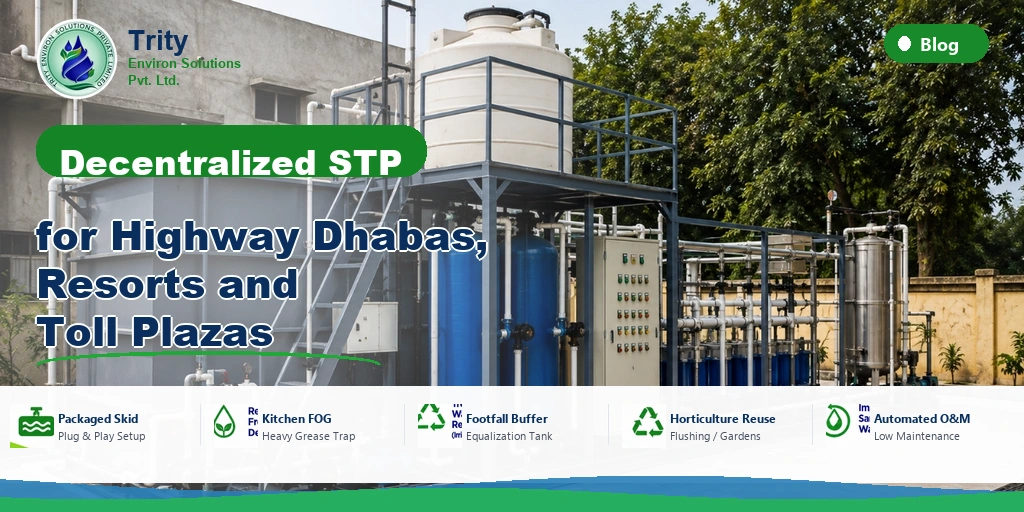
- Pre-Fabricated Skid-Mounted FRP / MS-Epoxy Architecture: Rather than
3.2 Operational Efficiency, Footprint, and Capital Trade-offs
constructing expensive, time-consuming underground concrete tanks on leased highway land, modern decentralized STPs are factory-fabricated as modular cylindrical or rectangular skids. Encased in heavy-duty Fiber-Reinforced Plastic (FRP) or carbon steel with high-build polyamine epoxy, these plug-and-play skids can be fully installed, plumbed, and commissioned in less than 7 days, with minimal civil excavation.
- Sequencing Batch Reactor (SBR) Limitations: While SBRs achieve excellent nutrient removal, they rely heavily on automated motorized decanters, multiple actuated pneumatic valves, and complex PLC timer programs. In remote highway locations where skilled instrumentation technicians are unavailable, a single valve actuator failure halts the entire plant, making simple continuous-flow MBBR systems far more practical and reliable.
4. Sizing Calculations: 30 KLD Packaged MBBR STP for a Highway Food Court
4.1 Mathematical Formulations and Governing Mass Balance
To demonstrate the exact engineering design, consider a 30 KLD (30,000 Liters/day) decentralized packaged STP for a high-traffic highway food court with 2,500 daily visitors:
Worked Engineering Design: 30 KLD Packaged Highway STP
Inflow Parameters:
- Daily Hydraulic Flow (Q) = 30.0 m3/day (Average 1.88 m3/hr over 16 operational hours)
- Peak Instantaneous Surge Flow = 6.0 m3/hr (Peak factor = 3.2)
- Raw Sewage BOD5 = 450 mg/L (13.5 kg BOD/day) | Raw COD = 950 mg/L (28.5 kg COD/day)
- Raw Oil and Grease (FOG) = 250 mg/L (7.5 kg/day)
Step 1: Multi-Chamber Grease Trap Sizing (Kitchen Line Dedicated):
Kitchen Flow = 40% of total = 12 m3/day (Peak flow = 2.5 m3/hr).
Mandatory Grease Trap Retention Time = 30 minutes at peak flow.
Required Liquid Volume = 2.5 m3/hr * (30 / 60) = 1.25 m3 (1,250 Liters).
Dimensions: 3-chamber stainless steel (SS304) grease interceptor with surface skimmer pipe.
Step 2: Equalization Basin Sizing (HRT = 10 Hours to Buffer Flash Surges):
Required Effective Volume = 30 m3 * (10 / 24) = 12.5 m3 (Round to 15.0 m3 gross volume).
Dimensions: 3.5 m Length * 2.0 m Width * 2.5 m Depth (RCC or underground FRP
4.2 Step-by-Step Numerical Sizing Protocol and Worked Example
tank).
Coarse Bubble Air Mixing: 15 m3 * 1.5 Nm3/m3/hr = 22.5 Nm3/hr (14 CFM) at 0.35 bar.
Transfer Pump Sizing: Dual submersible cutter pumps rated 2.0 m3/hr at 12 m Head (0.75 kW motor).
Step 3: Packaged MBBR Aeration Tank Sizing:
BOD to Remove = 13.5 kg/day * 95% = 12.82 kg/day.
Design Surface Area Loading Rate (SALR) = 18 g BOD/m2 media area/day.
Required Bio-Media Surface Area = 12,820 g / 18 g/m2/day = 712 m2 of active area.
Using Virgin HDPE K3 Bio-Carriers (Specific Surface Area = 500 m2/m3):
Volume of K3 Media = 712 / 500 = 1.42 m3 of media.
At 45% Media Filling Fraction, MBBR Tank Net Volume = 1.42 / 0.45 = 3.16 m3 (Round to 4.0 m3 for 2.1 hr HRT).
Skid Tank Dimensions: Cylindrical FRP vessel, 1.6 m Diameter * 2.2 m Height.
Aeration Air Blower: Twin-lobe blower delivering 35 CFM at 0.35 bar driven by a 1.5 kW motor.
Step 4: Secondary Tube Settler and Tertiary Filter Sizing:
Tube Settler Surface Area = 2.0 m3/hr / 1.0 m/hr overflow rate = 2.0 m2 (fitted with 60 deg PVC tubes).
Dual-Media Filter (Sand + Anthracite): 400 mm Diameter * 1,500 mm Height FRP vessel.
Activated Carbon Filter (Odor & Color Adsorption): 400 mm Diameter * 1,500 mm Height FRP vessel.
Disinfection: Online Sodium Hypochlorite (Bleach) electronic dosing pump delivering 5 ppm Cl2.
5. Kitchen Waste Segregation: Grease Interceptors and Enzymatic Bio-Dosing
5.1 Settling Characteristics and Solids Mass Balance Calculations
The single greatest operational cause of failure in highway resort and dhaba STPs is fat, oil, and grease (FOG) entering the biological tanks. Grease forms an impervious, waxy laminate over the plastic bio-carriers, smothering bacteria and preventing oxygen transfer:
- Point-of-Source Under-Sink Grease Traps: Compact stainless steel (SS304) grease interceptors installed directly beneath commercial pot-washing sinks capture heavy ghee and oils before entering the drainage line.
- Main Multi-Baffle Exterior Grease Trap: Exterior gravity interceptor featuring deep underflow-overflow baffles, allowin
5.2 Sludge Wasting Protocols, Return Ratios, and Dewatering Control
g vegetable oils and animal fats to cool and float into a separate skimming chamber where motorized belt oil skimmers or manual draw-off valves harvest the floating fat layer daily.
- Enzymatic and Bacterial Bio-Dosing: To prevent grease accumulation in underground collection pipes, automated peristaltic dosing pumps inject specialized liquid bacterial cultures (containing high concentrations of lipase-producing Bacillus strains) directly into kitchen drains during late-night hours. The enzymes break down complex triglyceride lipids into water-soluble glycerol and fatty acids, preventing pipe calcification and odor.
6. Standard Operating Procedure (SOP) for Daily Highway STP Maintenance
6.1 Daily Start-Up, Inspection, and Operational Shift Protocol
Because decentralized plants are operated by general site maintenance staff, the daily SOP must be straightforward, robust, and verifiable:
- Step 1: Daily Grease Trap Skimming (Morning Shift): Open the grease trap inspection cover. Use a perforated skimming ladle or activate the motorized oil skimmer to harvest floating solidified grease crust into sealed disposal bags. Never flush hot caustic water down kitchen drains, as this temporarily liquefies grease, carrying it straight into the biological aeration tank where it re-solidifies.
- Step 2: Air Blower and Diffuser Circulation Check: Check the aeration tank visual rolling pattern. The plastic bio-media carriers must circulate vigorously throughout the entire liquid volume. If media bunches at the surface or stagnates in corners, adjust blower air valves to clear diffuser lines.
- Step 3: Chlori
6.2 Preventive Maintenance, Instrument Calibration, and Safety Check
ne Dosing Tank Batch Preparation: Check the chemical disinfection dosing tank daily. Dissolve 500 grams of standard commercial calcium hypochlorite (bleaching powder) or add liquid sodium hypochlorite to maintain 1.0 to 2.0 mg/L free residual chlorine in the final treated irrigation water tank.
- Step 4: Tertiary Filter Daily Backwashing: Rotate the top-mounted multi-port valves on the sand filter and carbon filter to 'Backwash' mode for 5 minutes, followed by 'Rinse' mode for 2 minutes, discharging accumulated solids into the sludge drying pit.
- Step 5: Treated Water Re-Use Inspection: Inspect the treated water storage tank: the water must be crystal clear, sparkling, and completely odorless. The treated water is automatically pressurized by a hydro-pneumatic pumping system into dual plumbing lines for toilet flushing and lawn sprinkler irrigation.
7. Field Troubleshooting Matrix: Resolving Highway STP Operational Upsets
7.1 Diagnostic Root-Cause Analysis for Common Process Upsets
When highway STPs experience operational bottlenecks, site managers can rapidly restore performance using this troubleshooting guide:
7.2 Corrective Remediation Action Matrix and Operator Workflows
| Observed Operational Symptom |
Probable Root Cause |
Diagnostic Field Inspection |
Engineering Corrective Action |
| Plastic bio-media clump into a solid floating raft; aeration tank smells sour and septic. |
Severe grease fouling; commercial kitchen fat bypassed the grease trap and coated carriers. |
Extract a handful of bio-media; media feels sticky, greasy, and emits a rancid oil odor. |
Skim floating grease layer manually; dose concentrated lipase enzyme bacterial culture; clean upstream grease interceptor baffles. |
| Treated water in flushing cisterns appears yellow/brown with offensive sewage odor. |
Activated carbon filter media exhausted, or secondary clarifier sludge blanket carrying over. |
Measure treated water turbidity (> 10 NTU) and residual chlorine (0.0 mg/L). |
Backwash sand and carbon filters; replenish chlorine dosing tank; replace exhausted activated carbon media. |
| Sewage overflows from dhaba inspection chambers during busy Sunday afternoon rush. |
Inlet bar screen completely blinded with plastic gutkha pouches, wet wipes, and plastic bottles. |
Inspect inlet screening chamber for severe hydraulic head loss across the bar rack. |
Rake and clear bar screen immediately; install an inclined stainless steel dual-screen rack with overflow bypass weir. |
| Submersible transfer pumps trip repeatedly on thermal overload. |
Tough fibrous rags, mop strings, or sanitary towels wound tightly around the pump impeller. |
Pull pump out using guide chain; inspect impeller eye for jammed fibrous binding. |
Cut and remove bound rags; replace standard vortex impeller with tungsten carbide cutter shredder impeller. |
8. Lifecycle Economics, Water Recycling Savings, and Zero-Discharge Compliance
8.1 Statutory CPCB and SPCB Discharge Quality Standards
Installing a high-performance decentralized packaged STP transforms wastewater from an expensive operational headache into a valuable commercial asset:
- Freshwater Tanker Purchase Cost Elimination: Highway dhabas and resorts in water-scarce corridors frequently purchase freshwater via commercial tractor tankers at rates of Rs. 800 to 1,500 per 5,000-liter tanker (Rs. 160 to 300 per kL). Recycling 25,000 Liters of treated STP water daily for toilet flushing, vehicle exterior washing, and lawn irrigation eliminates 5 tanker deliveries daily, saving Rs. 1.2 to 1.8 Lakhs every single month (over Rs. 15 to 20 Lakhs annually).
- Land Footprint and Civil Construction Economy: Pre-fabricated FRP packaged plants occupy less than 35 square meters of land area, preserving valuable highway frontage for parking and customer seating. Capital payback on a 30 KLD packaged plant is achieved in less than.
- Total Immunity from NGT Penalties and.
By coupling heavy-duty grease interception, shock-resistant.
Install a Packaged Sewage Treatment Plant for Your Highway Property
8.2 Continuous Online Monitoring (OCEMS) and Compliance Audits
Eliminate foul kitchen odors, recycle 100% of treated wastewater for flushing and gardening, and comply with CPCB norms with Trity Environ Solutions compact packaged STPs.
Get Expert Consultation
Call: +91 98188 14787
Related Technical Guides & Engineering Solutions
Explore our detailed engineering manuals and turnkey industrial plant solutions:
- Commercial Sewage Treatment Plant (Stp) Solutions: Industrial engineering, manufacturing, and turnkey compliance support.
- Commercial Ro Plant Systems: Industrial engineering, manufacturing, and turnkey compliance support.
- Industrial Water Softener Systems: Industrial engineering, manufacturing, and turnkey compliance support.
- Environmental Engineering Consultation With Trity Enviro: Industrial engineering, manufacturing, and turnkey compliance support.
- STP Equalization Tank Design: Retention Time, Air Mixing and Peak Flow Sizing Guide
- MLSS and F/M Ratio Management in Activated Sludge STPs: Engineering Operating Manual
- STP Chlorination vs Ozonation: Secondary Disinfection, Sizing and Urban Reuse Guide
- STP Commissioning Checklist: Seeding, Acclimatization and 7-Day Performance Testing Guide
For turnkey plant sizing, technical audits, or statutory pollution control board compliance, contact our senior process specialists for on-site environmental engineering consultation.


 ISO 9001:2015 & QCI Approved