
Secrets Behind Water Softening: Why Size Matters for Perfect Results
Discover why the size of your water softener is crucial. Learn how to choose the right size for optimal performance, efficiency, and cost savings for your home.

 ISO 9001:2015 & QCI Approved
A generator that has run quietly for years can now be sealed. Learn what the rules require and what to fix before the next inspection.
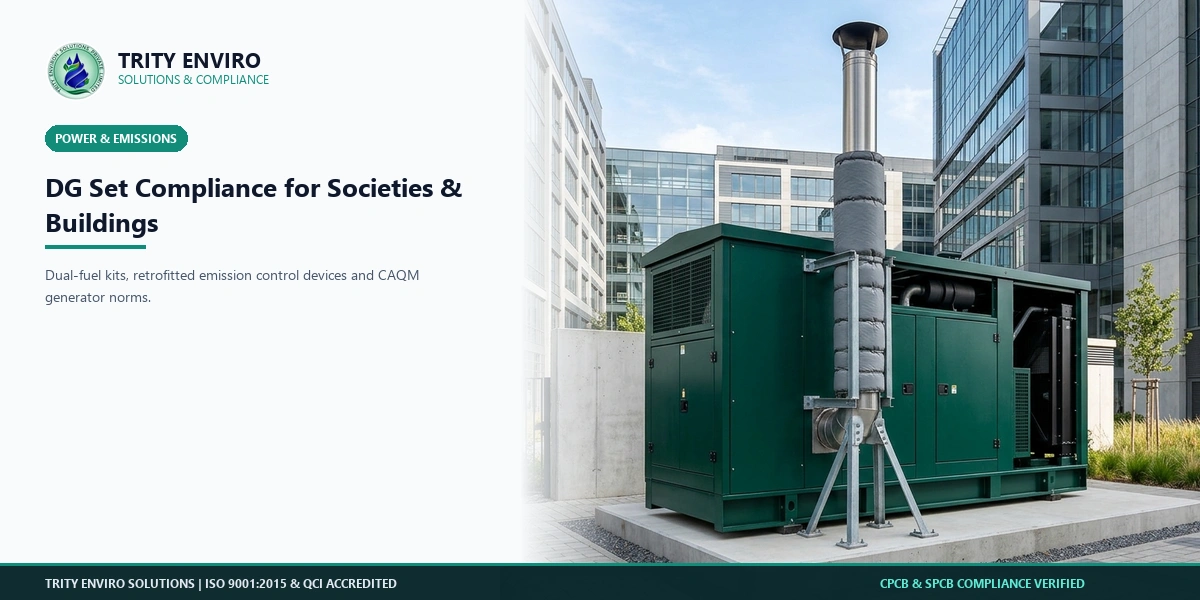
For most housing societies, malls, offices and hospitals, a diesel generator set is a background machine. It sits in a corner, starts when the grid fails and is serviced when someone remembers. That quiet existence is over in Delhi-NCR. Air quality authorities treat diesel generators as an avoidable source of particulate matter and nitrogen oxides, and they have built a rule set around them: directions on when and how generators may run, standards for their emissions, retrofit devices, penalties and sealing.
In its September 2026 revision of the Graded Response Action Plan (GRAP), the Commission for Air Quality Management (CAQM) moved the actions on DG sets from Stage II to Stage I, which means the restrictions come into play earlier in the season. Submissions made by the Delhi Pollution Control Committee (DPCC) to the National Green Tribunal describe a detailed enforcement framework: non-compliant DG sets of 19 kW and above can be sealed, and environmental compensation is levied under a standard schedule that depends on the size of the set. Reports of pollution board action against housing societies in Gurugram show that residential complexes are in the net as well.
For an RWA, a facility manager or a building owner, the questions are practical. Is our generator compliant? What do we need to retrofit? Can we run on dual fuel? What will we pay if we do nothing? This guide answers them in plain language. It is a practical overview, not legal advice. Directions change, so check the current CAQM, DPCC and state board orders for your location.
CAQM has issued directions on the regulated use of DG sets in the NCR, and DPCC and the state pollution control boards implement them. In broad terms, the framework does four things. It restricts the use of diesel generators as a regular power source. It requires generators to meet emission norms, with a separate stack emission standard for sets of 800 kW and above. It encourages or requires dual fuel operation, where diesel is partly replaced by gas, for specified ranges of sets. And it requires emission control retrofits on certain sets, using devices from vendors approved by the Central Pollution Control Board.
During GRAP periods, additional limits apply. Portable generators below 19 kW are largely outside the specific DG direction apart from the restrictions under GRAP, while larger sets face a tighter regime. The ranges, conditions and exemptions have been revised more than once, so rely on the current direction and not on an old circular.
According to DPCC's submission to the National Green Tribunal, non-compliant DG set users with sets of 19 kW and above can face closure or sealing directions after inspection. Environmental compensation is levied under a standard CAQM schedule, with the amount depending on capacity, and the DPCC description lists Rs 7,500 for sets between 20 kW and 125 kW, Rs 15,000 for sets above 125 kW and below 800 kW, and Rs 25,000 for sets of 800 kW and above, with the total based on the number of days of non-compliant operation. Check the current schedule and the basis of calculation, because these details can be revised.
Sealing can be revoked after the user proves compliance, for example by installing an approved retrofit device, switching to a compliant dual fuel arrangement or removing the non-compliant set, and by completing the required procedure with the authority. The cost of delay is therefore both the compensation and the loss of backup power.
A retrofit emission control device (RECD) is fitted to the exhaust of an existing diesel set to reduce particulate matter, and in some designs other pollutants. Typical devices use a particulate filter or a catalytic filter system. Under the CPCB scheme, devices must come from approved vendors and carry the required testing and certification. Ask for the approval number and check it. A device that is not approved will not satisfy the authority, and a poorly matched device can raise exhaust back pressure and damage the engine.
Compliance is not only about the exhaust filter. CPCB guidance gives a formula for the minimum height of the exhaust stack: the height of the building where the set is installed plus 0.2 times the square root of the set's kVA rating. For a 250 kVA set in a building 12 metres tall, that is about 12 + 0.2 × √250 = 12 + 3.2 = about 15.2 metres above ground. A short exhaust at roof level can cause complaints even when the set is within limits.
Noise is the other frequent source of complaints in societies. Sets are expected to be housed in acoustic enclosures that keep noise within the limit set by the authority, with a commonly cited figure of 75 dB(A) at one metre for newer sets. Check the enclosure's condition, door seals, silencers and ventilation. A generator room that has been opened up for ventilation or repaired without resealing may no longer meet the norm.
Start with an audit. For each set, record its make, capacity in kVA and kW, age, hours run, fuel mode, exhaust arrangement, stack height, enclosure condition, maintenance history and any certificate or approval it holds. Compare this with the current direction for its capacity range, and note the gaps.
Keep a file with the DG set registration or permissions, emission test reports where required, retrofit device approval and installation records, dual fuel certification, service logs, fuel purchase records and a log of running hours. Set a clear operating policy: start the set only when the grid fails, record each start and stop, and do not use the set for routine load shedding or convenience.
The best compliance strategy is to run the generator less. Improve grid reliability with a second feeder where possible. Install battery and inverter systems for critical loads such as lifts, lights and water pumps, and consider solar plus storage for common areas. Schedule heavy loads to avoid running on backup. In commercial buildings, tenants' loads can be prioritised so that essential services stay up with a smaller set. Reducing running hours cuts fuel, noise, maintenance and your exposure under GRAP.
Compare the options on lifecycle cost. A retrofit device has a purchase and installation cost, plus periodic cleaning or regeneration and a small fuel penalty from back pressure. A dual fuel conversion has a kit and gas system cost but can lower fuel cost. A new compliant set has a high capital cost but lower maintenance. Battery and solar systems reduce generator running but need capital. Include the cost of sealing, penalties and lost backup in your comparison, and take into account the age and remaining life of the existing set.
Our team can help you check stack, enclosure and compliance gaps, and you can see our range on the products page. Because societies also face notices on sewage, read our guides on how to calculate STP capacity and on the STP maintenance checklist for housing societies, and consider an annual maintenance contract for your utilities. For the wider winter picture, see our article on GRAP rules for industries in Delhi-NCR.
A certified DG set can still pollute if it is badly maintained. Service the engine on schedule, change oil and filters, check injectors and keep the air filter clean, since a blocked filter raises smoke. Run sets at a sensible load: lightly loaded engines produce more soot and unburnt fuel, so match the set to the building's demand and avoid running several lightly loaded sets together. Keep exhaust piping sound and the stack at the height your consent requires, with a sampling port for tests. Where an emission control device is fitted, follow the supplier's cleaning and regeneration schedule and record it. Keep a logbook with running hours, fuel used, servicing, emission test results and any outages, because inspectors usually ask for it first. Plan for cleaner backup power: grid connections, battery storage and rooftop solar reduce how often the set must run.
| Parameter / Stage | Target Optimal Range | Failure Impact / Risk | Corrective Engineering Action |
|---|---|---|---|
| Emission compliance of set | Meets the CAQM and CPCB norm for its capacity range | Sealing and compensation for non-compliant sets of 19 kW and above | Retrofit approved device, convert to dual fuel or replace set |
| Stack height | Building height plus 0.2 times square root of kVA | Exhaust at breathing level, complaints | Extend stack, add silencer, reroute exhaust |
| Noise at one metre | Within the authority's limit, commonly cited as 75 dB(A) for newer sets | Neighbour complaints, notices | Repair enclosure, add silencer, reseal doors and vents |
| Running hours | Only during grid failure, logged | Fuel cost, GRAP exposure, noise | Improve grid backup, add battery or solar for critical loads |
Trity Environ Solutions is an ISO 9001:2015 certified and QCI-approved air pollution control equipment manufacturer and supplier in India, delivering robust, high-efficiency systems engineered for CPCB and SPCB regulatory compliance.
Every installation is supported by pan-India Annual Maintenance Contract and Operation and Maintenance services.
Discover why the size of your water softener is crucial. Learn how to choose the right size for optimal performance, efficiency, and cost savings for your home.

10 practical, effective ways to reduce water pollution in India, from household habits to industrial treatment and policy-level infrastructure investment.
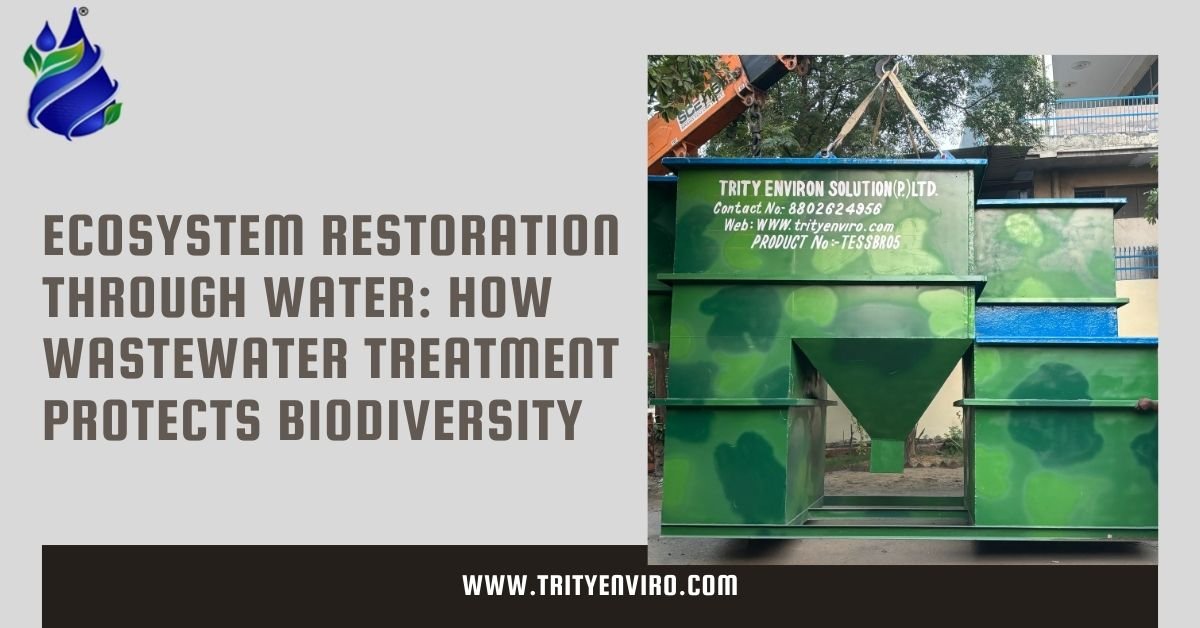
Discover how wastewater treatment supports ecosystem restoration, protects biodiversity, and promotes sustainable practices for cleaner water and healthier habitats.











Discuss your requirements with our engineering team and get practical guidance for your project.

