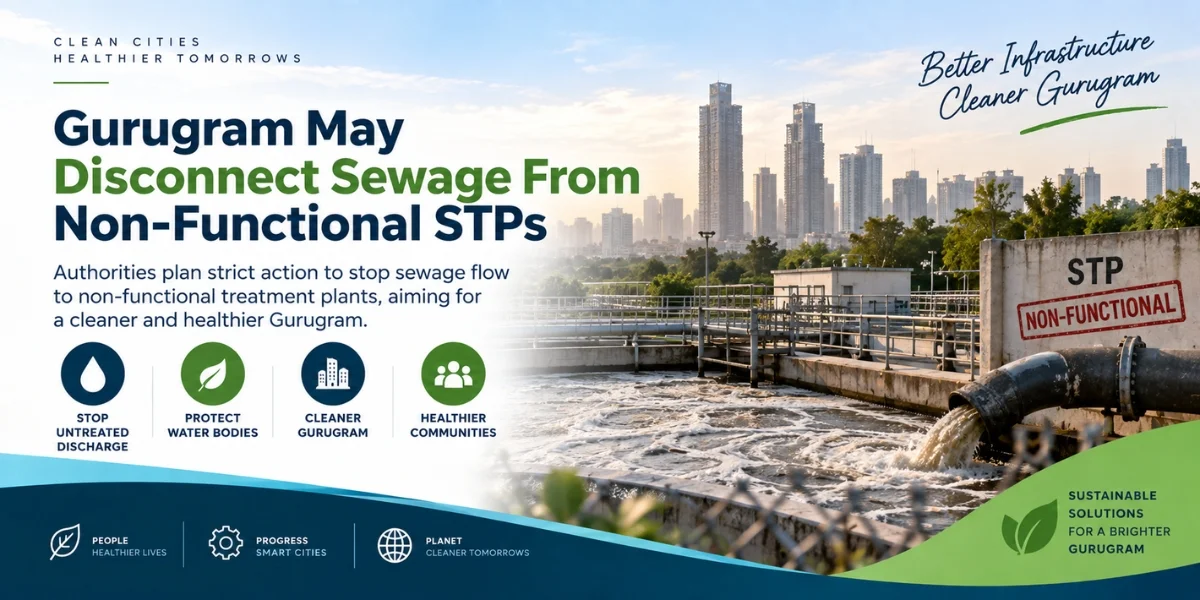
The Gurugram Metropolitan Development Authority (GMDA) has directed group housing societies, licensed colonies and commercial establishments to ensure their sewage treatment plants (STPs) remain operational, warning that sewage connections may be disconnected where corrective measures are not taken in accordance with applicable rules. The direction, reported on September 18, 2026, follows inspections that identified a number of premises across the city operating with non-functional STPs.
What GMDA Has Directed
According to the reported information, STPs are mandatory at 175 premises in north Gurugram and 179 premises in south Gurugram under applicable licensing and environmental norms. Inspections carried out across the city identified 33 premises in north Gurugram and 8 in south Gurugram where STPs were found non-operational. GMDA has issued notices to the concerned premises and, where applicable, penalties have already been imposed.
Per the reported figures, around ₹14 crore in penalties has been imposed on non-compliant premises in north Gurugram, of which around ₹4 crore has been recovered so far. GMDA has also directed surprise inspections at 15 premises, to be carried out in coordination with the Haryana State Pollution Control Board (HSPCB), with samples of treated wastewater to be collected and tested at these sites. GMDA-operated STPs are also set to undergo regular treated-water testing as part of the same compliance push.
Note: readers and site editors should verify these specific figures against GMDA's original notice or order before relying on them for compliance decisions, as this is a fast-moving current news item.
Role of the Haryana State Pollution Control Board
HSPCB is the statutory authority responsible for monitoring compliance with pollution-control norms in Haryana, including treated-water quality standards for STPs. Under the current direction, HSPCB may impose penalties, commonly referred to as environmental compensation, on establishments that fail to meet statutory treated-water quality or operational requirements, in line with its existing enforcement powers.
Why Functional STPs Matter
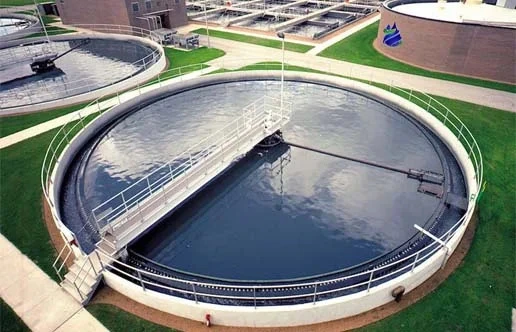
A sewage treatment plant is designed to remove organic matter, suspended solids and pathogens from wastewater before it is discharged or reused. When an STP is non-operational, either due to poor maintenance, mechanical failure or inadequate operation of its biological treatment stage, the wastewater passing through it is not treated to the required standard, even if the plant is technically present on site.
Untreated or inadequately treated sewage reaching stormwater drains or open land can contribute to groundwater and surface water contamination, and can create conditions for waterlogging and odour issues in the surrounding area. This is the underlying concern behind GMDA's compliance push, rather than the mere presence or absence of STP infrastructure on a given premises.
What This Means for STP Operators and Developers
For housing societies, commercial establishments and developers responsible for operating an STP, this development is a reminder that installation alone does not satisfy compliance requirements. Sustained, correct operation is what determines whether a plant is actually meeting its intended purpose.
- Regular maintenance: Mechanical and electrical components, aeration systems and pumps need scheduled upkeep to prevent breakdowns that take a plant out of service.
- Preventive maintenance: Addressing minor issues, such as worn seals or reduced aeration efficiency, before they cause a full operational failure helps avoid extended periods of non-compliance.
- Proper operation of biological treatment systems: The biological stage of an STP depends on maintaining the right conditions for the microorganisms that break down organic waste; poor operation here is a common cause of treated water failing quality parameters even when the plant is technically running.
- Regular treated-water testing: Periodic testing at the outlet helps operators identify a developing problem before it results in a violation being flagged during an official inspection.
- Maintaining operational records: Keeping logs of maintenance, testing results and any corrective action taken supports an establishment's position if compliance is questioned.
- Ensuring compliance with applicable requirements: Operators should confirm their specific obligations with the relevant authority, since requirements can vary by premises type and licensing conditions.
This article does not constitute legal advice, and establishments should consult the relevant authority or a qualified professional regarding their specific compliance obligations.
Why Regular STP Monitoring Matters
Having an STP installed on a premises is only the starting point of compliance, not the end of it. A plant that is present but poorly operated, under-maintained, or running below its intended treatment efficiency can still result in inadequately treated water being discharged, which is functionally similar to having no STP at all from an environmental standpoint.
Continuous or regular monitoring of treated-water quality, through parameters such as biochemical oxygen demand (BOD) and total suspended solids (TSS), allows an operator to confirm that a plant is actually performing as intended, rather than assuming compliance based on the equipment being switched on. This is also why GMDA's own STPs are being brought under a similar regular testing regime alongside the ones operated by private societies and developers, since consistent monitoring is relevant to publicly operated infrastructure as well as private premises.
Key Highlights
- GMDA has directed group housing societies, licensed colonies and commercial establishments to keep their STPs operational, warning of possible sewer disconnection for non-compliance.
- STPs are mandatory at 175 premises in north Gurugram and 179 in south Gurugram, per reported figures.
- Inspections found 33 non-operational STPs in north Gurugram and 8 in south Gurugram.
- Around ₹14 crore in penalties has reportedly been imposed in north Gurugram, with around ₹4 crore recovered so far.
- GMDA has directed surprise inspections at 15 premises with HSPCB, including treated-wastewater sample testing, and will also subject its own STPs to regular testing.
Conclusion
GMDA's latest direction underscores a point that applies well beyond Gurugram: an STP's value lies entirely in how consistently it is operated and maintained, not simply in its installation. As Haryana's urban centres continue to expand, stronger monitoring, regular treated-water testing and proactive maintenance by housing societies, developers and commercial establishments will remain central to keeping sewage management effective and reducing the risk of enforcement action.
Sources & Further Reading
This article is based on reported information regarding GMDA's September 18, 2026 direction on non-functional STPs in Gurugram. For background on GMDA's STP compliance framework and related enforcement history, see prior reporting from The Tribune on HSPCB penalty proceedings for non-functional STPs in Gurugram, and GMDA's official site at gmda.gov.in. Readers are encouraged to verify the specific figures cited in this article against GMDA's original notice or press communication.